






 Portuguese
  Spanish


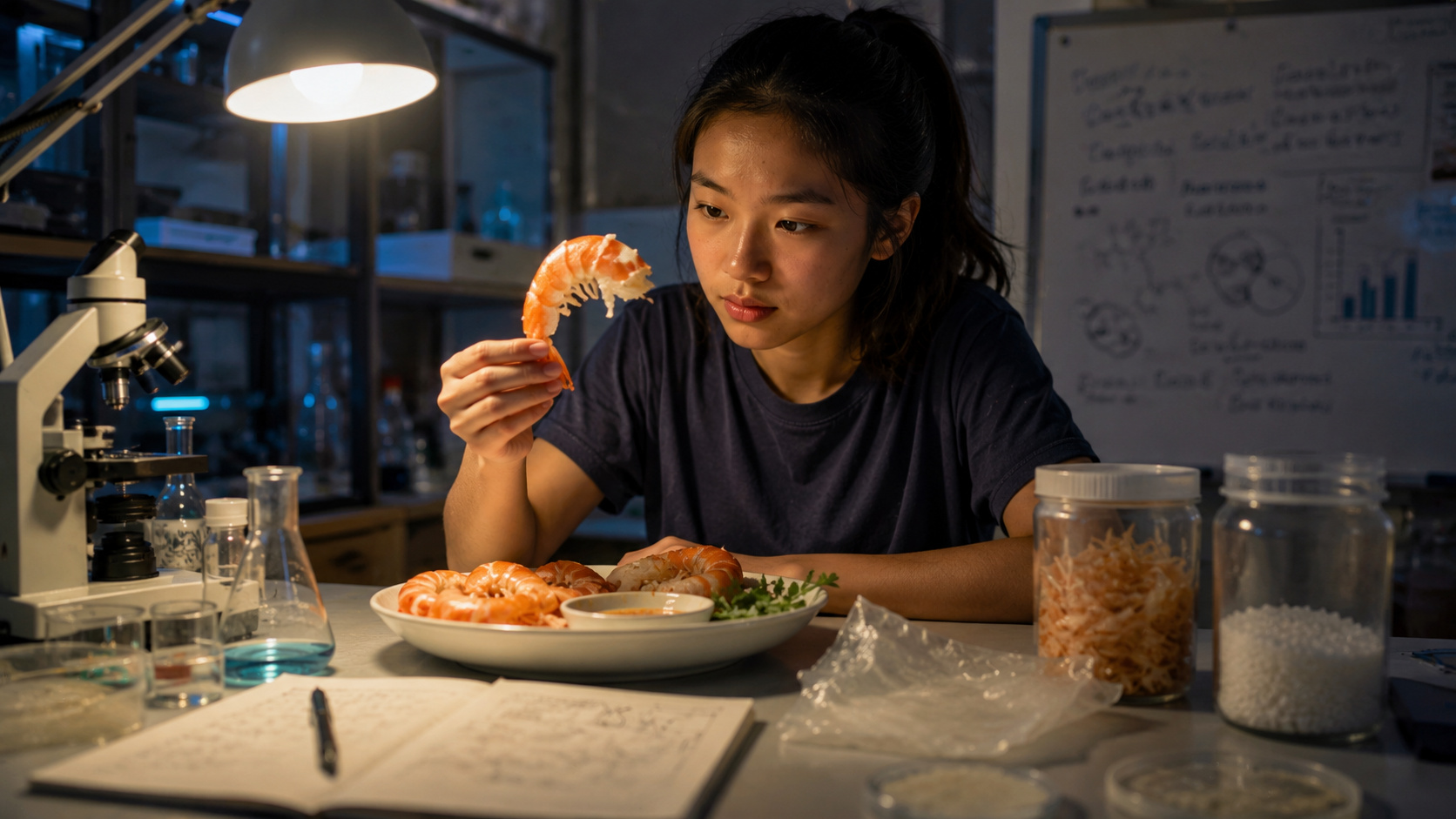

Inspired by an observation during dinner, the young Australian transformed shrimp shells into an innovative, biodegradable, and sustainable bioplastic, showing how creativity and science can revolutionize the fight against plastic pollution.
According to National Geographic, Australian Angelina Arora was only 16 years old when she created a sophisticated biodegradable plastic — and the idea that changed everything came at the dinner table. After experimenting and failing with various types of organic waste, including banana peels, Angelina turned her attention to shrimp upon noticing the similarity between their shells and plastic. “I looked at the shrimp and thought: what makes their shell look like plastic? Maybe I can extract that and use it somehow, linking the components to create a plastic-like material,” she explained to the publication.
This is how one of the most celebrated student inventions of recent years was born: a bioplastic made from shrimp shells that, according to National Geographic, decomposes 1.5 million times faster than commercial plastics, breaking down completely in just 33 days. Angelina’s story is proof that great solutions to the planet’s problems can be hidden in the most unexpected places — even in what’s left of a seafood dish — just waiting for someone, with curious eyes and a desire to change the world, to notice them.
The question that was born at the supermarket checkout
Before the dinner table, there was another everyday moment that planted the seed of the invention — a simple scene that reveals how scientific curiosity often begins with a question that most people don’t even bother to ask. According to National Geographic, Angelina’s interest in plastic pollution began the first time she saw her mother paying for plastic bags at the supermarket and asked the cashier why.
-
Scientists Develop Diving Suit for Cyborg Cockroaches to Survive Underwater for 3 Hours, Navigate Flooded Tunnels, and Aid in Disaster Rescue Missions, with Potential for Mars Exploration

-
Xiaomi Unveils Ultra-Slim Washer-Dryer with Over 30 Programs, Hygienic Steam, Smart Drying, 15-Minute Quick Wash, App Control, and Space-Saving Design

-
Brazilian Researchers Develop Ultrasound-Based Breast Scanner Using Warm Water, Currently Undergoing Clinical Validation
-
Brazil Develops Its First Locally-Made 5G Radio Unit, Achieves Over 1.5 Gbps in Lab Tests, Paving the Way for Interoperable Equipment


This childlike curiosity, combined with a genuine love for science, is what guided her years later. At 15 years old and a student at Sydney Girls High School, Angelina began investigating bioplastics precisely after being asked to pay for a plastic bag at a store. This prompted her to research a convenient and environmentally friendly alternative to plastic bags. “I have always been a curious child, asking why things work, and that turned into a love for science. I believe science is the key to all the world’s mysteries,” she said.
What started as a hobby and a passion soon turned into an ambitious science project and later into international recognition. The motivation, at its core, was clear and generous: plastic destroys the planet, and Angelina wanted to do something about it.
A path paved with failures
Like every good science story, Angelina’s was not a straight line to success — it was made of frustrating attempts, each teaching something that brought her closer to the solution. According to Forbes, Angelina set herself the goal of creating a bioplastic and began by making plastics from corn and potato starch.
But these early materials had a fatal flaw: they were water-soluble and, moreover, were not made from waste. She herself explained the limitation, according to the source: “For a school science project, I made a corn starch plastic bag, but it didn’t work because it was water-soluble, which would mean our groceries would end up on the floor — and it would also mean consuming precious food sources.” This is an important point of the philosophy behind Angelina’s work: she didn’t just want a plastic that would decompose, but one that was made from discarded material, without diverting food from people’s tables.
After experimenting and failing with different types of organic waste, such as banana peels, she finally had the shrimp insight. Each failure, therefore, was not a dead end but a step: it was the solubility problem of starch that pushed her to seek something more resistant, and it was the search for waste that led her to the crustacean shells.
The “eureka moment” at the dinner table
The moment of discovery has all the ingredients of a good story — exhaustion, casual observation, and the spark of genius that turns an ordinary dinner into a scientific milestone. Angelina recounted the exact moment of inspiration: “I was having dinner one night, after a long and hard day in the lab, and I noticed that shrimp shells looked like plastic. I thought to myself: what makes them look like plastic? And then, like any scientist would, I went straight to the lab and started researching.”
She called this moment her “eureka moment.” From there, the work began to have a clear direction. Angelina described the chemical process she developed: “I extracted a carbohydrate called chitin and chemically converted it into chitosan, and mixed it with fibroin, which is a protein from silk cocoons.” Chitin, it should be explained, is a carbohydrate found in the shells of crustaceans like shrimp, lobsters, and crabs — and is also present in many insects.
Fibroin, in turn, is an insoluble protein extracted from the silk produced by silkworms. It was the combination of these two organic components, plus a bit of chemical processing, that generated the material with the appearance and properties of plastic.
A plastic that turns into compost
What makes Angelina’s invention especially ingenious is not just the speed at which it decomposes, but what happens during this decomposition — an environmental bonus that few materials offer. According to Forbes, the mixture of the two organic components created a plastic-like material that decomposed 1.5 million times faster than commercial plastics, breaking down completely in 33 days when exposed to the bacteria and temperatures found in landfills.
The material is, according to the same source, cheap, versatile, insoluble, flexible, and durable — a rare combination of qualities. But there is an even more remarkable detail. Since the exoskeleton of shrimp is rich in nitrogen, when the plastic decomposes it releases this vital agricultural nutrient back into nature. This means that Angelina’s plastic could make a significant contribution to compost piles or agricultural fields.
The potential is exciting: by recycling natural sources of nitrogen, farmers could reduce the use of conventional fertilizers, which emit significant amounts of greenhouse gases into the atmosphere. In other words, the material not only disappears quickly but also enriches the soil in the process — turning what would be waste into food for plants. Angelina even tested her creation as medical packaging, demonstrating the material’s versatility beyond shopping bags.
A young scientist with a holistic view
The recognition of Angelina’s work came from various directions, but what is most impressive is the maturity with which she sees her own role in the fight against pollution. The invention earned Angelina the Innovator to Market award at the 2018 BHP Billiton Foundation Science and Engineering Awards, as well as recognition at the Intel International Science and Engineering Fair, where she competed against students from over 81 countries.
The student was also named Young Conservationist of the Year 2019 by the Australian Geographic Society. Despite all the recognition, Angelina remains grounded and has a remarkably mature view of the issue. According to National Geographic, she sums up her philosophy in a simple and powerful way: “Everyone should do what they can, so I’m just trying to do my part. Eliminate things you don’t need, plastic straws, for example, and just drink straight from the glass.”
She also revealed what keeps her steady in the face of difficulties: “Every time I fail or things don’t go right in the lab, I always think back to why I started doing this.” It’s important to maintain the perspective that Angelina’s bioplastic, as promising as it is, is an innovation that still needs more development and testing to be produced on a large commercial scale—a common path for almost all inventions born in science fairs. But the value of her contribution is undeniable.


