






 Portuguese
  Spanish


Ecological Innovation Enables Real-Time Monitoring, Reduces Environmental Risks, and Offers Affordable Alternative to Chlorine Use in Sanitation
Researchers from the Institute of Chemistry of São Carlos (IQSC) at the University of São Paulo (USP) developed a new sustainable technology that can transform water treatment in Brazil and worldwide. The project proposes a more ecological, safe, and economical solution by replacing the traditional use of chlorine with hydrogen peroxide, also known as bleach. The journal Process Safety and Environmental Protection, from Elsevier, published this innovation in January 2024. Anderson M. Santos (postdoctoral researcher at IQSC), Robson S. Souto (doctoral student at IQSC), Professor Marcos Lanza (USP), and Willyam R.P. Barros (UFGD) signed the scientific article.
The Method Uses an Electrochemical Reactor That Produces Hydrogen Peroxide On-Site
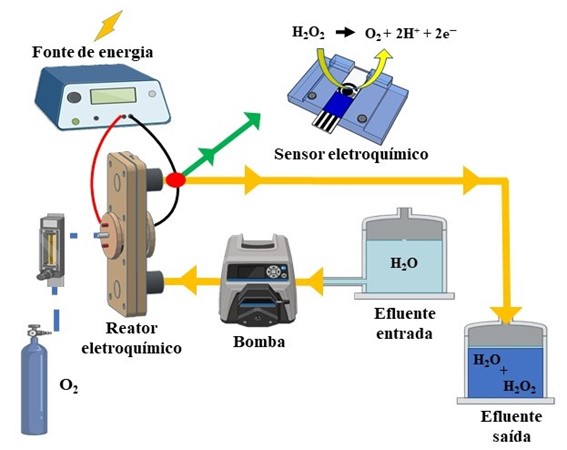
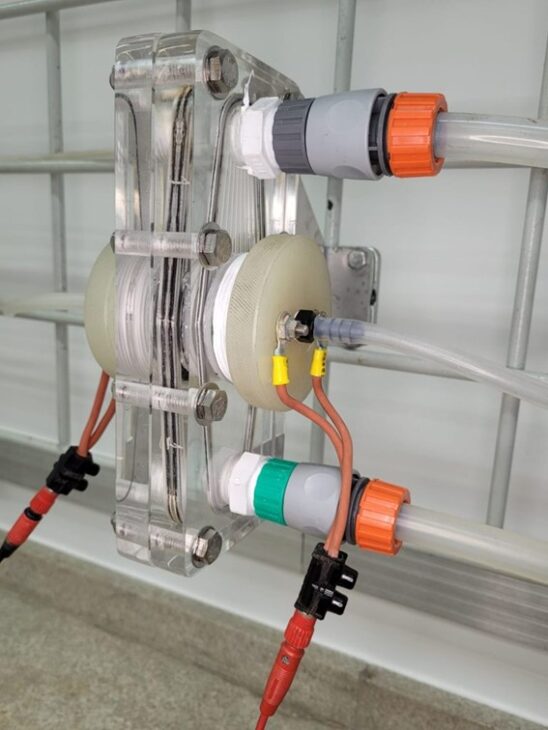
The system operates through the in situ generation of the compound, that is, directly at the treatment point. This technique converts atmospheric oxygen into hydrogen peroxide through electrochemical reactions generated within a portable reactor controlled by electrical energy. According to doctoral student Robson Souto, the operation is simple. By installing the device at the entrance of the water flow, the equipment automatically generates the substance. The operator can easily turn the process on and off, which prevents waste and eliminates risks associated with storage.
Disposable Sensor Monitors Reactions in Real Time at Low Cost
After the generation of peroxide, another component of the system comes into play. It is a screen-printed sensor, developed to monitor chemical reactions in real time. As postdoctoral researcher Anderson Santos explains, this sensor is disposable, inexpensive, and highly functional. It performs measurements directly in the system, eliminating the need for collection and sending samples to external laboratories, making the process faster and more automated. Continuous measurement ensures the release of the exact amount of oxidizing agent, avoiding excesses and reinforcing quality control.
-
China Develops Custom 140-Ton Electric Mining Truck with 770 kWh Swappable Battery, Deploys 290 Units in Xinjiang’s Largest Zinc Mine

-
Meta to Launch Arena, a New Prediction App Targeting 3.56 Billion Users, Competing with Polymarket and Kalshi

-
Scientist Challenges Famous Human Evolution Theory, Argues Homo Sapiens Evolved Gradually Over Thousands of Years
-
15-Year-Old American Builds Ocean Generator with PVC Pipe and 3D-Printed Propeller for $12, Wins National Prize, Presents at White House, and Makes Forbes 30 Under 30 List




Technology Is Safer, Reduces Costs, and Avoids the Formation of Toxic By-products
According to Professor Marcos Lanza, the use of hydrogen peroxide is much safer than chlorine, which can generate carcinogenic compounds when reacting with organic matter. Moreover, peroxide decomposes into water and oxygen, making the process cleaner. This characteristic drastically reduces health risks for operators. In industrial environments, where highly concentrated compounds are used, any accident can cause severe burns. The new system avoids this danger by operating on demand and at low concentration. Another essential point is the reduction of expenses with transportation and storage. The local production of the agent eliminates the need for complex logistical structures. According to Professor Willyam Barros, sensors produced even on paper could further reduce costs.
Use Can Be Expanded to Rural Areas, Industrial Locations, and Remote Communities
The researchers tested the system on a small scale but believe it could serve industrial stations, rural properties, and isolated communities. These locations still face limitations in accessing advanced sustainable technology for water treatment, which reinforces the importance of affordable and efficient solutions. Robson Souto explains that many farms, for example, do not have adequate structures to treat effluents. With portable devices that are easy to install and operate, the process can be decentralized, serving areas without urban infrastructure. Professor Willyam Barros highlights that the system is hybrid: in addition to eliminating microorganisms, it removes persistent organic contaminants. This expands the possibilities for water reuse, reinforcing the need for sustainable technologies for decentralized treatment in vulnerable regions.
Tests Prove the Efficiency of USP’s Sustainable Technology for Water Purification
The efficacy tests were conducted with water contaminated by tebuthiuron, a very common pesticide and, therefore, widely used in modern agriculture. On the other hand, the researchers collected samples of purified water and from a stream near the USP campus in São Carlos. Furthermore, to expand the evaluation, they applied the technology to real industrial effluents. These effluents are characterized by a high organic load. In both cases, however, the system significantly reduced the toxicity of the water and eliminated the present contaminants. Thus, the results prove that the solution is functional in practical conditions and even in more challenging scenarios. Finally, this data clearly reinforces the efficiency of the sustainable technology based on the use of hydrogen peroxide for water treatment.
Environmental-Focused Project Funded by FAPESP Follows Sustainability Criteria in Water Treatment
The Electrochemical and Environmental Processes Group (GPEA), led by Professor Marcos Lanza at IQSC, conducted the research with dedication and rigor. Furthermore, the work received funding from the São Paulo Research Foundation (FAPESP), which reinforces its scientific credibility. With this support, the team developed a comprehensive study entitled Integrated System for In Situ Generation and Online Monitoring of H₂O₂. Additionally, the study connects a flow electrochemical reactor to a flow injection analysis system. In the article, the technical operation of the system and the tests performed throughout the development are precisely and clearly explained. Moreover, all steps strictly followed recognized safety standards and sustainability guidelines. For this reason, the combination of applied science, technological innovation, and environmental responsibility makes USP’s technology a national milestone. Thus, the new system for water treatment can transform basic sanitation in the country and benefit thousands of communities.






