






 Portuguese
  Spanish
  4 min of reading
  0 comments


Compact Hatch Back Goes Below R$ 100,000 With Tax Exemption, Gathers Uncommon Equipment in Entry Versions and Surprises With Fuel Consumption Close to 20 Km/L on the Highway.
The Chevrolet Onix 1.0 MT has become the entry point of the 2026 line and the only member without turbo and with a six-speed manual transmission.
The strategy has placed the hatchback below the six-digit barrier: R$ 99,990, a value made possible by the IPI exemption under the Sustainable Car Program, a policy that allowed a price repositioning in the initial versions.
Price and Appreciation
In practice, the Onix has once again adopted a competitive price tag among compact cars, though far from the launch level of the current generation.
-
Used Civic and Corolla have been stuck in stock for months. “People are preferring Chinese cars,” says the car dealership owner.

-
Toyota Sienna becomes a “VIP lounge on wheels” in Brazil after receiving a Chinese luxury kit, seats with massage, Starlink, refrigerator, and a 245 hp hybrid engine, targeting high-income families, artists, and executive transport in an almost million-dollar van.

-
Two new 300cc models from QJ Motor are expected to arrive in Brazil as SBM to target the CB 300F and shake up the low-displacement market, with more power and liquid cooling than Honda.

-
Camaro may reappear in 2027, but not as you remember: Chevrolet prepares the return of the icon with four doors, manual transmission, and an extreme performance version to face the new era of sports cars.


In 2019, the 1.0 manual configuration started at R$ 48,490.
Today, at R$ 99,990, the nominal increase is about 106%.
Even considering the inflation during this period, the price correction has been much more intense than the cost of living indices.
The Only Naturally Aspirated Model in the 2026 Lineup
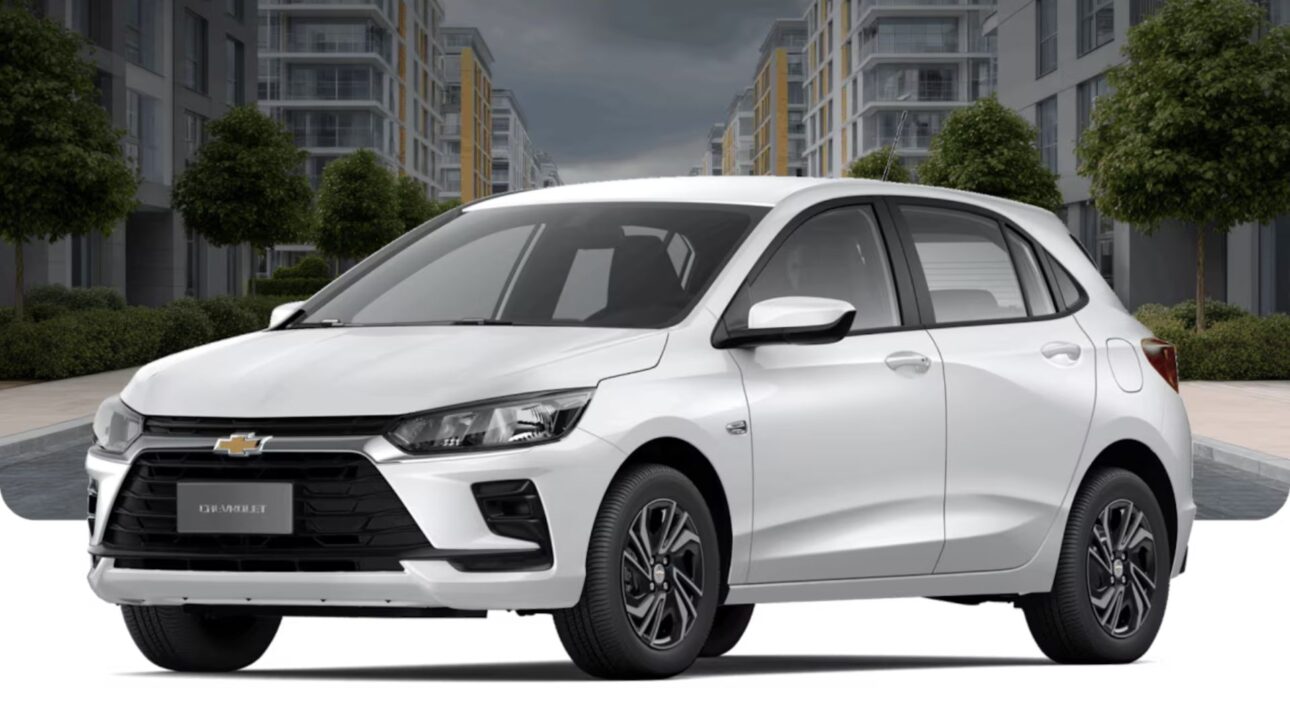
The 1.0 MT version continues with the well-known three-cylinder naturally aspirated flex engine of up to 82 hp and 10.6 kgfm, connected to the six-speed manual transmission.
It is the only combination without forced induction in the 2026 lineup.
Above it, all migrate to the 1.0 turbo.
The set prioritizes fuel economy and simple maintenance, remaining distant from the performance of its turbocharged siblings.
Fuel Consumption
In press tests with gasoline and air conditioning on, the Onix 1.0 MT registered 13.9 km/l in the city and 19.7 km/l on the highway.
With a 44-liter tank, the measured range under these conditions reaches 661 km in urban use and 866 km on the highway.
These numbers help explain why the brand maintains its image as an economical hatchback in the Onix family.
Standard Equipment
Although simple in its proposal, the 1.0 MT gathers items that used to appear only in intermediate versions.
It includes six airbags, stability and traction control, hill start assist, and automatic headlight activation by twilight sensor.
It also has keyless entry with push-button start, MyLink with an 8″ screen, and wireless integration to Android Auto and Apple CarPlay.
Electric windows on all four doors and electrically adjustable mirrors complete the package.
Visual and Wheels
At first glance, the wheels appear to be alloy, but the set is made of steel with 15-inch hubcaps.
This is a cost-effective solution that keeps the appearance updated after the slight facelift, maintaining the focus on efficiency and price.
Interior of the Onix 1.0 MT
The interior of the Onix 1.0 MT prioritizes basic ergonomics and easy operation.
The window and mirror controls are illuminated, which helps at night, and the multimedia center quickly pairs with mobile phones.
Still, the finish uses hard plastics, and there are no amenities in the back seat, such as air vents or USB ports dedicated to the rear rows, something expected in this entry level.
Recent evaluations noted the absence of fabrics on the doors and the one-piece front seat, which limits headrest adjustments.
Performance on the Tracks
When it comes to acceleration, the naturally aspirated 1.0 has no simple mission.
In a track measurement, the manual Onix needed 14.3 s to go from 0 to 100 km/h.
The gear ratio is short, and the shifts are light, which helps in urban driving and reduces the RPM in cruising thanks to the sixth gear, but it doesn’t turn the car into a reference of performance.
The setup prioritizes economical and predictable driving, consistent with the proposal of the set.


Dimensions and Capacities
The hatch measures 4.16 m in length, 1.73 m in width, and 1.47 m in height, with a wheelbase of 2.55 m.
The 303-liter trunk accommodates daily luggage well, and the 44-liter tank matches the good efficiency for long trips.
The wheels use 185/65 R15 tires, and the suspension combines McPherson in the front with a torsion beam in the rear, a tried-and-true recipe in the category.
Cost/Benefit
In a market that pushes automatic SUVs and turbo engines into increasingly higher price ranges, the Onix 1.0 MT occupies a pragmatic niche.
It is economical, comes with a complete safety package for the base, and delivers current connectivity, even without the 11″ display reserved for higher catalogs.
For those who drive a lot and seek cost predictability, the appeal lies precisely in mechanical simplicity combined with low consumption.
Why Doesn’t It Cost Less?
The difference between the 2019 price and the current one is not explained by a single factor.
The automotive supply chain still feels the effects of more expensive materials, currency fluctuations, environmental and safety requirements, as well as the global semiconductor crisis that has re-priced entire projects.
The result is an entry hatch at R$ 99,990, but with content and safety that, a few years ago, were at higher levels.
Given the scenario and the proposal, the Onix 1.0 MT delivers what it promises: simplicity, efficiency, and a coherent package for those who prioritize spending per kilometer driven.
In your opinion, does this balance between equipment, fuel consumption, and performance make sense for R$ 99,990?


-

-

3 people reacted to this.