Portuguese
  Spanish


Maranhão’s highways advance in a federal package combining rigid concrete paving, reconstruction of strategic sections, and duplication of a logistics corridor, in an offensive announced by the Ministry of Transport to reinforce cargo circulation, sustain agricultural and mineral production, and enhance the state’s efficiency in port operations
Highways in Maranhão were placed at the center of a new infrastructure package after a meeting held on February 24, 2026, when the Minister of Transport, Renan Filho, received Governor Carlos Brandão to align the progress of works in the state. At the meeting, the delivery of 54 kilometers of rigid concrete paving on BR-135, between Miranda and the village of Caxuxa, was confirmed for the first quarter of 2026, in addition to the announcement of the reconstruction of BR-222/MA, between Itapecuru and Chapadinha, and the future publication of the tender for the duplication of BR-010/MA, between Imperatriz and Açailândia.
The advancement of highways was presented as part of a larger strategy to sustain Maranhão’s economic strength. Renan Filho highlighted that the state is already a reference in agricultural and mineral production, port operations, economic growth, and the improvement of the population’s quality of life, making it clear that the new interventions were not designed merely to improve the asphalt, but to strengthen the logistical backbone that moves cargo, connects productive regions, and facilitates development.
BR-135 receives 54 km of concrete and becomes the package’s core
Among all the announced interventions, BR-135 holds the most concrete and immediate data. The government confirmed the delivery of 54 kilometers of rigid concrete paving between Miranda and the village of Caxuxa still in the first quarter of 2026.
-
Giant Robots Build Entire Neighborhood of 100 3D-Printed Homes in the U.S., Showcasing Technology’s Impact on Construction Industry

-
Helsinki Residents Receive Water That Travels 120 Kilometers Through a Hidden Rock Tunnel from a Lake Before Treatment

-
Brazil’s Sertão Region Nears Completion of Latin America’s Longest Artificial River, Transforming Water Access in Drought-Prone Ceará
-
Pre-mixed stabilized mortar set to revolutionize construction in 2026: extends usability to 36 or 72 hours, boosts productivity, and minimizes waste in building projects.


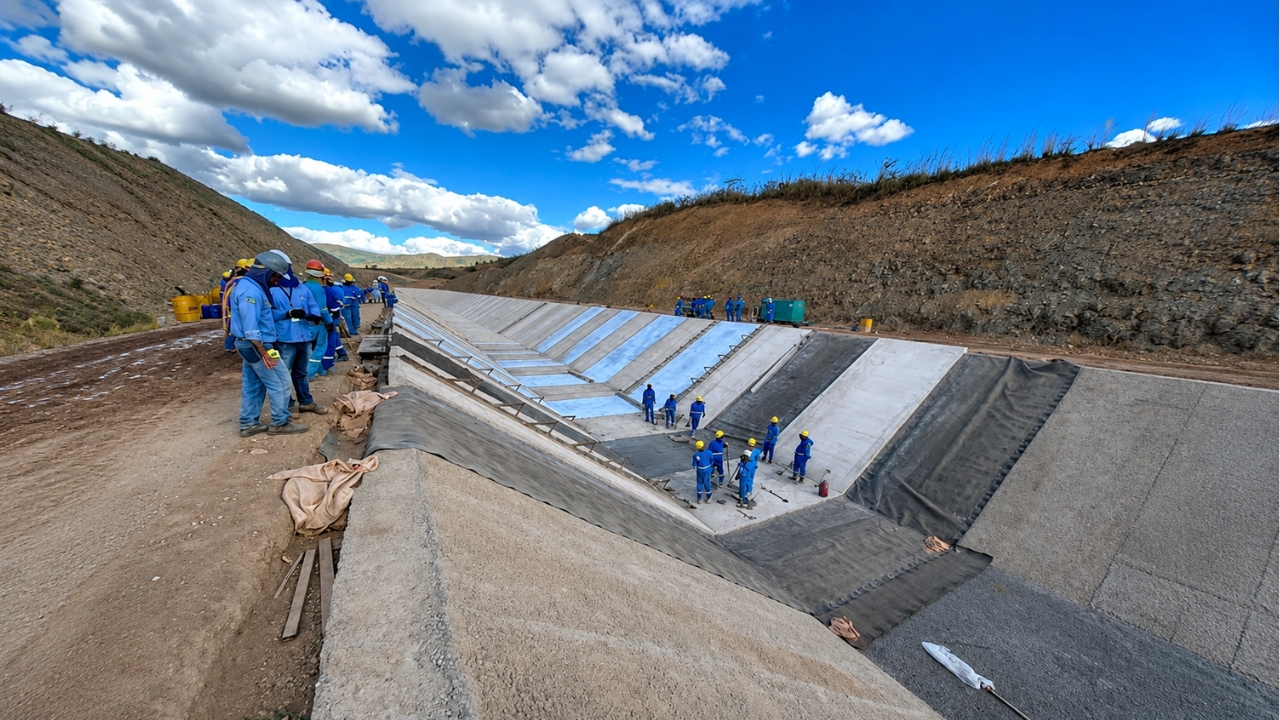

This detail matters because BR-135 is one of the most critical corridors for the circulation of goods in the state. When one of the main highways receives rigid concrete over a stretch of this length, the message is one of structural reinforcement to support heavy traffic and provide greater durability to a route essential for Maranhão’s economy.
BR-222 enters the reconstruction route
Another highlighted front in the package is the reconstruction of BR-222/MA, on the stretch between Itapecuru and Chapadinha. Although the source does not detail the timeline or extent of the work, the choice of the verb “reconstruct” indicates a more profound intervention than a simple punctual recovery.
On highways, words matter. Reconstructing means recovering the capacity, safety, and reliability of a section that needs to resume its logistical role with greater robustness, especially in a state that depends on the integration between producing areas and outflow corridors.
BR-010 could gain new importance between Imperatriz and Açailândia
The third announced axis was the duplication of BR-010/MA, on the stretch between Imperatriz and Açailândia, with a tender expected in the coming months. This is a significant move because it impacts a corridor that connects important poles of Maranhão’s economic dynamics.
Duplicating highways is not just about widening lanes; it directly affects fluidity, safety, travel time, and outflow capacity. In a high-traffic section, this can represent a direct gain for cargo transport, regional movement, and logistical predictability.
The package was designed to serve the state’s economic vocation
The announcement does not appear in isolation from a larger context. The minister’s own statement reinforces that Maranhão already holds a prominent position in agricultural and mineral production and in port operations. This helps to understand why the highways chosen for the package make so much sense.
Better road conditions mean less disruption in the transport chain, more stability for agriculture, greater efficiency for mining, and better connection to ports. Ultimately, the package acts as an attempt to align road infrastructure with the state’s productive vocation.
Recent works help show that the package doesn’t start from scratch
The meeting between Renan Filho and Carlos Brandão did not only discuss future promises. The base also recalls deliveries already made in previous months, which gives the package a broader framework of continuity.
In December 2025, the Ministry of Transport delivered the Juscelino Kubitschek de Oliveira Bridge, over the Tocantins River, connecting Estreito, in Maranhão, to Aguiarnópolis, in Tocantins. The project received R$ 171.97 million in investments and was completed exactly one year after the collapse of the previous structure. This fact adds political and technical weight to the discourse of progress, because it shows a highly visible delivery in record time.
The Timon Road Bypass became a complementary part of this mechanism

Another point mentioned in the balance sheet was the delivery, in January 2026, of the new Timon Road Bypass, which connects BR-226/MA and BR-316/MA. The project received R$ 55 million through the Novo PAC.
This type of intervention completes the reasoning of highways as a system. It is not enough to recover only one major axis if the connection points remain bottlenecked. Bypasses, bridges, duplications, and reconstructions work better when thought of as parts of the same network.
The impact of highways goes beyond cargo transport
Although the logistical and economic discourse is at the center of the announcement, the base text also points to a broader effect. By associating the package with the improvement of quality of life, the government tries to show that highways influence more than business transport.
A road in better condition affects travel time, access between municipalities, road safety, and the daily circulation capacity of the population. When infrastructure improves, the reflection is not limited to trucks and ports. It reaches the routine of those who live and move through the state.
The meeting also had political weight
The meeting also had the presence of federal deputies Hildo Rocha and Márcio Honaiser, which reinforces that the highway package also has an important political dimension. Infrastructure works in Maranhão always carry regional, economic, and electoral impact, especially when they involve strategic stretches and deliveries announced in sequence.
But, beyond politics, what stands out most strongly in the announcement is the logistical design. The three fronts, BR-135, BR-222, and BR-010, point to an attempt to strengthen circulation, expand capacity, and prepare the state to sustain its productive expansion with a less fragile road base.
Maranhão tries to align growth and infrastructure
Ultimately, the federal package reveals a clear understanding of the state’s current moment. Maranhão is growing in areas such as agriculture, mining, and ports, but this growth demands adequate infrastructure. Without more resilient, duplicated, and reconstructed highways where necessary, part of this progress could end up stalled precisely on the way between production and final destination.
That is why the announcement made in February 2026 carries more weight than the sum of the works. It shows an attempt to fit Maranhão’s economic present into a stronger, more modern road network, better prepared to support the volume already emerging in agriculture, mining, and logistical corridors.
What this package can change in the coming years
If deliveries and tenders advance as announced, Maranhão can gain significant reinforcement in its land transport base. BR-135 tends to consolidate as a more resilient corridor, BR-222 can regain operational momentum, and BR-010 can enter a new level of capacity with duplication.
When highways cease to be bottlenecks and become support, the effect usually appears in a chain, in logistics costs, travel time, safety, and the state’s competitiveness. And this is precisely the core of the bet being made now.
With 54 km of concrete on BR-135, reconstruction of BR-222, and duplication of BR-010 entering the radar, will this new package of highways finally manage to bring Maranhão’s infrastructure up to speed with agriculture, mining, and the ports that are already driving the state’s economy?