






 Portuguese
  Spanish
  3 min of reading
  0 comments


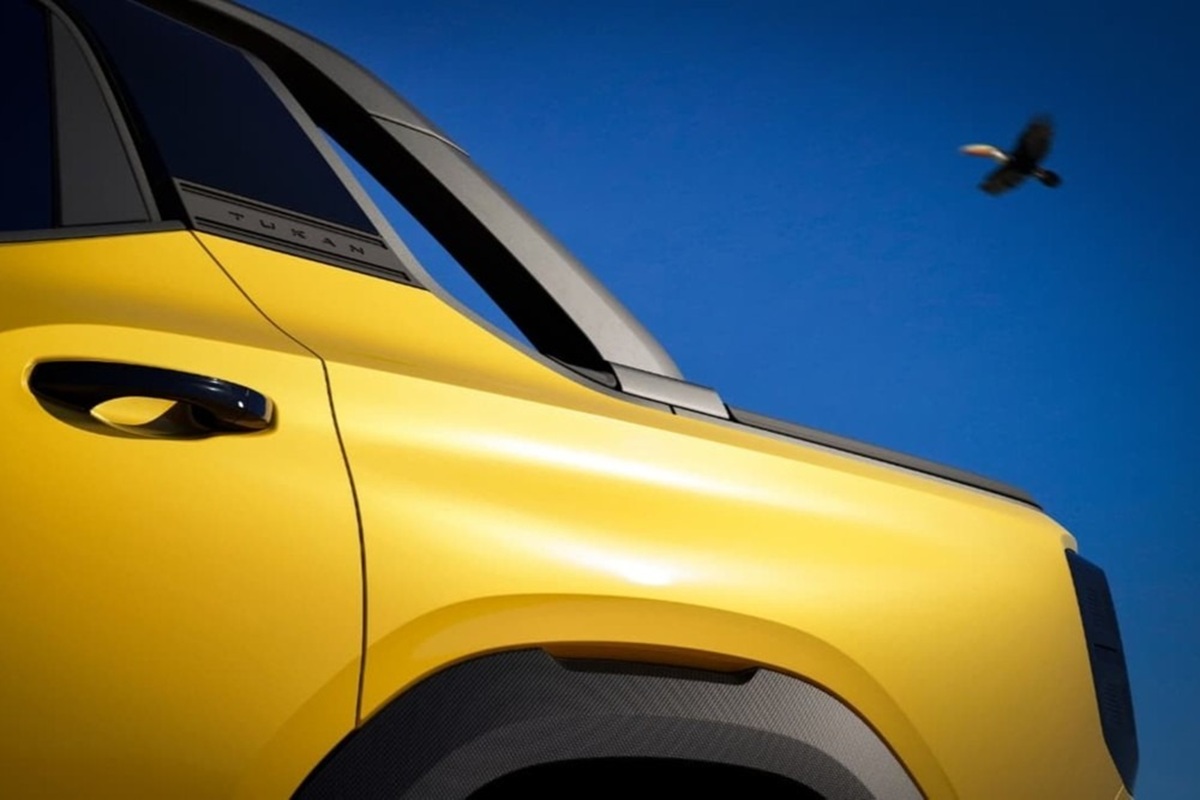
With Production Confirmed for the First Quarter of 2027 in São José dos Pinhais, the Volkswagen Tukan Will Have 4.75 M in Length, 2.80 M in Wheelbase, Two Body Styles and Versions with 1.0, 1.4 Engines and 48-Volt Mild Hybrid System to Compete Between Strada and Toro
Volkswagen confirmed the intermediate pickup Tukan with about 4.75 m in length and 2.80 m in wheelbase, production expected for the first quarter of 2027 in São José dos Pinhais and positioning between Strada and Toro, succeeding the Saveiro.
Dimensions Define Positioning Between Strada and Toro
At approximately 4.75 meters in length, 2.80 m in wheelbase, less than 1.80 m in width and 1.70 m in height, the Tukan has been sized to occupy the intermediate range of the segment. The size supports the strategy to compete with higher versions of the Strada and basic configurations of the Toro.
The proposal aims to meet two distinct profiles. On one side, consumers who prioritize robustness and professional use. On the other, customers interested in more equipped versions aimed at leisure, without leaving the intermediate segment.
-
Dodge Charger Daytona receives solid-state battery in real test and reignites the race for lighter electric cars, faster to charge and with more range.

-
Hyundai Staria Hybrid arrives as a “premium Kombi” hybrid with 7 or 9 seats, 1.6 turbo engine, 54 kW electric motor, spacious cabin, Relaxation seats, and a work van version with 3 or 6 seats in Europe.

-
Commission approves IPI exemption on the purchase of seven-seater cars for mothers of multiples: the benefit could assist women with three or more children, amends Law 8.989/95, and still needs to pass through two more commissions before proceeding to the Chamber and Senate.

-
7-seater SUV has become an alternative for those who need space without spending much, combining a 260 hp V6 engine, automatic transmission, and the size of a large utility vehicle for less than R$ 80,000: meet the 2012 Hyundai Veracruz.



Two Body Styles and Focus on Work and Leisure
The Tukan will be sold in single and double cab versions. The work configuration will feature a simplified design and elements geared towards intense use, directly targeting the market currently served by the Saveiro, including fleets and companies.
In this version, the pickup will have a rear suspension with a rigid axle and semi-elliptical springs. This solution aims to enhance robustness and load capacity, meeting the demands of those who use the model in daily work.
In the double cab variants, the proposal will be more focused on leisure. The design will be bolder, with eye-catching color palettes, distinctive wheels, and interior finishes with more refined materials.
Production in Paraná and Shared Base with the T-Cross
All production will be concentrated at the factory in São José dos Pinhais, Paraná, where the T-Cross is already assembled. The Tukan will share with the compact SUV the front structure of the monocoque body, based on the MQB A0 platform.
The arrival of the pickup represents the first new model from the brand in the segment since the Saveiro and Amarok, originally presented in 2010. In 2018, there was anticipation around the Tarok, but the project did not advance to production.
Expected Engines and Debut of the Mild Hybrid System
The entry-level versions with a single cab are expected to use the 200 TSI, 1.0 turbo flex three-cylinder engine, with up to 128 hp. The mid-range versions are expected to feature the 250 TSI, 1.4 turbo flex four-cylinder engine, with 150 hp and 25.5 kgfm, operating in Otto cycle and equipped with a six-speed automatic transmission.
As part of the brand’s electrification announcement, the Tukan is expected to be the first national product with a hybrid flex engine. The expected powertrain is the 1.5 TSI Evo2 with a 48 Volt mild hybrid system, 150 hp and 25.5 kgfm, paired with a DSG seven-speed transmission.
This system will initially be imported from Mexico. The strategy includes expanding the offering of mild, full, and plug-in hybrid products planned for the brand’s upcoming launches.
Name, Visual Identity and Altered Timeline
The name Tukan was revealed in honor of the toucan, a typical Brazilian bird. The choice reinforces the manufacturer’s trend of using the letter T in the naming of its models, such as Tera, T-Cross, Taos, T-Roc, Tiguan, and Touareg.
In terms of visual design, the inspiration will come from SUVs like Tera and Tiguan, particularly at the front end. A recent teaser indicated options for two-tone paint and a roll bar with “Tukan” branding, as well as the color Canarinho Yellow, associated with special editions of the Gol.
The initial expected debut was during the first half of 2026. The schedule has been altered, and mass production will begin only in the first quarter of 2027, with sales following shortly after, consolidating the brand’s repositioning strategy in the segment.


Be the first to react!