Portuguese
  Spanish


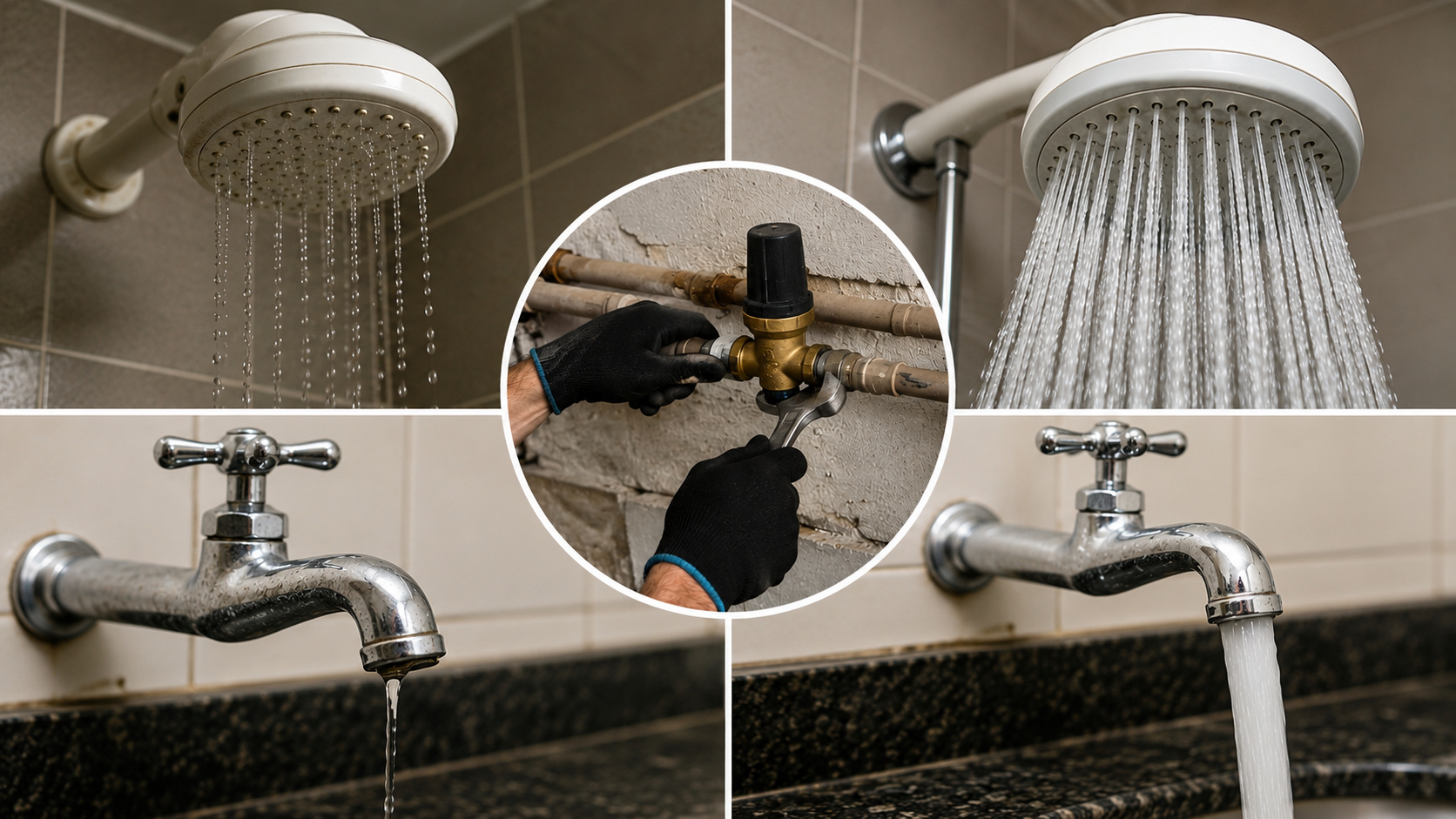

Poorly adjusted plumbing can drastically reduce water pressure in showers and faucets inside the house.
Few things are as annoying inside a house as turning on the shower and realizing the water comes out weak, without enough pressure for a comfortable bath. The same problem often appears in kitchen faucets, bathroom faucets, and even in washing machines, creating the feeling that something is wrong with the residence’s water supply, although manufacturers and technical guides in the plumbing sector point out that the cause is often within the house’s own installation. On February 14, 2025, Krona highlighted that low flow can be linked to failures such as air entering the piping and lack of adequate ventilation in the water column.
Most of the time, however, the problem is not necessarily in the street, the pump, or the sanitation company. According to guidelines published by Bela Metais on August 16, 2024, shower pressure depends directly on the height of the water column, that is, the difference between the water tank and the point of consumption; the greater this height, the greater the available pressure tends to be.
Loja do Mecânico, on April 15, 2024, also cites the installation of the water tank at an adequate height and position as one of the measures used to improve shower pressure.
-
How to Prevent Brown Recluse Spider Bites: Common Hiding Spots and Free Tips to Reduce Risks

-
Natto: The Unusual Japanese Superfood Gaining Popularity on Social Media and Driving Record Exports
-
Brazilian Mayor Goes Undercover as Homeless for 24 Hours to Assess Public Services

-
15-Year-Old Entrepreneur Malu Lira Publishes 20 Children’s Books on Financial Education, Earns $500,000, and Expands Her Project to the Amazon Rainforest




Water pressure depends directly on the height of the water tank relative to the house’s outlets
One of the most important factors for water force within a residence is what is called gravity pressure. In conventional systems without a booster pump, water descends from the water tank using only the weight of the liquid column.
In practice, the greater the vertical distance between the tank and the outlet points, the greater the water pressure tends to be in the shower and faucets.
This is precisely why single-story houses with very low water tanks often have weak water flow, especially in electric showers.
Many flow problems start with incorrect water tank installation
According to plumbing professionals, a very common mistake occurs when the water tank is installed practically at the same level as the residence’s water outlets.


In this situation, the water column loses force because there isn’t enough height to generate adequate pressure within the piping.
The result is immediately apparent in the shower: weak water, low flow, and difficulty using two points simultaneously in the house.
A difference of a few centimeters can already significantly alter the pressure
In residential plumbing installations, small changes can generate a noticeable difference in operation. Increasing the height of the water tank or repositioning part of the piping often already improves system performance without the need for expensive equipment.
In many residences, the problem is not in the amount of water available, but rather in how it flows down through the installation.
Very thin piping can restrict water flow inside the house
Another very frequent problem involves the diameter of the piping. Very narrow pipes reduce flow and create hydraulic head loss along the path.
In practice, water encounters more resistance to circulate, especially when several points in the house are used simultaneously.

This type of error appears frequently in improvised extensions, old renovations, or adaptations made without adequate hydraulic calculation.
Excessive connections also reduce water pressure in the shower
Too many bends, elbows, splices, and connections within the piping can significantly reduce pressure.
Every sudden change in direction causes energy loss in the water flow. When the plumbing has too many unnecessary bends, the entire system loses efficiency.
That’s why well-planned hydraulic projects try to maintain more direct routes with fewer interferences in the water’s path.
Modern showers require minimum pressure to function correctly
Many current models of electric showers and showerheads are designed to operate within a certain minimum pressure range.
When the installation does not provide sufficient flow, the equipment loses performance, spreads less water, and may even show irregular heating.
This explains why some houses have seemingly good showers but a poor bathing experience.
Partially obstructed water tank can also cause flow loss
In addition to height and piping, plumbers warn about another frequently overlooked detail: dirt inside the water tank.
Sediments, residues, and accumulation of impurities can reduce water passage at the lower outlets of the tank, impairing pressure throughout the residence. In some cases, a simple cleaning already significantly improves the flow at consumption points.
Many people live with weak water pressure without realizing that there is a partially closed valve in some section of the installation. This usually happens after maintenance, faucet replacements, or minor plumbing repairs.
When the valve does not fully return to the open position, the flow is limited, and pressure decreases at various points in the house.
Pressure boosters became a common solution for houses with low hydraulic height
When the residence does not have sufficient height between the water tank and the outlets, many professionals resort to pressure boosters. These equipment use electric motors to artificially increase water pressure in the piping.

Although they work well in various situations, plumbers emphasize that the ideal approach is still to first correct basic structural problems of the installation before installing additional pumps.
Older houses often show a gradual reduction in flow due to internal wear of the pipes. Old pipes can accumulate mineral deposits, rust, and residues that decrease water passage over time.
In old metallic installations, this problem tends to be even more noticeable.
Simultaneous use of multiple points can reveal hidden installation flaws
A simple way to detect hydraulic deficiency is to observe the water’s behavior when several points in the house are used simultaneously. If the shower drastically loses pressure when another faucet is opened, there’s a high chance the system is poorly sized.
This usually indicates flow limitation, inadequate piping, or insufficient pressure caused by the low height of the water tank.

The most interesting aspect is that not every pressure loss requires demolition or a complete renovation. In many residences, relatively simple adjustments can significantly improve the hydraulic performance of the house.
Repositioning the water tank, checking valves, eliminating obstructions, and correcting small sections of piping often completely change the user experience.
Weak water pressure inside the house almost always reveals invisible flaws in the hydraulic installation
The problem of low pressure normally does not appear in an obvious way. Most of the installation is hidden in slabs, walls, and ceilings.
Because of this, many residents end up believing that the defect is in the shower or faucet, when in fact the origin lies in structural details of the hydraulic system.
In the end, the water pressure inside the house depends much more on how the installation was planned than just on the amount of water available in the network.