Portuguese
  Spanish


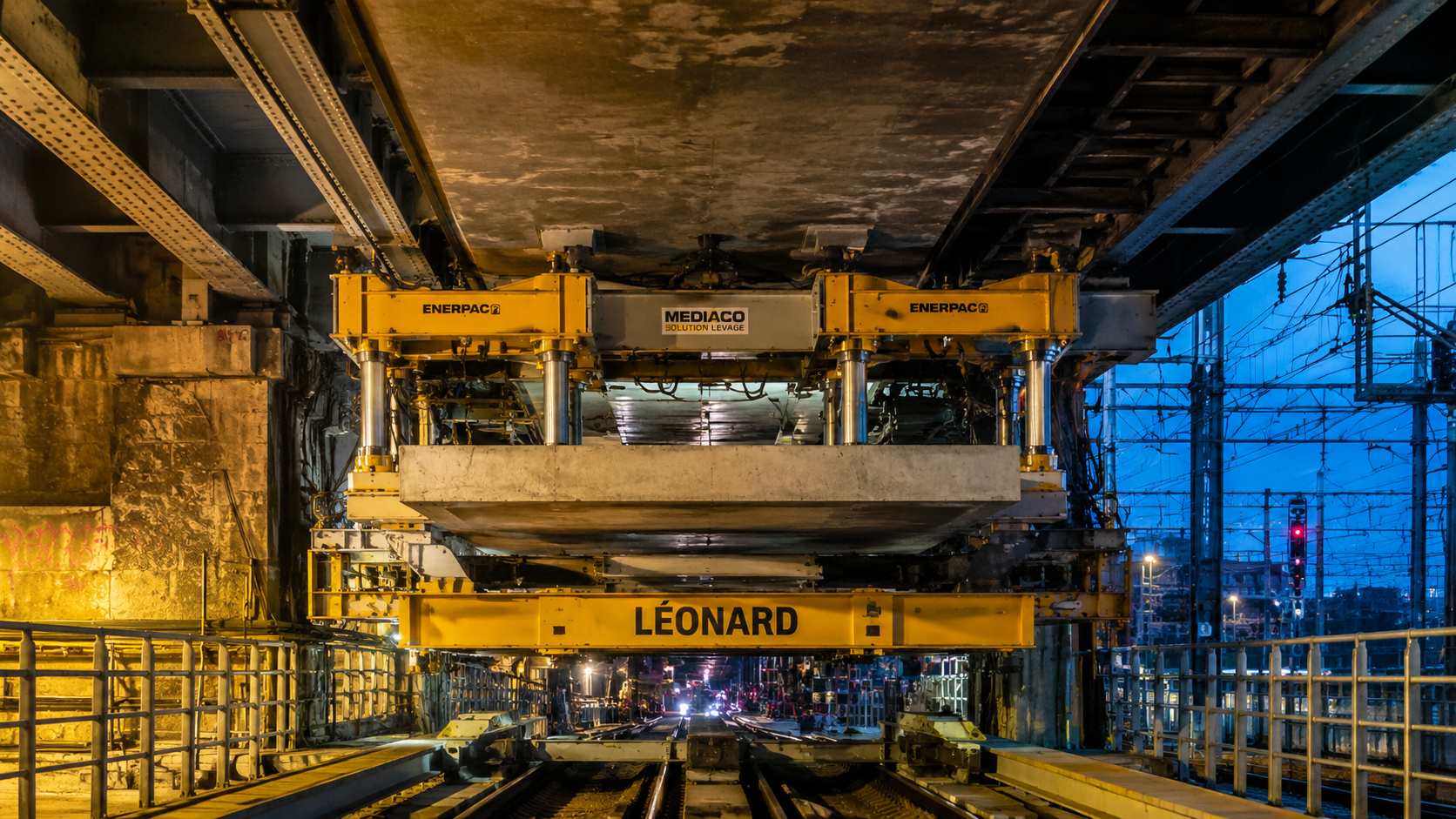

The replacement of the decks on the Viaduc des Souverains showed how a railway project in Paris managed to replace parts of the bridge with lifting from below, hydraulic gantry, turntable, and a solution created to work where the overhead power grid prevented the use of traditional methods from above
A lifting system called Léonard lifted parts of a viaduct from below in Paris to replace bridge decks without removing the overhead power grid. The operation took place at the Viaduc des Souverains, in an urban railway project marked by limited space, electrical risk, and the need to reduce interruptions.
The information was released by Heavy Lift News, a portal specialized in industrial heavy lifting. The project used an Enerpac hydraulic gantry and a turntable to lift, rotate, and position the decks within the viaduct’s own tunnel.
The most curious point is that instead of lifting the bridge from above, the project worked from below. This choice allowed parts of the structure to be replaced even with the overhead power grid in place, something that made the conventional method much more difficult.
-
How to Prevent Brown Recluse Spider Bites: Common Hiding Spots and Free Tips to Reduce Risks

-
Natto: The Unusual Japanese Superfood Gaining Popularity on Social Media and Driving Record Exports
-
Brazilian Mayor Goes Undercover as Homeless for 24 Hours to Assess Public Services

-
15-Year-Old Entrepreneur Malu Lira Publishes 20 Children’s Books on Financial Education, Earns $500,000, and Expands Her Project to the Amazon Rainforest




Why the bridge needed to be lifted from below in Paris
The overhead power grid above the railway needed to remain installed. This prevented a common operation with large cranes working from above the bridge.
Therefore, the solution was to bring the project’s force to the lower part of the viaduct. The deck, which is the part of the bridge where the track and rails are located, began to be moved from below.

The Viaduc des Souverains is located in an urban railway environment. This requires extra care because there are tracks, power grid, old structure, and railway traffic in the surroundings.
The project also had a clear goal: to reduce the impact on service. In a busy railway, each stage needs to be planned to avoid major stoppages.
How the Léonard machine, which became the center of the operation, works
The Léonard machine was created to work inside the viaduct. It uses an Enerpac hydraulic gantry, which functions as a controlled lifting structure.
This gantry lifts a steel platform. On this platform is an Enerpac turntable, used to change the position of the deck after it is lifted.
In practice, the piece rises from below, gains space to be adjusted, and then rotates until it aligns with the tracks. It is a movement that depends on precision, not just strength.
The system also allows the platform to rise and descend synchronously. This helps keep the set level during operation.
The overhead power grid turned the bridge replacement into an urban puzzle
In a typical construction, lifting a piece from above might seem the most direct route. In the case of the viaduct in Paris, this option was hindered by the overhead power grid.
The presence of this grid required a less obvious solution. The upper space was occupied, so the replacement of the decks had to occur from below.
This type of limitation is common in large cities. The works share space with roads, tracks, cables, tunnels, buildings, and systems that cannot simply stop.
Therefore, the operation drew attention. It showed how a railway construction can be organized in a tight space without relying solely on giant machines above the structure.
The rotation of the decks was the most visual part of the work
The most impressive movement of the operation was the rotation of the decks. The piece was not just lifted. It also needed to change position to align correctly with the tracks.
The Enerpac turntable helped in this stage. The deck was placed in one position, taken to the correct point, and then rotated to fit in the right direction.
This detail turns the work into an easily imaginable scene. The structure rises from under the viaduct, rotates within a limited space, and descends to the final position.

The process shows that difficult urban works depend on a kind of choreography. Each movement needs to happen at the right time to avoid error, rework, and risk.
What the numbers reveal about the size of the challenge at Viaduc des Souverains
The Souverains railway viaduct was built in 1868 and underwent renovation to ensure safety, reliability, and performance of the railway network in the Paris region.
The work involved the replacement of 25 decks. The structure supports 13 railway tracks, used by about 1,600 trains every day.
Heavy Lift News, a portal specialized in industrial heavy lifting, reported that the new concrete decks are 9.33m long and 3.74m wide, with a weight between 28t and 52t.
These numbers help to understand the difficulty. It was not about moving small pieces, but heavy parts of a railway bridge in an environment where space was limited.
Why this technique draws attention for tight urban constructions
The replacement of the decks from below shows a solution for cities where there is no free space for large maneuvers. In many cases, the problem is not just building, but building without dismantling everything around.
The use of Léonard shows that the solution may lie in more specific equipment. Instead of relying on a tall crane, the construction used a system prepared to lift, rotate, and position pieces within the viaduct itself.
This type of technique can inspire other constructions in dense urban areas. Viaducts, railway bridges, and old structures are often surrounded by networks, tracks, and essential services.
The main lesson is straightforward: when the space above does not exist, engineering needs to find another way. In Paris, this way came from below.

A bridge replacement from below shows that strength alone does not solve difficult constructions
The operation at the Viaduc des Souverains was notable because it solved a common problem in an uncommon way. The overhead electrical network prevented the simple use of cranes from above, and the response was to create a lifting system from the bottom.
With the machine Léonard, the construction lifted, rotated, and positioned heavy decks within a limited urban space. The result shows how engineering can depend as much on precision as on power.
If a bridge can be replaced from below to keep a railway functioning, which Brazilian constructions could gain time and safety with solutions designed for truly tight spaces?