






 Portuguese
  Spanish


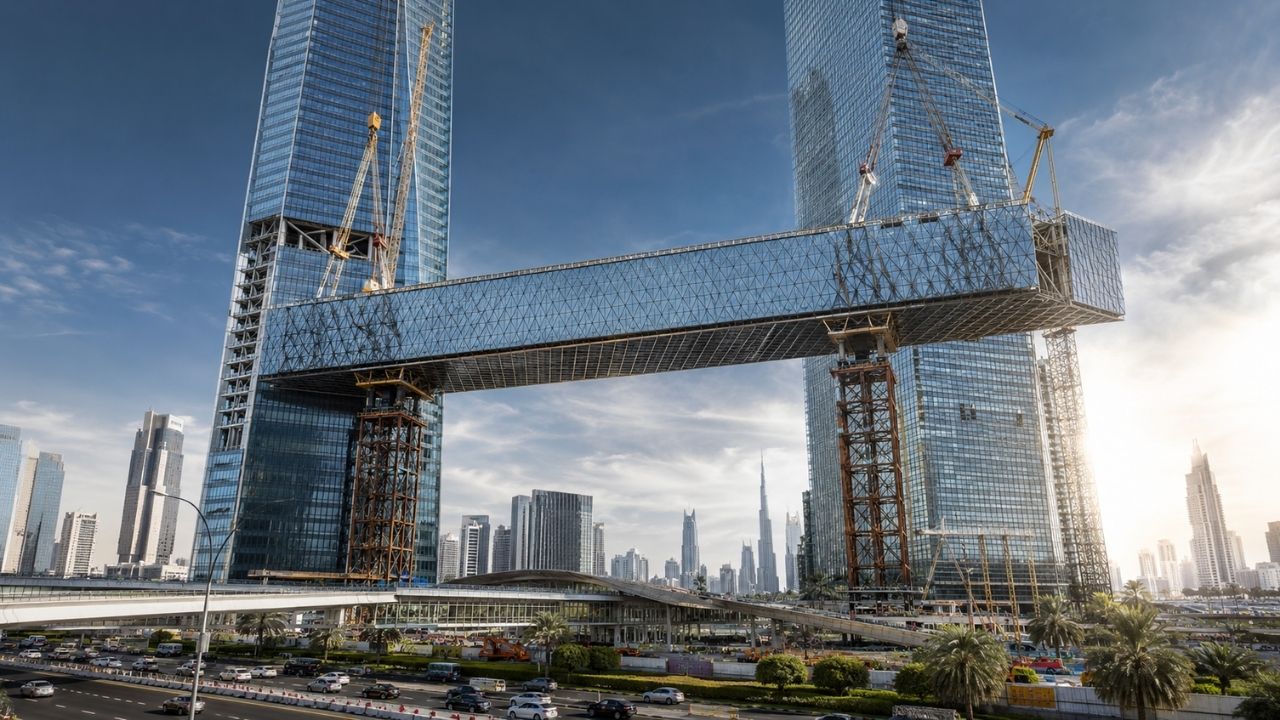


Between the skyscrapers of One Za’abeel, Dubai installed The Link, a suspended structure of 230 meters and over 8,500 tons, in two lifting stages totaling 16 days, using special hydraulic jacks, without blocking the expressway below and entering the Guinness World Records as a modern engineering world record.
The skyscrapers of One Za’abeel in Dubai now house one of the most impressive suspended structures in the world: The Link, a panoramic walkway of 230 meters installed 100 meters above the ground. The achievement was officially recognized by the Guinness World Records on March 1, 2024.
According to One Za’abeel, the project was developed by ICD, Investment Corporation of Dubai, and executed in two lifting phases over 16 days. The feat drew attention because the structure was positioned between towers, above an expressway, without interrupting traffic on the four lanes below.
Suspended structure crosses the skyscrapers 100 meters above the ground

The Link connects the skyscrapers of One Za’abeel and extends 230 meters in length. The structure stands out not only for its size but for the 67.277-meter cantilever designed beyond the main tower of the development.
-
Proper Cement Mix Extends Plaster Durability, Prevents Early Detachment, and Reduces Home Structural Risks

-
Brazilian Researchers Develop Plant Fiber Cement Absorbing 100 kg of CO2 per Cubic Meter, Aiming for Low-Carbon Construction

-
Brazil’s Largest Sewage Plant Boosts Capacity with New High-Performance Pumps, Treating Over 1 Billion Liters Daily
-
Brazilian Mother and Homemaker Becomes Bioconstructor, Builds 24-Ton Earth Dome and Teaches Technique Across Argentina


This cantilever is what brought the project to the Guinness World Records as the “Longest Cantilevered Building” in the world. In practice, the structure seems to float between the towers, creating a rare horizontal volume in a city known for extreme vertical constructions.
Lifting took 16 days and was divided into two phases

The installation of The Link took place in two stages. The first phase involved the lifting of the main steel structure, weighing over 8,500 tons, positioned over 12 days in one of the heaviest operations in the region.
In the second phase, a cantilever structure weighing over 900 tons was lifted and positioned in four days. Combined, the two stages completed the 16 days of assembly that placed the suspended walkway between the skyscrapers of One Za’abeel.
Operation used more than 110 special hydraulic jacks

To move a structure of this size, the team used more than 110 special hydraulic jacks and high-strength cable jacks. The process required coordination among engineering, construction, and heavy assembly professionals.
The challenge was not just to lift weight, but to control position, stability, and alignment at height. In projects of this type, any variation can affect the final fit of the structure, especially when it needs to connect precisely between two already constructed towers.
Traffic continued passing below during assembly
One of the most remarkable points of the project was the decision to carry out the installation without interrupting traffic on the four lanes of the expressway below. This made the operation more complex because the assembly needed to progress without halting an important urban route.
The choice required rigorous planning of safety, logistics, and execution. While the structure was lifted 100 meters high, the city continued functioning at street level, a contrast that reinforces the technical ambition of the project in Dubai.
The Link became a viewpoint, gastronomic destination, and architectural landmark

Besides the structural and symbolic function, The Link was designed as an experiential space. The structure houses eight restaurants inspired by the Michelin Guide, a suspended infinity pool touted as the longest in the United Arab Emirates, and a bar with a panoramic view.
With a 360º view of Dubai, the space transforms the skyscrapers of One Za’abeel into more than just a set of towers. The project creates an elevated area for leisure, tourism, and gastronomy, reinforcing the mixed-use nature of the development.
Guinness recognized Dubai as a stage for urban records
The recognition by the Guinness World Records consolidated One Za’abeel as another record-breaking landmark in Dubai’s skyline. The city is already associated with large-scale constructions, and The Link adds a new layer to this reputation.
Representatives associated with the project highlighted the innovation, ambition, and technical execution behind the achievement. The record came not only from the length of the structure but from the way it was installed between skyscrapers, at height, without interrupting the surrounding urban routine.
The work shows how Dubai uses engineering to create visual impact


The Link draws attention because it mixes heavy engineering, high-impact architecture, and urban strategy. Instead of creating just another tower, the project created a suspended connection that changes the visual perception of the complex.
This type of work also shows how major cities use iconic structures to compete for global visibility. In the case of Dubai, the suspended walkway reinforces an already known identity: architectural projects designed to impress, attract visitors, and break records.
A walkway between skyscrapers became a symbol of scale and precision
The installation of The Link at One Za’abeel shows how contemporary construction can surpass the traditional logic of vertical buildings. The structure of 230 meters, suspended 100 meters above the ground, required weight, precision, coordination, and an uncommon urban operation.
Now the question arises: do works like this represent the future of cities, or are they projects mainly made to impress and mark territory on the global stage? Do you think suspended walkways between skyscrapers can become a trend in other metropolises? Share your opinion.


