






 Portuguese
  Spanish


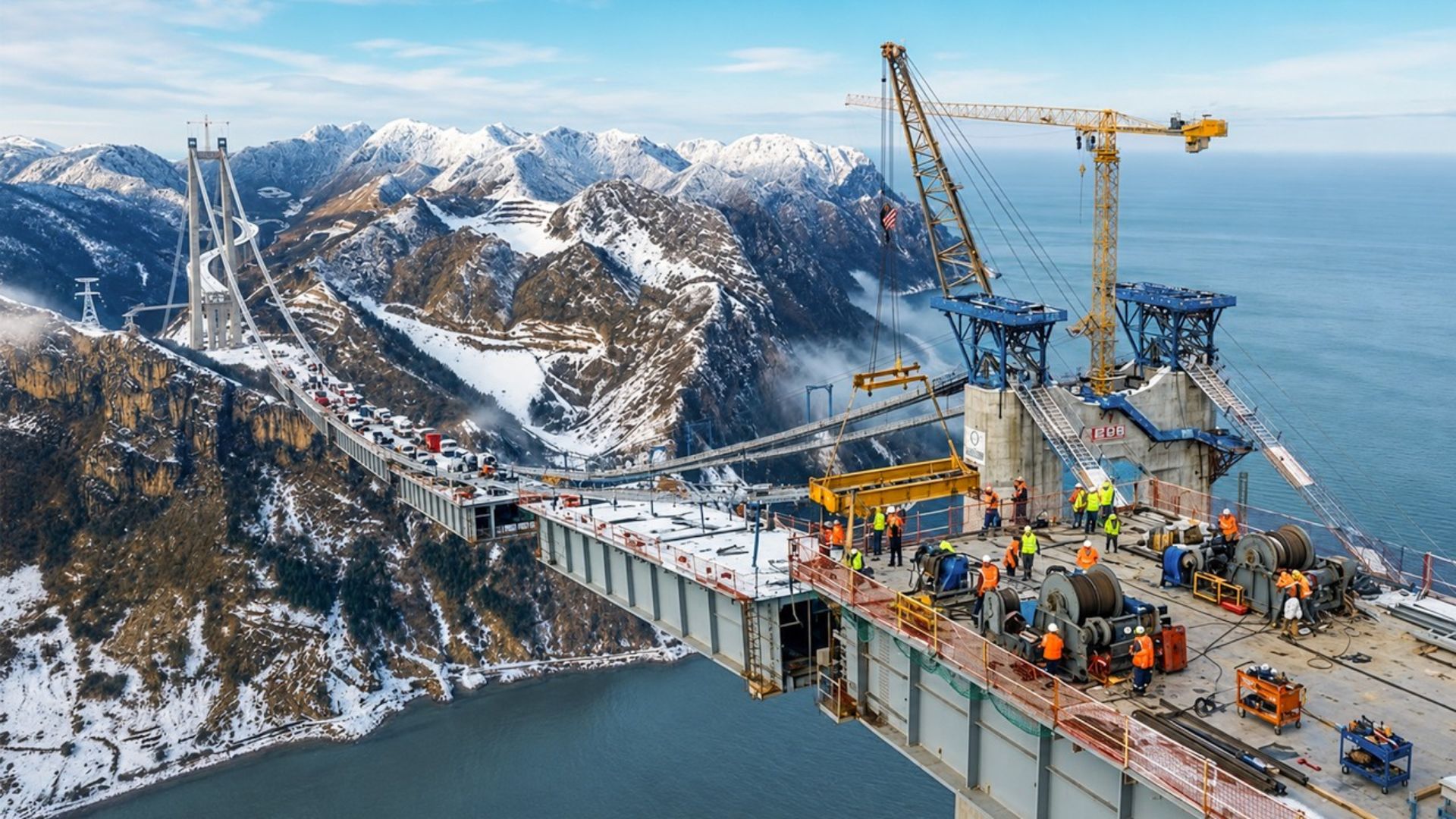

To overcome a fjord 300 meters deep at the top of the world, engineers had to tame storm winds and 40-degree variations throughout the year. The result is the longest suspension bridge ever built within the Arctic Circle, with A-shaped towers as tall as a sixty-story building.
Suspended almost 200 meters above a frozen fjord, the Hålogaland Bridge transformed travel in northern Norway. The imposing structure replaced a winding and dangerous road, vulnerable to landslides and ice, with a crossing of just a few minutes, a feat of engineering erected amid heavy snow and Arctic storms, near the city of Narvik, in one of the most inhospitable regions on the planet.
The bridge crosses the Rombaksfjorden fjord, in the county of Nordland, about 220 kilometers within the Arctic Circle, and leads to the important European Route E6, the main north-south road axis of the country. A contextual clarification is worth mentioning: although its impressive images circulate frequently, the work is not recent. Its construction began in 2013 and the inauguration took place on December 9, 2018, which does not detract from its merit of remaining among the most extraordinary crossings ever built in the far north of the world, as we will see below.
A record-breaking bridge at the top of the world

With a total length of 1,533 meters and a main span of 1,145 meters, the Hålogaland Bridge is the longest suspension bridge ever built within the Arctic Circle, and the second largest suspension bridge in all of Norway, second only to a structure in the south of the country.
-
Brazil Invests in Massive Waterway to Transport Soybeans by Barge, Reducing Costly Truck Reliance

-
Bridge Rebuilt in Just One Year Reconnects Two Brazilian States
-
Custom Furniture Costs in Brazil Expected to Range from $350 to Over $1,450 per Square Meter by 2026, with Kitchens, Closets, and Laundries Highlighting the Impact of Premium Features
-
Australia Builds Entire Airport from Scratch to Spark Development of New City


The bridge is supported by two A-shaped towers, which rise 179 meters above the fjord, a height comparable to a building of about sixty stories.
The deck, through which vehicles pass, is a steel box girder, formed by about 30 sections and totaling approximately 7,000 tons.
For its elegance and striking silhouette, the structure was compared to famous bridges, such as the Golden Gate in San Francisco, United States.
Why the bridge was necessary
The motivation behind the project was deeply practical.
Before the Hålogaland Bridge, travelers in the region had to bypass the fjord via a long and winding road, often threatened by landslides and the harsh Arctic winter conditions, with snow and ice, making the journey lengthy and risky, especially in the colder months.
With the new crossing, the distance between the regional centers of Narvik and Bjerkvik was reduced by about 18 kilometers, and the travel time to the region’s airport decreased significantly.
More than saving minutes, the bridge brought safety and reliability to the transport of people and goods, in a section considered strategic for connecting northern Norway with the rest of northern Europe.
The challenge of building in the Arctic
Erecting a structure of this magnitude in the far north was a feat in itself.
The project faced winds that can exceed 130 kilometers per hour, temperature variations reaching 40 degrees throughout the year, and the rugged terrain of rocky cliffs along the fjord, requiring highly specialized engineering solutions to ensure stability and safety.
To handle these extremes, the design adopted a slender and aerodynamic shape, with a spatial cable system and anchoring of the main cables directly into the mountain rock, which reduces visual impact and helps integrate the bridge into the landscape.
The A-shaped towers not only serve an aesthetic purpose: they provide extra stability to the structure in the face of the enormous tension exerted by the cables, essential for supporting the deck suspended over the deep waters of the fjord.
How the structure was erected


The construction combined robust techniques and great precision.
The bridge’s foundations were set on large concrete caissons installed dozens of meters below the fjord’s surface, while the towers were erected using sliding formwork, a technique where concrete is molded in successive layers as the structure rises, step by step, until reaching the final height.
After the main cables were installed, connecting the two banks by passing over the top of the towers, the steel sections of the deck were hoisted from barges and connected one by one, suspended by vertical hangers attached to the cables.
Before being opened to traffic, the bridge underwent rigorous load tests, with heavy trucks positioned to measure the deflection and response of the structure, ensuring that all movements remained within safety limits.
An International Collaboration
The Hålogaland Bridge is also the result of the union of expertise from several countries.
The engineering project was developed by the consultancy COWI, specialized in long-span bridges, with architecture signed by the Danish firm Dissing+Weitling, while the construction was carried out by the Chinese company Sichuan Road and Bridge Group and partners, in a cooperation that brought together European engineering and international execution.
The anti-corrosive coating, essential for protecting the steel from the icy winds and salty air of the fjord for decades, was supplied by the Norwegian manufacturer Jotun.
More than 900 workers participated in the construction over approximately five years.
The investment was in the order of billions of Norwegian kroner, equivalent to hundreds of millions of dollars, reflecting the complexity of building a structure of this size in such adverse conditions.
The Hålogaland Bridge is a remarkable example of how modern engineering can overcome some of the Earth’s most hostile environments, connecting previously isolated regions and making transportation faster and safer.
Even though it was inaugurated in 2018, the structure remains a reference in suspension bridge projects under extreme conditions, uniting functionality and beauty amidst the snow-capped mountains of the Norwegian Arctic.
More than just connecting two banks, it shows how far the human capacity to transform landscapes considered impassable into routes for the future can go.
And you, would you have the courage to cross a suspension bridge almost 200 meters high over a frozen fjord? What do you think of such construction in such extreme conditions? Leave your comment, share your opinion, and help spread the article to those interested in engineering, large constructions, and wonders of world infrastructure.


