Portuguese
  Spanish


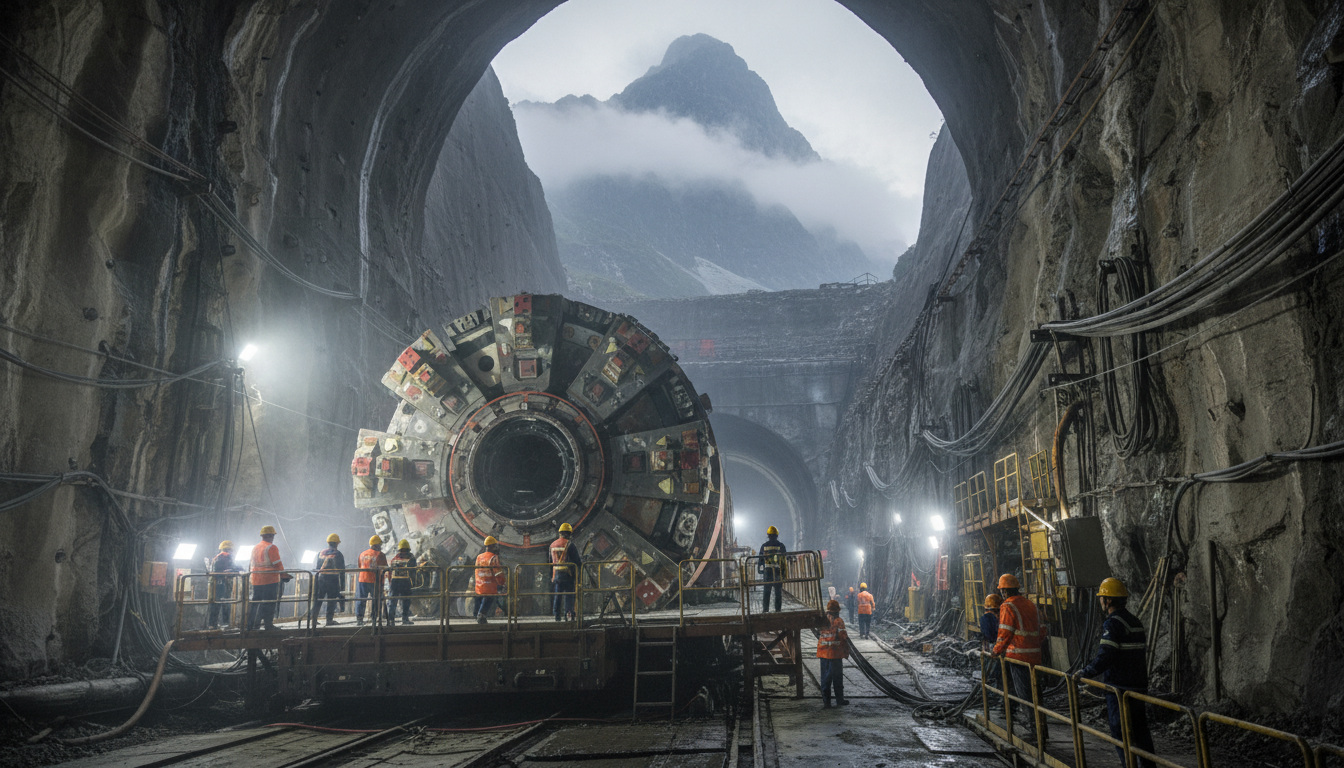


With 330 km of extension, 19 active seismic faults, and a 34 km tunnel under 3,000-meter mountains, the world’s most difficult railway in China challenged all known engineering — and took 14 years to get off the ground
Deep within the Gaoligong mountains in southwest China, gigantic machines have been advancing inch by inch for over a decade. The Dali-Ruili railway is considered the world’s most difficult railway, and the numbers explain why.
According to a report by Exame, construction began in 2008. The main tunnel, named Gaoligong, is exactly 34,538 meters long — over 34 km drilled under a mountain range that reaches 3,000 meters in altitude.
And the challenge isn’t just the distance. There are 19 active seismic fault zones along the way.
-
Two-Bedroom Home Built in a 40-Foot Shipping Container Delivered and Ready for Same-Day Living in São Paulo Countryside

-
China Constructs Artificial Island 32 km Offshore for Yangshan Port, Connected to Shanghai by 32 km Bridge, Unloading 3,000 Containers in 20 Hours
-
China’s $70 Billion River Diversion Project, the World’s Largest, Moves 44.8 Billion Cubic Meters Annually, Crosses Under the Yellow River, and Displaced 330,000 People
-
Indian Driver Spends 14 Years Digging 10-Meter Tunnel Through Mountain to Connect Isolated Village to the World



While in Brazil, projects like Ferrogrão — a 933 km railway connecting Mato Grosso to Pará — accumulate decades of delays and legal disputes, China delivers entire railway sections in conditions many engineers considered impossible.

The world’s most difficult railway in numbers: 330 km, 14 years, and 19 seismic faults
The Dali-Ruili railway has a total length of 330 km, divided into two sections.
The first, between Dali and Baoshan, is 133 km long. Construction began in 2008 and it became operational in 2022.
The second section, between Baoshan and Ruili, started in 2015. This is where the Gaoligong tunnel — the heart of the project — is located.
Bridges and tunnels account for 75% of the total 330 km length of the railway. The Hengduan mountains region features steep terrain, unstable geology, and dense vegetation.
- Total length: 330 km
- Main tunnel (Gaoligong): 34,538 meters (34.5 km)
- Seismic faults along the route: 19 active zones
- Start of construction: 2008 (Dali-Baoshan section)
- Tunnel completion forecast: December 2027
- Full line operation: 2028
Furthermore, once completed, the journey from Kunming — the capital of Yunnan — to Ruili, on the border with Myanmar, will drop from 9 hours to 4.5 hours.
Inside the Gaoligong tunnel: extreme heat, groundwater, and moving rocks
Senior engineer Gao Shangjie, from the Mangshi transport department in the Dehong Dai and Jingpo Autonomous Prefecture, closely monitors the work.
“Recent technical advances have accelerated the pace of construction,” Gao Shangjie told the Chinese press.
However, the challenges inside the tunnel are brutal. Soft rocks that yield under pressure. Abundant groundwater that invades excavation corridors. And intense geothermal heat, which transforms the mountain’s interior into an underground greenhouse.
Engineers had to change the excavation method several times due to unpredictable geological conditions.
Unlike other Chinese mega-projects like the Shenzhen-Zhongshan maritime expressway, here the enemy is not seawater — it’s the mountains themselves.

The China-Myanmar corridor: why this railway matters for all of Asia
The Dali-Ruili railway is not just an engineering feat. It is a strategic piece of the China-Myanmar railway corridor.
Therefore, when the tracks reach Ruili — a border city with Myanmar — China will have a direct freight and passenger route to Southeast and South Asia.
In this way, logistical integration benefits not only Yunnan province but all bilateral trade between China and its southern neighbors.
However, the project goes beyond economics. Remote and mountainous regions of Yunnan, historically isolated, gain connection with the rest of the country.
Consequently, communities that relied on precarious roads and 9-hour journeys will have access to a modern railway in less than half the time.
Other Chinese mega-projects that defied the impossible
China is no stranger to projects considered impossible. For example, the Tianshan Shengli tunnel is 22 km long and crosses 16 geological faults.
That tunnel was completed in 52 months — 25% faster than the original 72-month deadline. Around 3,000 workers faced extreme cold and unstable terrain.
Additionally, the railway in the Mongolian desert extends for 2,700 km on elevated tracks. The foundations need to reach stable layers beneath the shifting sand dunes.
Even so, the Gaoligong tunnel stands out among them all. It has 19 seismic faults compared to Tianshan’s 16. And its 34.5 km length will make it the longest railway tunnel in Asia when completed.
In Brazil, railway projects such as the elevation of tracks in Criciúma show that infrastructure investments are also advancing, albeit on a different scale.

What could go wrong: deadlines, costs, and seismic risks
On the other hand, it is important to consider the caveats. There are no official data on the total cost of the Dali-Ruili railway. Nor is there public information on the exact number of workers or any accidents during construction.
The forecast for the completion of the Gaoligong tunnel by December 2027 — and full operation in 2028 — depends on there being no new collapses or underground floods.
The region is subject to earthquakes, and the 19 active seismic faults represent a permanent risk, even after inauguration.
Furthermore, available sources do not mention studies on the long-term environmental impacts of drilling under the Gaoligong mountains — an area of biodiversity recognized by UNESCO.
Still, if all goes according to plan, China will have demonstrated that even the planet’s most hostile mountains can be conquered — inch by inch, fault by fault, year after year.