Portuguese
  Spanish


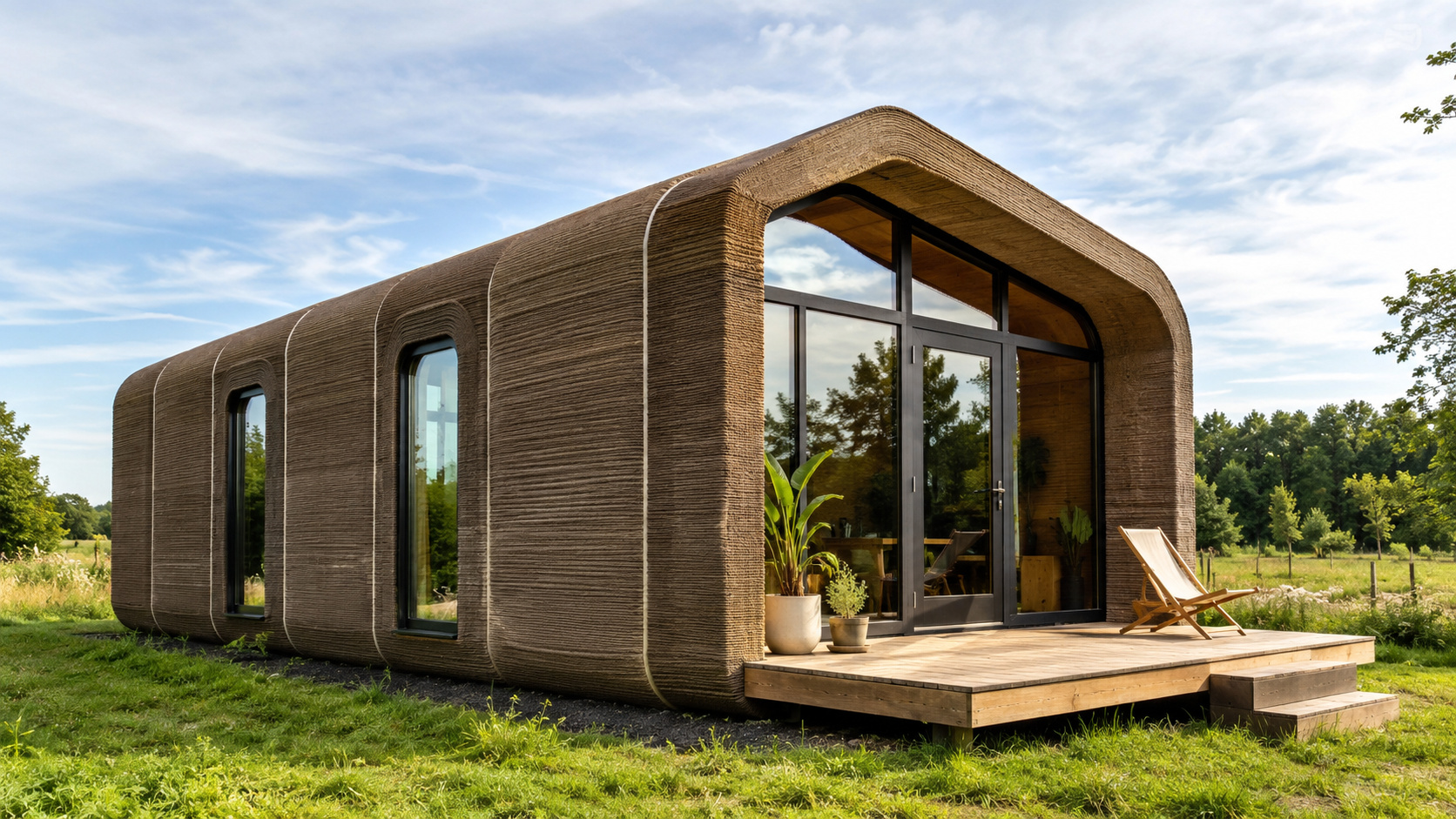


The Dutch cardboard house created by Wikkelhouse shows how a modular construction can leave the workshop, arrive ready at the site, reduce construction stages, and still accommodate a kitchen, bathroom, and customized openings in an unusual compact housing proposal
The Dutch cardboard house draws attention because it transforms a material associated with boxes and waste into a habitable, modular, and transportable structure.
Wikkelhouse uses 24 layers of cardboard wrapped around a house-shaped mold. The layers are glued together and finished to withstand residential use.
The information was released by Fiction Factory, the Dutch studio that created Wikkelhouse. The proposal showcases a house made in a workshop, delivered in modules, and connected on-site in just one day.
-
Katie Stagliano’s 18 kg Cabbage at Age 9 Fed 275 People, Inspired Katie’s Krops, and Led to 100 Community Gardens in 32 U.S. States to Combat Hunger with Fresh Produce

-
Black Granite Sarcophagus Found in Alexandria Reveals Three Skeletons, Strange Liquid, and an Ongoing Archaeological Mystery in Egypt

-
Childhood Psychology: Experts Highlight How Playing Outdoors Until Dusk Boosted Autonomy, Decision-Making, and Resilience in Previous Generations, Influencing Adult Behavior Today
-
Former Truck Driver from Brazil Builds Logistics Company Aiming for $70 Million Revenue with 11 Branches, 700 Monthly Clients, and $10 Million Fleet Investment




Cardboard house uses 24 layers to create a habitable structure
The most surprising point is simple: cardboard stops being seen only as packaging and starts forming a modular house.
Wikkelhouse is born from 24 layers of cardboard wrapped around a house-shaped mold. Then, these layers are glued and finished to gain strength.

The idea works by joining the parts. A sheet of cardboard seems fragile, but many well-attached layers create a firmer structure. Therefore, the project draws attention in the debate about modular construction.
Modules allow expanding the house with kitchen, bathroom, and customized openings
Each module measures about 4.6 m x 1.2 m x 3.5 m. The house can grow with extra segments, allowing the space size to be adjusted to the desired use.
The structure accommodates a bathroom, kitchen, and customized openings. This paves the way for uses such as lodging, office, compact house, and temporary housing.
This format also facilitates assembly. Instead of building everything from scratch on-site, the house arrives in ready-to-connect parts.
House that arrives ready changes the logic of on-site construction
The Wikkelhouse is manufactured in a workshop in Amsterdam. Afterwards, the modules are transported to the installation site.
Fiction Factory, the Dutch studio that created the Wikkelhouse, details the manufacturing in segments that can be connected to form the house. This model reduces steps on-site and makes installation faster.
The practical gain lies in the reduction of wet work, dirt, and assembly time. For those seeking a compact solution, the main advantage is receiving an almost ready structure.
Modular construction transforms cardboard into alternative architecture
The house made of cardboard shows a different way of thinking about construction. The project does not try to mimic a traditional building. It bets on lightness, transport, and assembly by modules.

The compact dwelling also stands out for deviating from the common standard. Instead of cement, brick, and long construction, the Wikkelhouse uses treated cardboard in multiple layers.
Even so, the project fits better as alternative architecture rather than a popular mass solution. The main value lies in the innovation and the unusual way of using a simple material.
Installation in just one day reinforces the appeal of the modular house
The possibility of installation in just one day is one of the strongest points of the Wikkelhouse. This does not mean that the entire process starts on-site, but that the final assembly is simplified.
A good part of the work happens beforehand, inside the workshop. Thus, the site receives the modules ready for connection.

This model interests those seeking speed, less complexity, and smaller spaces. The house can function as accommodation, office, compact house, or temporary residence.
Cardboard, modules, and quick assembly place the Wikkelhouse at the center of curiosity
The Wikkelhouse combines three strong elements: cardboard as the base of construction, transportable modules, and installation on-site in just one day.
The project shows that a house doesn’t always need to follow the same path of heavy and long construction. With 24 wrapped layers, the proposal transforms a common material into a different architectural solution.
Would you live or work in a house made with treated cardboard if it reduced construction time and arrived ready at the site? Share your opinion.