Portuguese
  Spanish


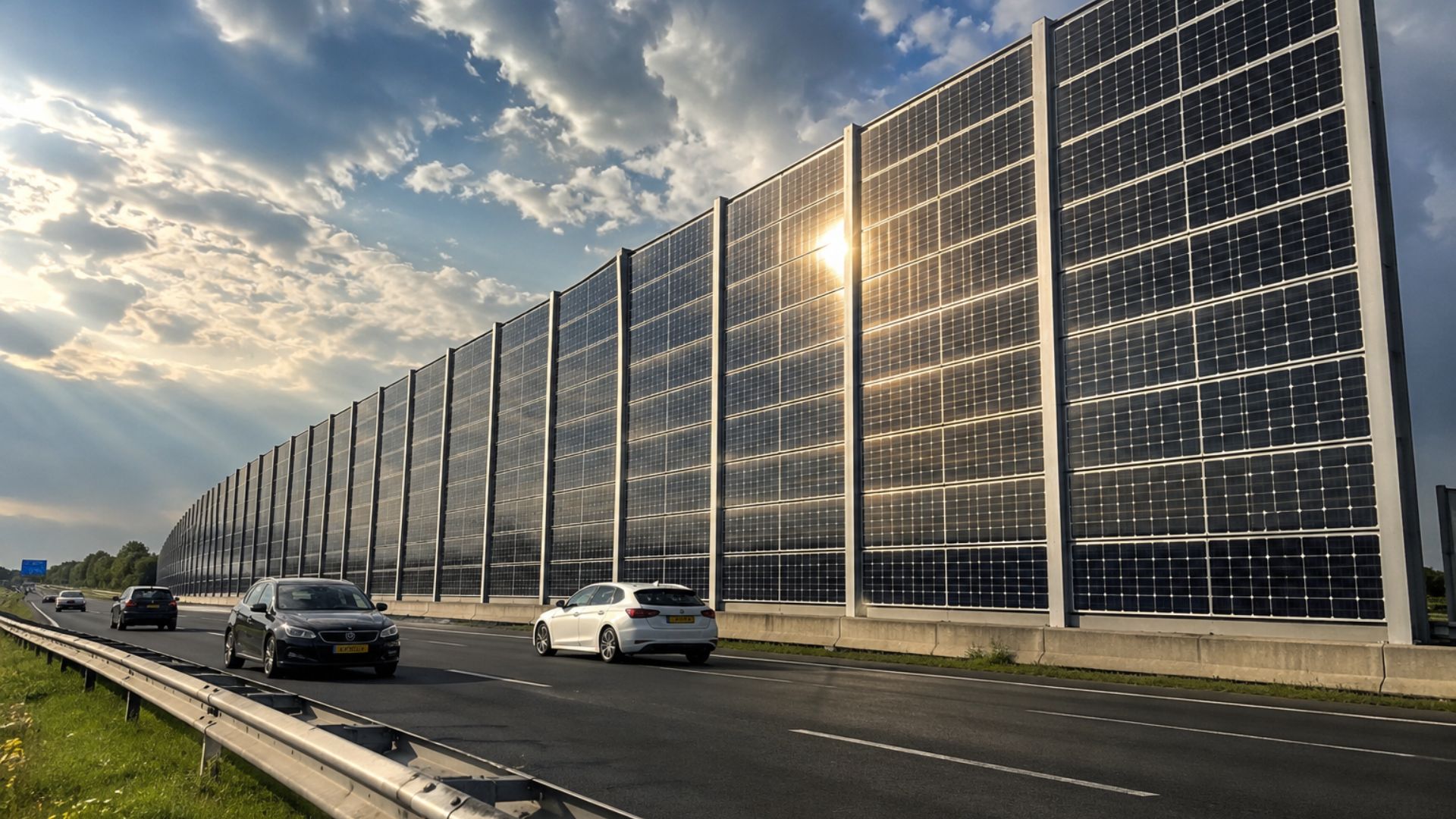


Structures created to reduce noise on Dutch highways have started generating solar energy without occupying new land, in a solution that combines road infrastructure, renewable production, and intelligent use of existing urban space.
Structures originally created to reduce traffic noise have taken on a new function in the Netherlands: generating solar electricity without requiring the occupation of new land for the installation of photovoltaic plants.
Within this strategy, the Solar Highways project, developed by Rijkswaterstaat, the agency responsible for Dutch public infrastructure, transformed highway noise barriers into surfaces capable of producing renewable energy.
The best-known application was installed along the A50 highway, in the Uden region, on the east side of the road and north of the Volkel exit, where the acoustic wall now integrates solar panels into its own structure.
-
How to Prevent Brown Recluse Spider Bites: Common Hiding Spots and Free Tips to Reduce Risks

-
Natto: The Unusual Japanese Superfood Gaining Popularity on Social Media and Driving Record Exports

-
Brazilian Mayor Goes Undercover as Homeless for 24 Hours to Assess Public Services

-
15-Year-Old Entrepreneur Malu Lira Publishes 20 Children’s Books on Financial Education, Earns $500,000, and Expands Her Project to the Amazon Rainforest

Although it continues to perform the function of reducing the sound impact of traffic on neighboring areas, the barrier now also injects renewable electricity into the grid through modules integrated into the containment system.
With 400 meters in length, five meters in height, and approximately 1,600 square meters of solar panels, the project was designed to evaluate the technical and economic viability of this type of application in road infrastructure.
In practice, the adopted logic is simple: if the road already requires permanent acoustic protection, the same structure can assume an energy function without increasing the competition for land use.
Acoustic barrier with solar energy gains ground in the Netherlands
The model gained relevance by addressing one of the main obstacles to solar expansion in densely populated countries, where large photovoltaic plants often compete for space with agriculture, housing, and environmental preservation areas.
Along the A50, however, electricity generation was incorporated into a structure already present in the road landscape, avoiding the need to convert new land for renewable energy production.
Instead of occupying open areas, the solution utilized an indispensable acoustic barrier for the highway and added a second utility to it without altering its original function.
Furthermore, the experience has broadened the discussion about the use of urban and road surfaces that are normally seen only as auxiliary elements of transport infrastructure.
Acoustic walls, shoulders, embankments, and rights-of-way can gain relevance in energy planning when they receive distributed generation systems integrated into their physical structure.
Bifacial solar panels increase structure efficiency
The Dutch solar barrier uses bifacial panels, capable of producing electricity from both sides.
This characteristic is important in vertical structures, as it allows light to be captured on both the front and back faces, according to solar incidence and environmental reflection throughout the day.
According to Rijkswaterstaat, Solar Highways specifically investigated the integration of double-sided panels into acoustic barriers on highways.
The objective was to understand whether this type of construction could combine energy performance, noise reduction, and adequate maintenance under real-world conditions of use.
Construction began in 2018 and was completed in February 2019.
Since then, the barrier has operated as a practical demonstration of a dual-purpose public infrastructure, combining sound protection and renewable electricity generation in the same physical space.
A50 highway project underwent technical monitoring
The project was accompanied by an 18-month monitoring period, between January 2019 and June 2020.
During this interval, the barrier produced 325.5 MWh of solar electricity, equivalent to approximately 220 MWh per year, according to data from the European LIFE program.
This production is sufficient to supply approximately 60 to 70 homes, according to the project report.
Rijkswaterstaat itself also reports that the barrier can provide local green electricity for about 40 to 60 homes, a difference linked to the criteria used in each consumption estimate.
The technical monitoring evaluated operational parameters, maintenance scenarios, and cleaning effects on energy performance.
The collected data served to update technical and financial models, as well as to guide potential similar applications on municipal, provincial, regional roads, and even in the railway sector.
Road infrastructure gains new energy function
The monitoring results confirmed the potential of integrating road infrastructure and solar generation, although the data also revealed challenges related to cost and initially expected performance.
According to the LIFE program report, energy production fell below original projections, while capital costs exceeded initial estimates due to expenses related to the contractual execution of the project.
Nevertheless, the experience generated technical recommendations aimed at reducing costs and improving efficiency in future similar applications on roads and other public structures.
Among the conclusions recorded by those responsible for monitoring, one pointed out that cleaning the panels had no measurable impact on the energy performance of the solar barrier.
Designed to operate for approximately 30 years, the structure also became a reference for studies on module durability and maintenance costs throughout its lifecycle.
As a result, the project ceased to be merely a technological showcase and began to provide technical parameters for future evaluations involving solar generation integrated into road infrastructure.
Smart use of space boosts renewable energy
The A50 barrier is part of a larger set of noise reduction measures on the stretch between Sint-Oedenrode and the Paalgraven interchange.
In this context, solar generation did not replace the acoustic purpose of the structure, but added value to an intervention that would already be necessary to protect neighboring areas.
This type of solution does not have the scale of large solar farms, but offers a complementary alternative to expand renewable production.
By distributing panels over already occupied surfaces, the system reduces land-use conflicts and brings electricity generation closer to existing structures in urban and road environments.
For countries facing pressure for clean energy and space constraints, the Dutch experience shows that part of the energy transition can occur in overlooked locations.
Noise barriers, facades, roofs, parking lots, and other built surfaces can expand solar supply without displacing essential activities.
The relevance of Solar Highways lies less in the absolute volume of electricity produced and more in demonstrating a planning principle.
Public infrastructures can cease to serve a single function when they are designed to combine mobility, environmental protection, quality of life, and energy generation.
On the A50, the wall that reduces vehicle noise also injects renewable electricity into the grid. The solution keeps the highway operational, preserves the acoustic function of the barrier, and transforms a previously passive surface into an active part of the energy matrix.