






 Portuguese
  Spanish
  6 min of reading
  0 comments


Technology validated in the UK uses floating modules, fuel cells, and batteries to provide power to docked ships, reducing emissions without relying on the port’s electrical grid
A hydrogen-powered floating platform has been validated in the UK with the proposal to provide electricity directly to docked ships without requiring major construction on the dock. The solution, called Hydrogen Power Hub, functions as a modular plant installed on the water and aims to solve one of the most costly bottlenecks of port decarbonization: delivering clean energy to stationary vessels that continue to consume diesel.
The project was led by ELIRE Maritime in partnership with companies and institutions such as Ricardo UK, Schneider Electric, Rux Energy UK, Offshore Renewable Energy Catapult, and the University of Strathclyde. According to information from Advanced Maritime Technology International, the system underwent a six-month feasibility program and was supported by a British government initiative aimed at reducing emissions in maritime transport.
In practice, the technology does not “refuel” the ship with hydrogen as fuel for navigation. The goal is different: to provide electrical power while the vessel is docked, allowing diesel auxiliary engines to be turned off during the port stay.
-
A billionaire could buy a huge yacht, but chose a 17,000-acre farm in Australia for $10 million to transform former pastures into a nature reserve, save a historic forest, and provide shelter for endangered species.

-
Women farmers in Guatemala bring water to dry crops, create a plantain brand, and help restore mangroves.

-
Two helicopters, 41 people, and over 38 tons of bait were mobilized on a remote Pacific atoll to eliminate rats; five years later, native trees grew by 5,000%, seabirds gained habitat, and the rainforest began to regenerate.
-
Florida dumped 2 million tires into the ocean near Fort Lauderdale to create an artificial reef, but hurricanes scattered the rubber across the seabed, and cleanup efforts initiated decades later are still trying to correct the environmental disaster without a guarantee of full coral recovery.



This detail is important because many ships, even when stationary, keep generators running to power lights, refrigeration, air conditioning, internal equipment and onboard systems. It is precisely during this period, silent to those observing from outside, that part of the pollution continues to be released over port cities.
Platform attempts to solve the problem of ports that cannot quickly expand the electrical grid
The electrification of port berths is one of the most discussed alternatives to reduce local emissions. The concept, known as shore power, allows the ship to connect to an external power source instead of keeping its own generators running.
The problem is that not every port has an electrical grid ready to accommodate large ships. Installing substations, high-voltage cables, specific connections, security systems, and new structures on the dock may require licenses, civil works, and high investments.
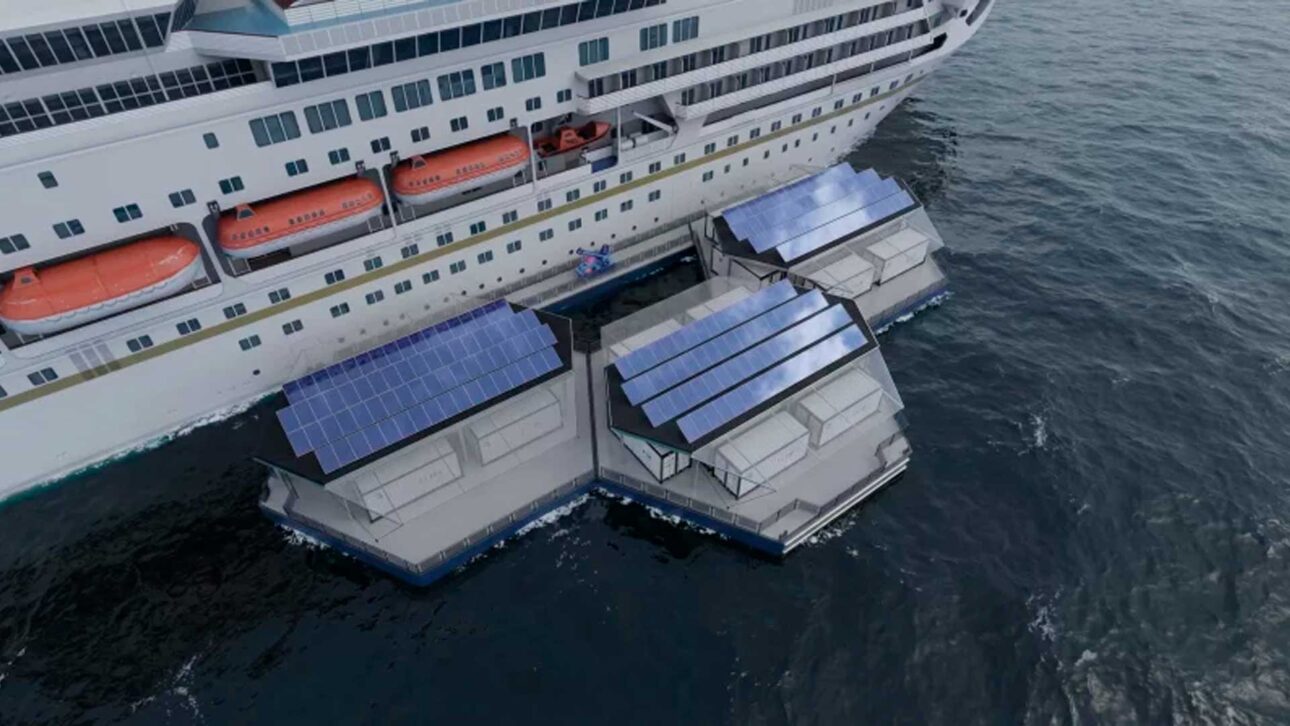
This is where the floating platform comes in. Instead of waiting for the expansion of the land network, the system brings generation and storage to the water. The proposal is to create a kind of mobile maritime micro-grid, capable of being installed near the docking point and adjusted according to the demand of each port.
According to the United States Environmental Protection Agency, shore power systems can reduce or eliminate emissions from auxiliary engines during docking, although the benefits depend on the type of ship, time at the dock, fuel used, and available power grid. The hydrogen platform attempts to expand this concept to locations where the grid still cannot handle the demand.
How the floating hydrogen power plant for ships works
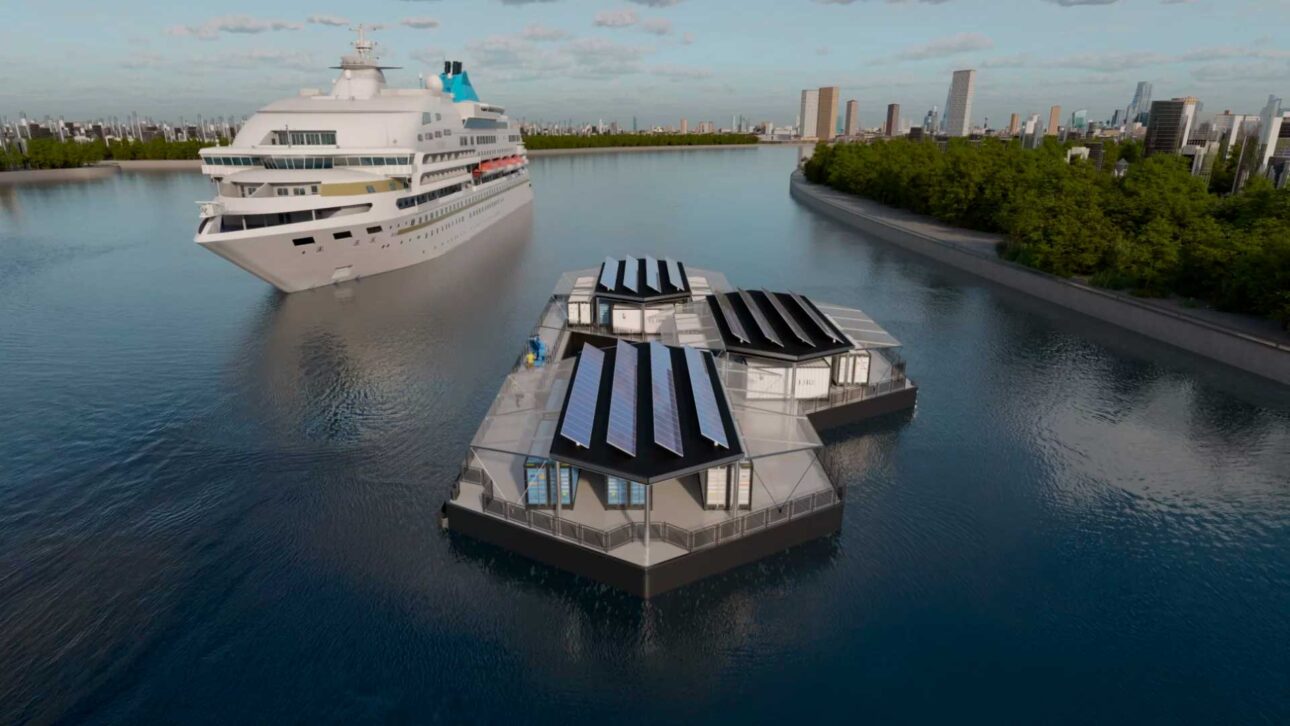
The Hydrogen Power Hub consists of three hexagonal floating modules, with a combined area of about 1,200 m². Inside the structure are fuel cells, batteries, electrical systems, and hydrogen tanks integrated into the platform.
According to New Atlas, the validated configuration can deliver up to 5 MW of continuous power and about 91 MWh of energy per week. The capacity was designed to serve large docked vessels, including medium-sized cruises and other maritime assets that require 6.6 kV and 11 kV connections.
The system also includes approximately 45 MWh of batteries. The logic is simple: the fuel cells work continuously, converting hydrogen into electricity, while the batteries accumulate energy over time. When the ship arrives, this energy can be released more quickly.
In practice, the platform functions as a large floating energy bank. It does not depend on a robust connection to the port’s grid and can be refueled with hydrogen by support vessels, as needed.
The technology also includes onboard solar generation of up to 146 kW, a small reinforcement given the total power, but useful to extend the autonomy of auxiliary systems. The central point, however, remains the combination of hydrogen, fuel cells, and battery storage.
Emission reduction draws attention, but depends on the type of hydrogen used
The main promise of the project is the reduction of emissions during the ships’ stay at the dock. A feasibility analysis led by Ricardo UK estimated that the platform can cut about 77% of emissions at the berth, compared to conventional diesel generators used on board.
The developers also estimate a savings of approximately 47 tons of CO₂ per ship each week, depending on the operation profile. This number helps explain why the solution attracts attention from ports facing environmental pressure without being able to halt their activities for long works.
There is also an important local gain. By turning off auxiliary generators, the port reduces smoke, noise, and pollutants near urban areas. For cities that coexist with busy terminals, this impact can be as significant as the global reduction of carbon.
But there is a technical caveat: the climate benefit depends on the origin of the hydrogen. If the hydrogen is produced with renewable energy or low-emission processes, the environmental gain is greater. If it comes from fossil sources without carbon control, part of the pollution just shifts location in the production chain.
The International Maritime Organization established in its 2023 strategy the goal of bringing international maritime transport to net-zero emissions around 2050. In this scenario, technologies like hydrogen, dockside electrification, alternative fuels, and operational efficiency begin to compete for space in a transition that still does not have a single winning solution.
Low-pressure storage is one of the most curious points of the project
One of the most relevant technical elements of the platform is in the storage of hydrogen. Instead of relying solely on high-pressure tanks, the project includes nanoporous materials developed to store the gas more compactly and at low pressure.
According to information about the consortium, Rux Energy UK was responsible for hydrogen storage solutions using materials with microscopic pores. These materials help retain hydrogen molecules and can simplify part of the logistics when compared to more intense conventional compression systems.
The validated model consumes approximately 7,500 to 8,000 kg of hydrogen per week. Replacement is planned about twice a week by support vessels, which reinforces the mobile nature of the solution.
This characteristic also creates a challenge. To function on a large scale, it will be necessary to organize a reliable supply chain, with hydrogen that is available, safe, traceable, and competitively priced. Without this, the platform may be technically viable but commercially limited.
Energy cost is still the biggest obstacle for mass adoption
Despite the technical advancement, the platform still faces a common problem in emerging technologies: the price. Current estimates place the electricity generated between £0.25 and £0.50 per kWh, above the cost of some conventional land-based energy alternatives.
This cost does not mean that the project is unfeasible, but it shows that its initial adoption should occur in specific situations. Ports with congested electrical grids, strict environmental targets, cruise operations, regulatory pressure, or difficulty in executing works may see more value in the system’s flexibility.
The advantage is not just in the price per kWh. It lies in the possibility of delivering energy where traditional infrastructure has not yet reached. For some terminals, avoiding years of waiting for network reinforcement may justify a higher initial cost.
Another point is that the technology tends to depend on scale. If the price of hydrogen falls, if the manufacturing of modules grows, and if contracts with ports become more predictable, the cost may decrease. Even so, this reduction is not automatic and will depend on the market, investment, and regulation.





Be the first to react!