Portuguese
  Spanish


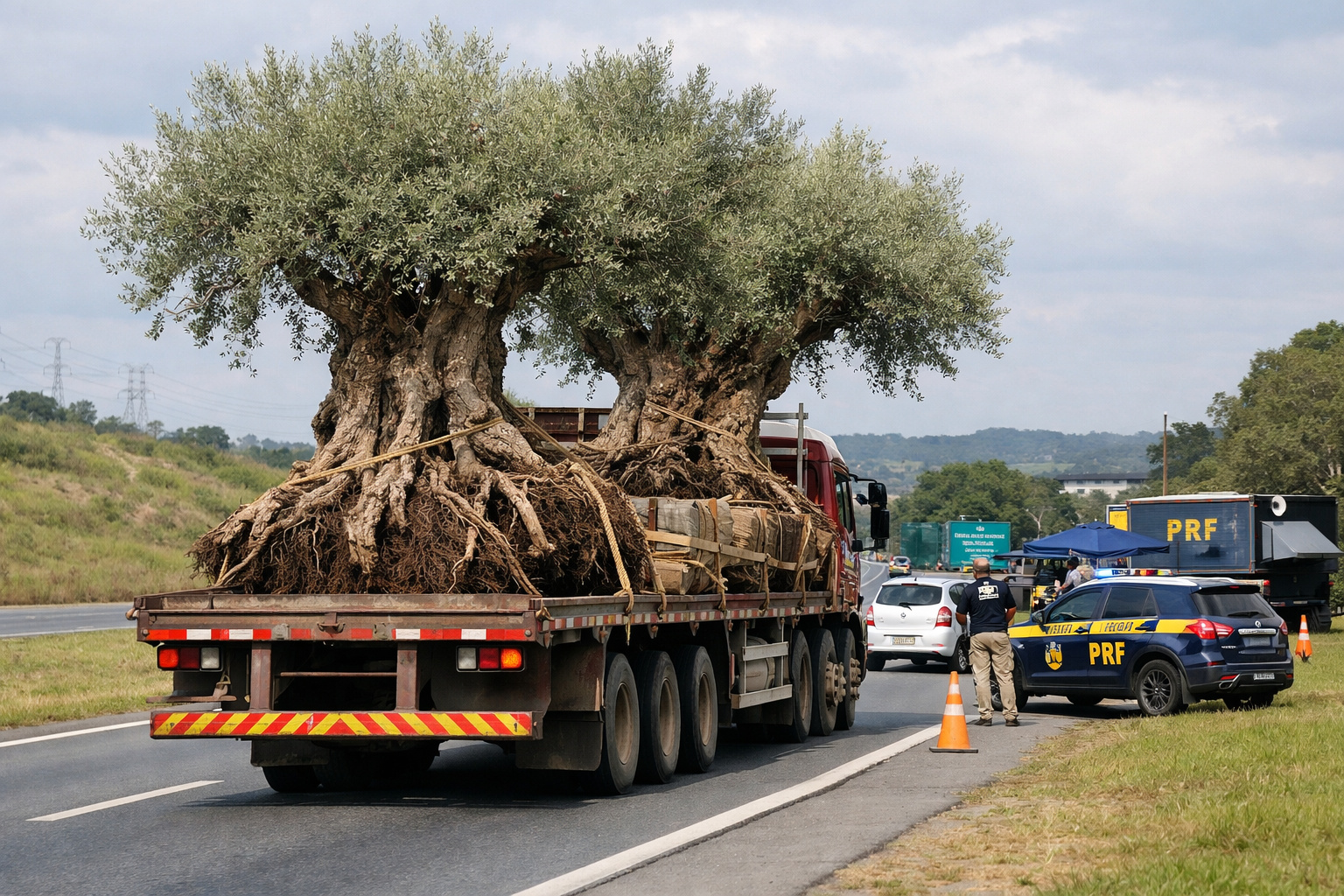

Historical and rare trees cross borders illegally while becoming status symbols in high-end landscaping projects in Brazil
The smuggling of century-old olive trees from Argentina to Brazil has ceased to be an isolated case and has begun to attract the attention of authorities and the luxury market. In recent months, this type of illegal operation has gained momentum, driven mainly by the high value of these trees and the growing demand in sophisticated landscaping projects.
The information was disclosed by “Gazeta do Povo”, which detailed recent seizures carried out by the Federal Highway Police (PRF), revealing a scheme that involves significant sums and complex logistics to transport extremely rare specimens of trees over 200 years old.
Seizures reveal a growing scheme at Brazilian borders

Last Sunday (12), the PRF seized six century-old olive trees in Maringá, in the interior of Paraná. The cargo, originating from smuggling, had left Argentina and was destined for the city of Herculândia, located in the Marília region of São Paulo.
-
Dairy Farm Prevents Manure Lagoon Overflow with High-Powered Tractors and Industrial Pumps, Turning 100,000 Gallons of Waste into Fertilizer

-
Masked Man Claims to Have Traveled to 2118, Predicts World War Starting with North Korea and Reveals Secret CIA Technology

-
At 54, Brazilian Artisan Turns Textile Waste into a Successful Handbag Brand, Earning Over $6,000 Monthly

-
Brazilian Entrepreneur Sells $50,000 Monthly in Sustainable Luggage Made from Recycled Bottles, Eyes International Market




However, the truck driver was unable to present the mandatory documentation required for this type of import. Among the required documents are the phytosanitary permit, laboratory reports proving the absence of pests, and customs clearance.
In light of the irregularity, he was arrested in the act, while the cargo was sent to a Federal Revenue yard. Furthermore, this type of occurrence is no longer rare: according to the PRF, more than a hundred olive trees have already been seized since last year, mainly in the border regions between Paraná, Santa Catarina, and Argentina, as well as on strategic highways in the interior of Paraná, such as Cascavel and Maringá.
Luxury market drives the smuggling of rare trees

The growth of this type of crime is directly linked to the high-end market in Brazil. This is because century-old olive trees have become key pieces in architecture and landscaping projects aimed at luxury residences and exclusive condominiums.
Specialized companies seek these trees to meet demanding clients, especially in states like São Paulo, Minas Gerais, and Goiás. As a result, the growing demand has significantly raised the value of these specimens.
In the regular market, a single centenary olive tree can cost around R$ 100 thousand. On the other hand, when acquired clandestinely, this cost can drop considerably, which ends up encouraging buyers and intermediaries to resort to the illegal market.
Moreover, the fact that many of these trees are over two centuries old further increases their symbolic and financial value, turning them into true living relics within landscaping projects.
Historical origin and excess supply in Argentina explain the phenomenon

Olive trees originate from the Mediterranean region and also the Middle East, traditionally associated with olive oil production, especially in countries like Spain. During the 17th century, these trees were brought to South America by Spanish colonizers, reaching Argentina, Chile, and Uruguay.
On the other hand, in Brazil, the cultivation of these species only gained significant scale in the 20th century. This historical difference helps explain why Argentina today has a large number of ancient olive trees available.
Currently, due to low productivity in some Argentine regions, many producers choose to replace these trees with more profitable crops. Consequently, this generates an abundant supply of centenary olive trees, which end up being sold in large quantities — often irregularly — to Brazil.
Thus, the perfect scenario for smuggling is formed: high supply of ancient trees, great demand in the Brazilian luxury market, and high prices that encourage illegality.
A lucrative market that raises environmental and legal alarms
Although the trade of these trees is highly profitable, it also raises important concerns. This is because irregular importation can bring phytosanitary risks, such as the introduction of pests and diseases that can affect national agriculture.
Moreover, the transportation and removal of these trees from their places of origin also generate significant environmental impacts. Nevertheless, the high market value remains the main driver of this type of crime.
Therefore, while the luxury market continues to drive demand for exclusive and historical elements, the smuggling of centenary olive trees is likely to remain a challenge for Brazilian authorities.