Portuguese
  Spanish



Understand how historical decisions, economic interests, and technical limitations created one of the world’s most confusing electrical systems — and why it still affects your routine
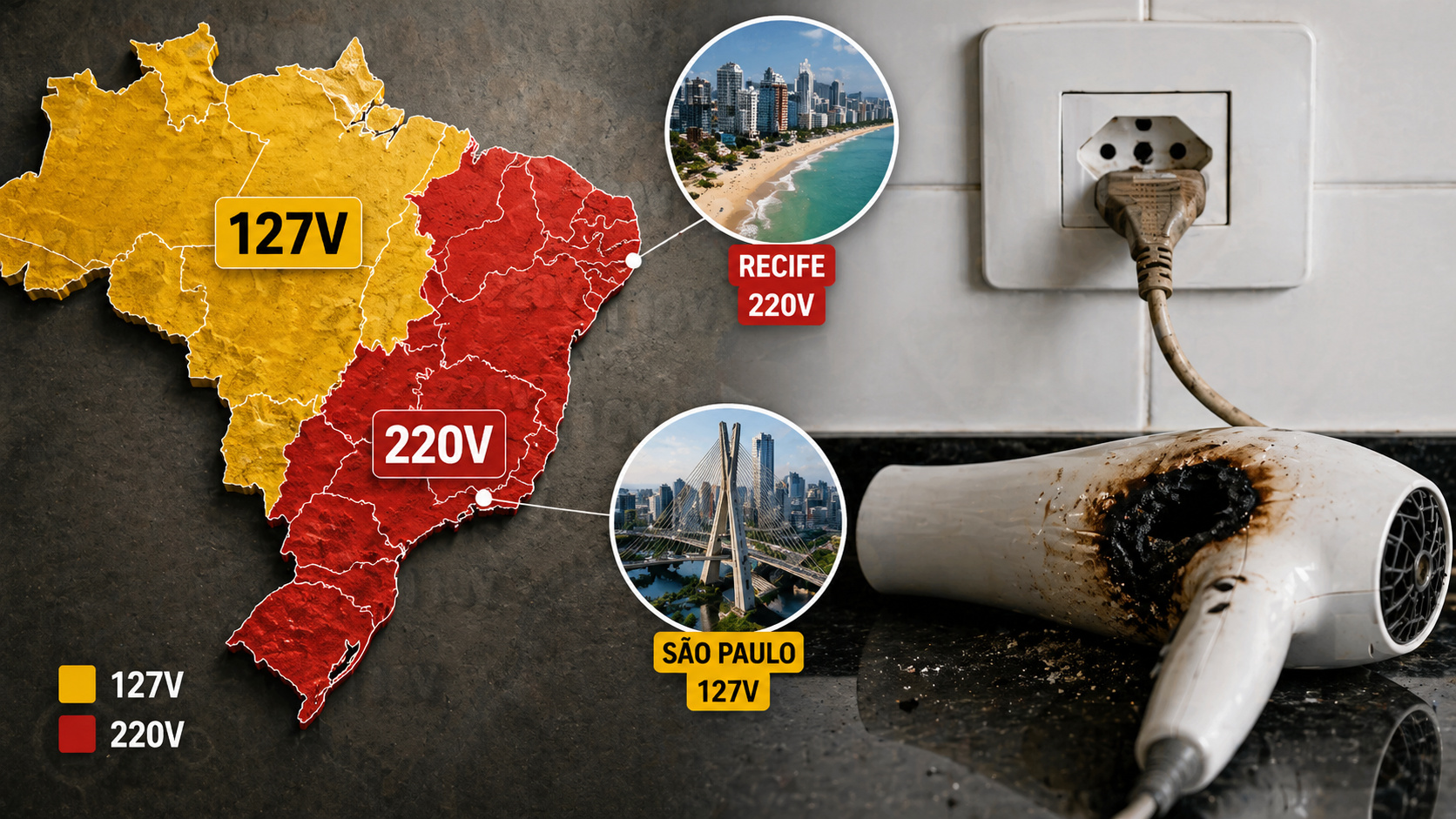
Have you ever noticed that two seemingly identical outlets can hide an invisible risk in Brazil? In cities like São Paulo and Recife, for example, plugging in the same hairdryer can result in completely opposite experiences: perfect operation in one, instant burnout in another. This happens because the country still deals with two distinct electrical standards — 127V (commonly referred to as 110V) and 220V.
While much of the Southeast and North operates on 127V, regions like the Northeast, South, Midwest, and the Federal District use 220V. In some cases, this duality reaches the extreme: there are cities where both voltages coexist on the same street — or even within the same house. The information was released based on historical data from the Brazilian electrical sector and analyses by energy engineering specialists.
But after all, how did Brazil reach this unique scenario in the world — and why has it never been corrected?
-
Ferrari, BMW, Tesla, and Chinese Automakers Shift from Copper to Aluminum Wiring to Reduce Weight and Costs in Electric Vehicles

-
Understanding Plastic Codes: Numbers 1 to 7 on Packaging Aid Efficient Recycling and Boost Circular Economy

-
400 km² of Greenhouses in Almería, Spain, Astonish American Visitor by Producing Millions of Tons of Produce for Cold-Weather Markets
-
Antarctic Volcano Emits Microscopic Gold Particles That Travel Up to 1,000 Kilometers Across the Continent



A historical dispute that shaped the Brazilian electrical system
To understand the origin of this division, we need to go back to the 19th century when electricity was still a novelty. The term “volt” was coined in honor of Alessandro Volta, creator of the first electric battery in 1800.
In the following decades, scientists like Michael Faraday discovered fundamental principles of electricity, including alternating current. However, it was Thomas Edison who turned electricity into a viable business by creating, in 1879, the first commercial distribution system based on 110-volt direct current.
Despite being functional, this system had serious limitations: it required power plants close to consumers and generated energy losses during transmission. The solution came with the use of transformers, a technology associated with alternating current, advocated by Nikola Tesla.
With the evolution of materials, especially the tungsten filament developed by William D. Coolidge in 1904, it became possible to work with higher voltages, such as 220 volts. While Europe adopted this standard from the start, the United States maintained the 110V system due to the already installed infrastructure.
Brazil: an electrified country without standardization
In the early 20th century, Brazil began its electrification — but without a unified national plan. Foreign companies played a central role in this process. Canadian companies like Rio de Janeiro Tramway, Light and Power, and São Paulo Light and Power implemented 110V networks in major cities.
On the other hand, regions electrified by European companies adopted the 220V standard. Thus, from the beginning, the country started to live with two distinct systems.
This division directly influenced the market. Manufacturers began producing appliances in two versions. Brazilian companies like Arno and Walita followed this logic, consolidating the duality as a national standard.
According to Ronaldo Roncolatto, engineering manager at CPFL Energia, the choice between 127V and 220V also involved economic factors: population density, material costs, and the extent of the electrical network.


Why do 127V and 220V still coexist today?
The technical explanation is simple — but counterintuitive. For an appliance to work, it needs energy, which is the result of the combination between voltage and current.
Voltage is the “force” of electricity. Current is the amount of electric charge that circulates. To deliver the same power, you can use:
- High voltage + low current (220V)
- Low voltage + high current (127V)
In the 127V system, the current is higher, requiring thicker wires — which increases costs and risks of overheating. In the 220V system, the current is lower, allowing for thinner and cheaper cables.
This explains why smaller cities, with more distant consumers, opted for 220V: it was more economical. Meanwhile, large urban centers, with high population density, maintained 127V.
The problem is that once installed, the electrical infrastructure is extremely expensive to replace. Unifying the system today would require billion-dollar investments — without sufficient benefits to justify the change.
Real risks: when voltage becomes a loss

This duality is not just a historical curiosity — it has practical consequences. In December 2024, for example, an operational error by Enel in São Paulo reconnected a condominium with the wrong voltage after a blackout.
The result? At least 35 apartments had their appliances burned out — including refrigerators, washing machines, and coffee makers.
Furthermore, recent data indicates nearly 400 deaths in 2025 related to electrical accidents in Brazil, many involving exposed high-voltage networks.
According to Professor Marco Antonio Saidel, from the University of São Paulo, the risk is not just in the voltage, but in the electric current that passes through the human body — and which increases proportionally with the voltage.
The future: why Brazil is unlikely to change
Today, many residences use bi-phase systems, allowing the use of 127V in common outlets and 220V in higher-power appliances, such as showers and air conditioners. This flexibility reduces some of the problems, but does not solve the lack of standardization.
In practice, Brazil continues to live with this “dual standard” as a legacy of historical decisions, economic interests, and technical limitations.
And all indications are that this won’t change anytime soon.