






 Portuguese
  Spanish
  5 min of reading
  0 comments


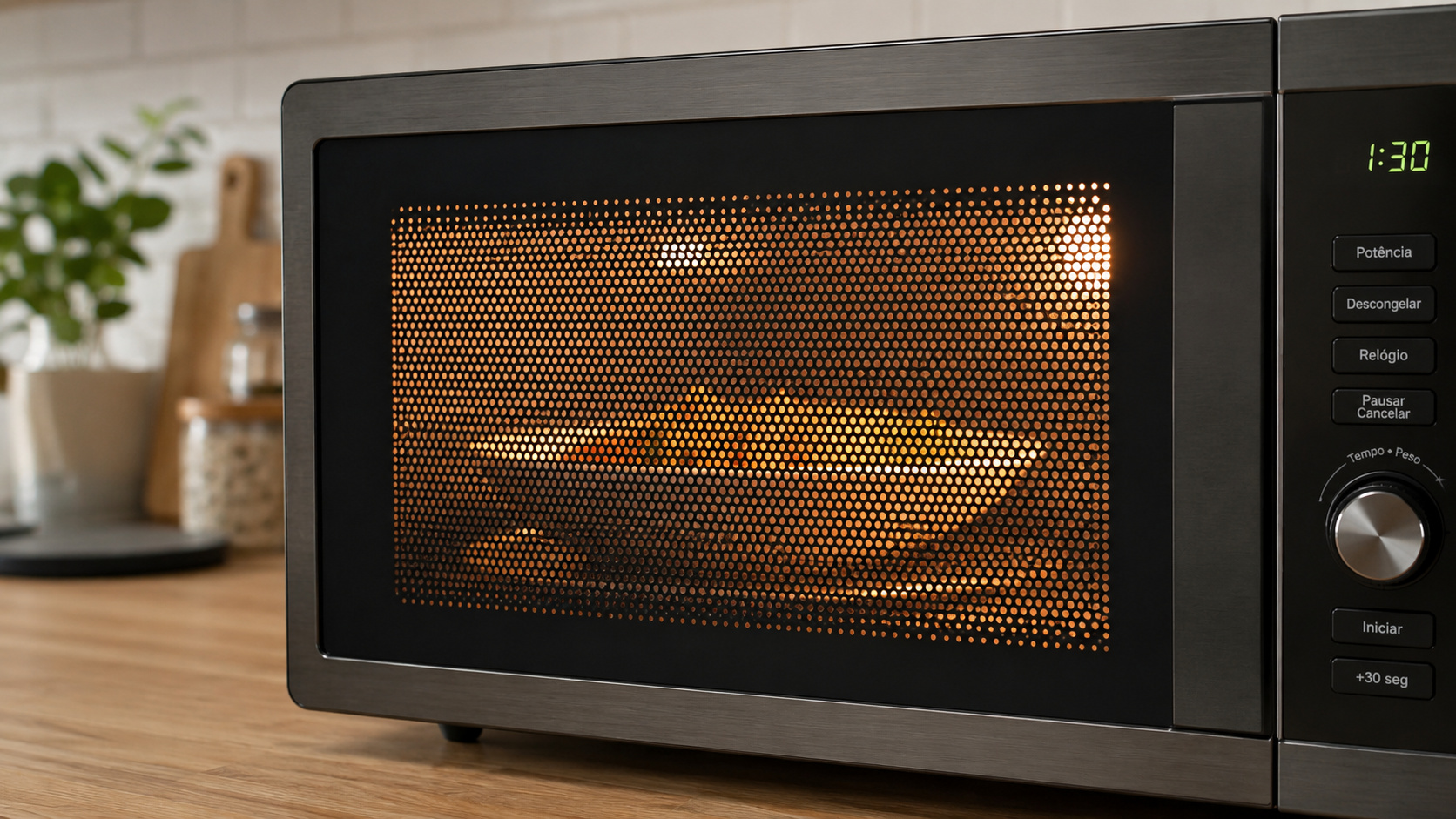
Understand why the perforated screen on the microwave door lets you see the food but prevents the microwaves from escaping and helps keep the appliance safe.
Almost everyone has watched food spinning inside the microwave through the door window. What many people don’t realize is that this window is not just made of glass or transparent plastic. Between the user and the interior of the appliance, there is a perforated metal screen, and it plays a central role in the safety of the appliance.
This detail was not placed there for aesthetics. It is part of the engineering that allows the microwave to heat food efficiently while preventing the energy used in heating from escaping into the environment. Without this structure, it would be much more difficult to combine visibility, containment of microwaves, and safe operation in the same appliance.
Microwave heats food with non-ionizing radiation reflected inside the metal cavity
According to the FDA, the microwave oven works by producing microwaves, a form of non-ionizing electromagnetic radiation, similar to radio waves. Inside the appliance, a component called a magnetron generates this energy, which is reflected by the metal walls of the cavity and absorbed by the food.
-
About 700 residents live inside the crater of an active volcano in Cape Verde, with houses and vineyards spread over the already solidified lava. With each eruption that buries the village, the population returns and rebuilds everything in the same place, in one of the most extreme settlements on the planet.

-
Workers removed old panels from a Scottish lighthouse and found a hidden bottle with a message from 1892, names of engineers, lighthouse keepers, and details of a lens used to guide ships.

-
Your child may be gifted and you don’t even suspect it: experts warn that even low grades and disinterest in school may hide high abilities behind boredom.
-
An old telephone booth was removed during construction at an English station and ended up revealing tunnels under platform 4, with hidden rooms connected to the railway logistics of another era.



When this energy primarily hits the water molecules present in the food, it causes molecular vibration and generates heat. This process allows meals to be heated in a few minutes. The energy does not turn the food into something radioactive. It is simply converted into heat as it is absorbed.
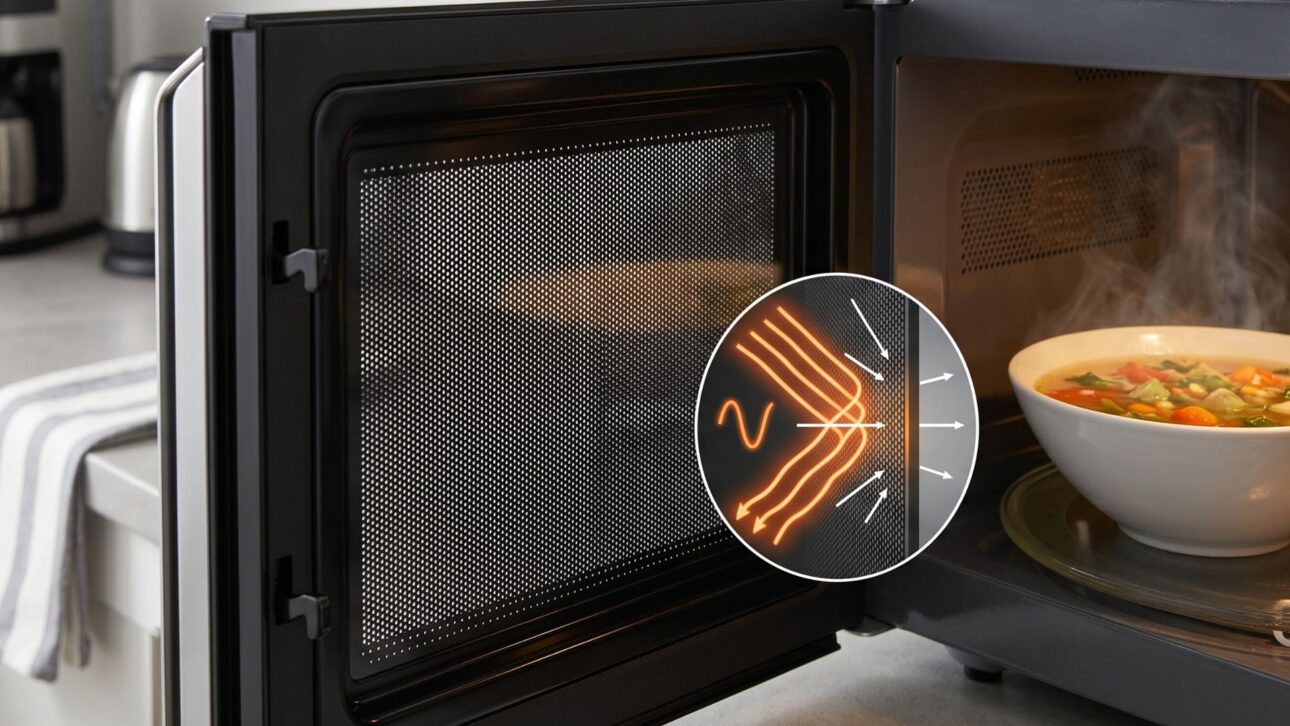
The FDA itself highlights three central characteristics of the microwaves used in these appliances: they are reflected by metal, pass through materials like glass, paper, plastic, and ceramic, and are absorbed by food. It is precisely in this combination that the microwave door was designed.
The metal screen on the door reflects energy and prevents microwaves from passing through the window
According to GE Appliances, the microwave door has a metal mesh specifically designed to allow viewing of the interior while simultaneously reflecting microwave energy, preventing it from passing through the window or the plastic layer of the door.
GE Appliances also explains that the door includes other elements besides the mesh, such as a protective plastic layer, a containment structure around the door called a choke seal, and multiple safety switches. These components work together to keep the energy confined within the oven cavity.


In practice, the perforated screen functions as part of the appliance’s metal shielding. The energy used to heat the food continues to circulate where it should, inside the microwave, while the window maintains the function of allowing the user to monitor the food preparation.
Light passes through the holes, but microwaves remain contained within the appliance
The reason for this difference lies in the scale. The microwaves used in household ovens are much larger, in terms of wavelength, than visible light.
Since the mesh holes are extremely small compared to the wave used in heating, the energy does not pass through the screen in a relevant way and ends up being reflected back inside the appliance. However, visible light can pass through the holes and reach our eyes.
This is why the microwave door creates an apparently curious situation. The user can see the food normally, but the energy responsible for heating remains confined inside the oven. This is one of the most discreet and intelligent examples of engineering applied to a household appliance.
GE Appliances also emphasizes that the plastic layer on the inside of the door should not be removed. It exists precisely to prevent interference with the metal screen. If this protection is damaged, the recommendation is not to use the appliance until a technical evaluation is performed.
Microwave door has lock, seal, and strict federal limit for potential leakage
According to the FDA, there is a federal safety standard that limits microwave energy leakage over the appliance’s lifetime to 5 milliwatts per square centimeter at about 2 inches, approximately 5 centimeters, from the oven’s surface. The agency highlights that this value is well below the level known to cause harm to people.
The FDA also states that manufacturers are required to install two independent interlock systems that stop microwave production as soon as the door is opened or the lock is released. Additionally, there is a monitoring system to stop operation if one of these mechanisms fails.
This shows that the safety of the device does not rely solely on the perforated screen. It depends on the combination of metal mesh, door seal, protective layer, mechanical lock, and electrical interlocks, all designed to prevent significant energy leaks during normal use.
The screen full of small holes is one of the most discreet and intelligent solutions in domestic engineering
The metal mesh on the microwave door seems simple because it has been so naturally incorporated into the product that almost no one stops to think about it. But its function is sophisticated. It simultaneously solves two challenges that might seem incompatible: allowing the user to see the food and keeping the heating energy trapped inside the appliance.
Without this solution, the microwave would lose efficiency, safety, and practicality. The door could not function as it does today, and the everyday use of the appliance would be much less intuitive. That is precisely why those small holes are not a decorative detail. They are a central part of the design.
Next time you watch the food spinning inside the oven, remember that visibility exists because engineering found an elegant way to let light pass without letting microwaves escape.








Be the first to react!