Portuguese
  Spanish


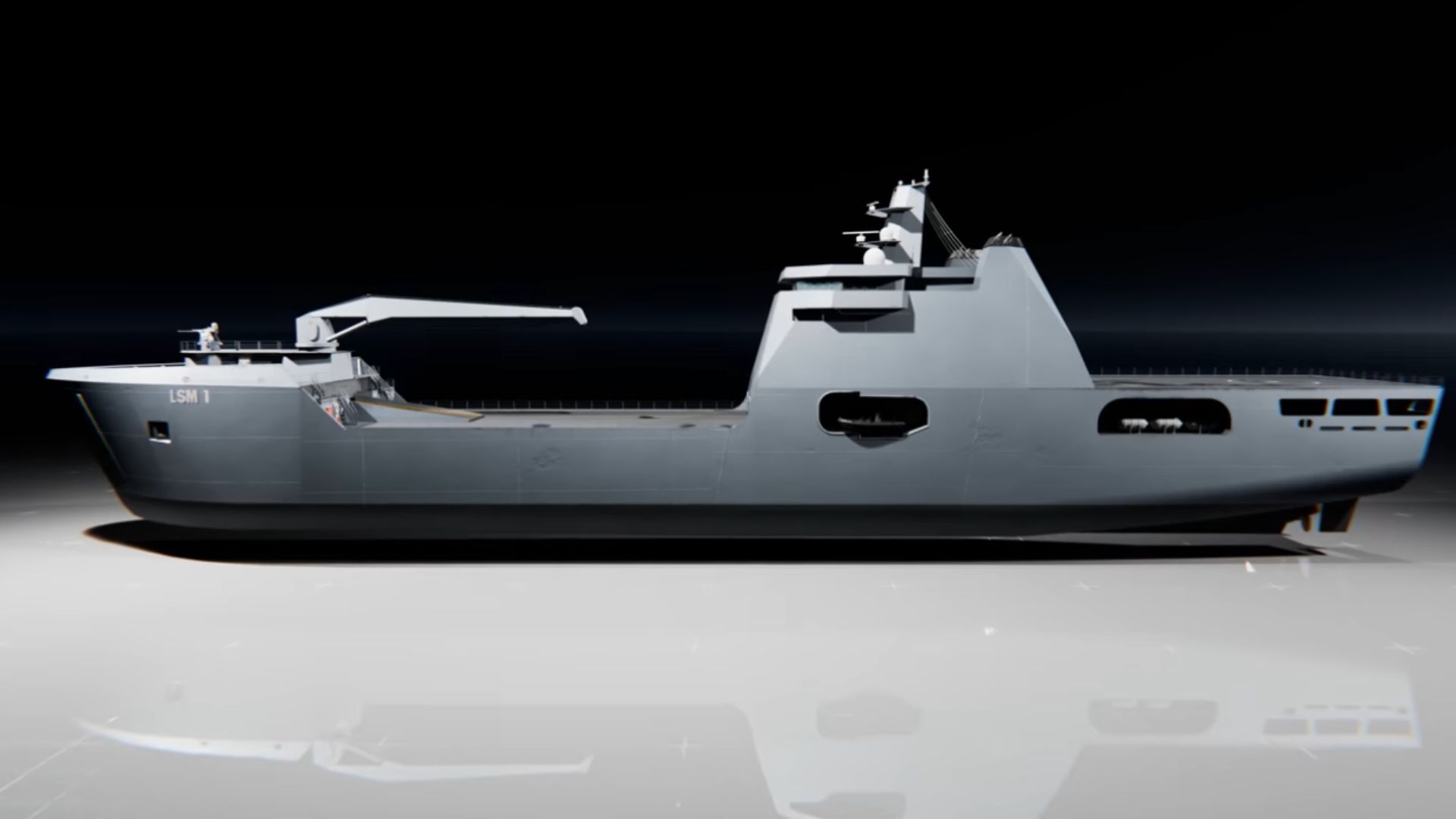

In an increasingly unpredictable war scenario, the vessel bets on extreme mobility, silent operations, and decentralized logistics to ensure strategic advantage in disputed regions
Modern warfare is changing — and with it, the way the world’s major military powers prepare for future conflicts. In this context, the United States Marine Corps presented a new vessel concept that completely breaks from the traditional standard. Instead of relying on overt power, the new Medium Landing Ship (LSM) emerges with a silent, strategic, and highly efficient proposal.
The information was disclosed by “Sofrep”, based on an official video from the U.S. Marine Corps, which reveals unprecedented details about the vessel and its role in operations in the Pacific, one of the most tense regions on the planet today.
Unlike the naval giants that have dominated the oceans for decades, the new ship does not impress with size or visible armament. However, it is precisely this characteristic that makes it a potentially revolutionary piece within contemporary military strategies.
-
Brazilian Navy Demonstrates Strength in Naval Exercise with Over 20 Nations, Deploys Frigate Independência in Anti-Submarine and Air Defense Scenarios, and Joins Historic Formation with 26 Ships from 14 Allied Navies off the U.S. Coast

-
BAE Systems to Supply New Bofors 40Mk4 Cannons to the Brazilian Navy
-
Ukraine Bets on Swedish Gripen E Jets to Counter Russia, But 16 Fighters Won’t Arrive Until Late 2020s; Kiev to Use C/D Models for Pilot Training and Operations Amid Ongoing Missile and Drone Threats
-
End of an Era: US Navy’s C-2A Greyhound Makes Final Catapult Launch Before Retiring to Arizona Desert; Aircraft Supported Carriers in Wars and Humanitarian Missions for Nearly 60 Years


100-meter ship that does not require ports could completely change the logic of military operations
Unlike traditional warships, the Medium Landing Ship was designed with a completely different logic. Based on the Landing Ship Transport 100 model, developed by the Damen Shipyards group, the ship is approximately 100 meters long and has the capacity to transport over 800 tons of cargo, including military vehicles and long-range attack systems.
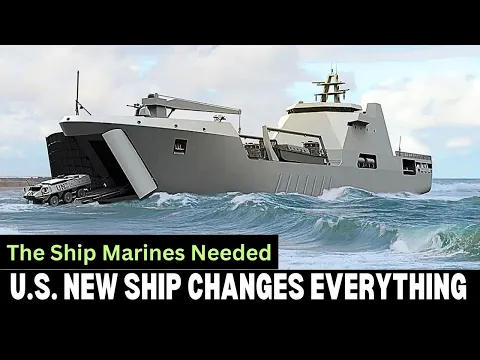
Moreover, the major differentiator is its ability to operate without any fixed infrastructure. In other words, the ship can simply ground directly on unprepared beaches, eliminating the need for ports or logistical bases.
Consequently, this characteristic completely changes the game. In modern combat scenarios, ports are easy targets for surveillance and attacks. Therefore, by eliminating this dependency, the LSM drastically reduces its vulnerability.
Additionally, this mobility allows for rapid, unpredictable, and highly decentralized operations — a factor considered essential in regions like the Indo-Pacific, where the competition for territory and influence is constantly growing.

Distributed warfare strategy gains momentum and places logistics at the center of the conflict
On the other hand, the introduction of this new ship is not just a technological innovation — it represents a profound change in the military doctrine of the United States.
For decades, amphibious operations have been based on large formations and concentrated attacks. However, this model has been increasingly questioned in the face of modern threats, such as long-range missile systems and advanced surveillance.
In this way, the concept of distributed operations emerges, in which small units move independently, making detection difficult and increasing survival on the battlefield.
In this scenario, the Medium Landing Ship becomes essential. It functions as a mobile logistical bridge, allowing for the constant movement of troops, equipment, and armaments between islands and coastal regions.
Moreover, its ability to enter and exit high-risk areas quickly reinforces its utility in maritime denial operations, a strategy aimed at preventing the advance of enemy forces in certain regions.
Stealth ship may be more decisive than large vessels in future conflicts
Interestingly, the new Marine Corps ship represents a reversal of values within naval warfare. Instead of relying on brute force and visibility, the strategy now values discretion, flexibility, and persistence.
In other words, the goal shifts from winning a single decisive battle to remaining operational longer than the adversary.
In this sense, the LSM fits perfectly into a scenario where war will be defined by logistical resilience and adaptability.
Therefore, although it may not attract attention at first glance, this vessel could play a crucial role in future conflicts, especially in the Pacific, where geopolitical disputes involve global powers and require increasingly sophisticated solutions.