Portuguese
  Spanish


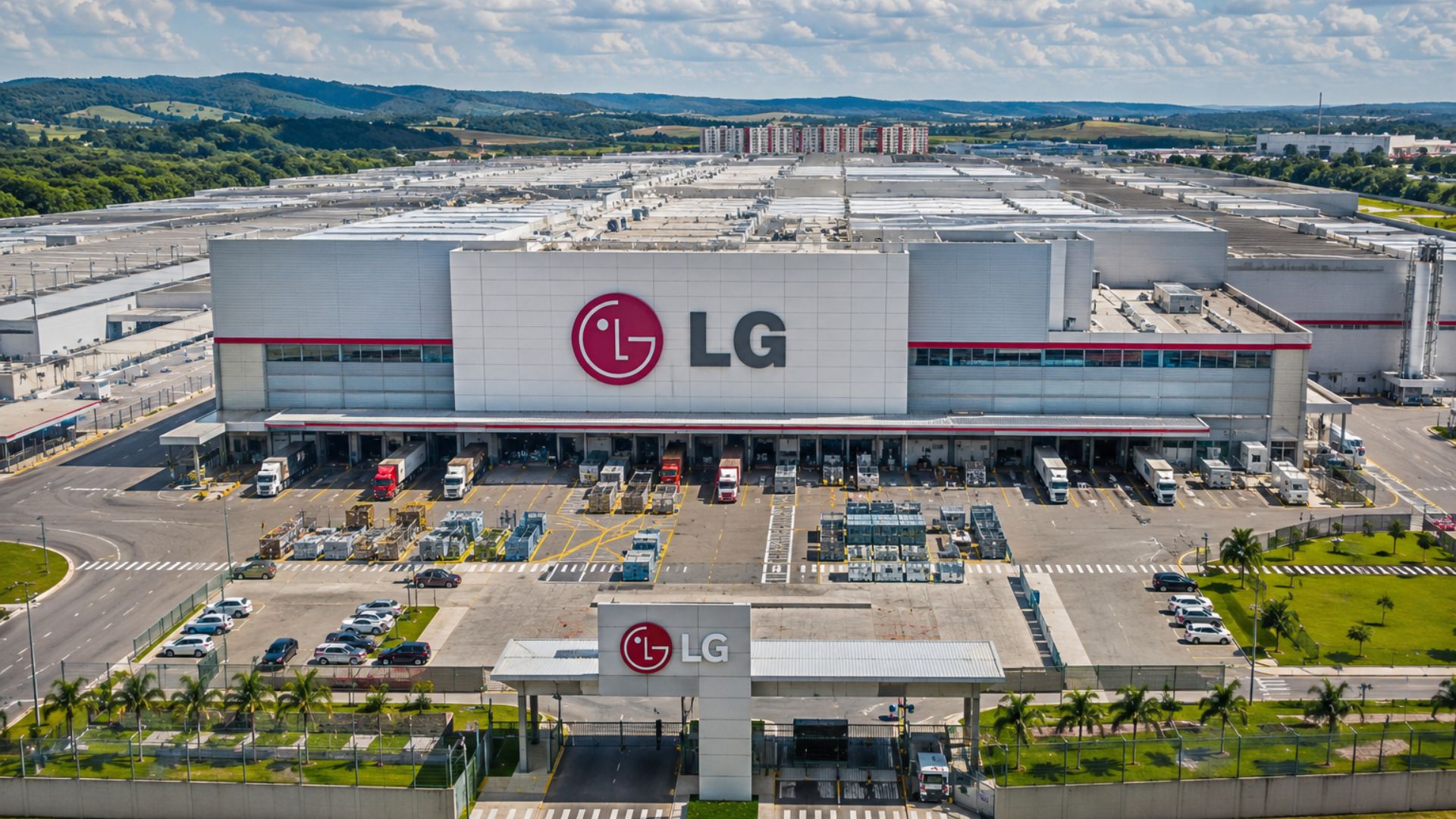

LG’s billion-dollar investment in Paraná accelerates the brand’s industrial expansion in Brazil, strengthens competition in the white goods market, and raises employment expectations in Fazenda Rio Grande, the city chosen to host one of the company’s largest production units in South America.
LG Electronics confirmed the installation of a new factory in Fazenda Rio Grande, in the Metropolitan Region of Curitiba, with an estimated investment of R$ 2 billion and operations scheduled to begin in July 2026.
The unit will initially focus on refrigerator production and is part of the South Korean multinational’s strategy to expand its presence in the home appliance sector in Brazil.
The announcement reinforces the company’s industrial expansion movement in the Brazilian market, considered one of the most relevant in Latin America for the white goods segment.
-
Brazilian City Makes Remarkable Leap, Becomes 4th Wealthiest in the Country with GDP of R$ 134.1 Billion

-
Controversial 6-day Workweek Elimination in Brazil Faces Economic Criticism Over Productivity Claims

-
Itaú to Refund Customers After 14 Years of Unauthorized Credit Card Charges; Agreement Includes No Interest or Adjustments, Deadline by 2028, with Potential Impact of Up to $6.5 Billion

-
Brazilian Company Grows from Bartering Soap for Food to Producing 30 Million Units Monthly, Challenges Global Giants with $100 Million Revenue and Expands into Premium Cosmetics



The company’s expectation is to expand local production capacity and accelerate the distribution of home appliances manufactured in the country.
The decision to install the factory in Paraná was also interpreted by industry representatives as a sign of strengthening national industry, especially at a time of increased competition between traditional manufacturers and Asian multinationals.
In addition to expanding its presence in Brazil, LG intends to use the structure to meet part of the regional demand in South America.
The industrial plant is being built on an area of approximately 770 thousand square meters and is expected to become one of the company’s main production hubs in South America.
In a second phase, the company plans to include washing machines and clothes dryers in the production line, expanding the local manufacturing of so-called white goods items.
The structure planned by the multinational will allow for gradual expansion of operations without the immediate need for a new industrial unit.
The forecast is that investments will be applied to industrial equipment, logistics, production technology, and operational infrastructure.
Refrigerator production will be a priority at LG’s new unit

The first phase of operation will focus on assembling refrigerators, a segment in which the company seeks to gain more market share in Brazil.
Local production tends to reduce logistical costs and make the company more competitive against brands already established in the country.
The disclosed plan foresees the unit expanding to other large home appliances in subsequent years.
With this, LG intends to expand its portfolio manufactured in Brazil and reduce its dependence on imported products to supply part of the national demand.
Manufacturing in Brazilian territory can reduce delivery times and costs related to the transport of finished products, a scenario considered strategic for increasing retail competitiveness.
Local production also facilitates specific adaptations for the Brazilian market, including models developed according to consumption habits and energy demand.
In recent years, the home appliance sector has undergone significant changes in the country, driven by the growing demand for more efficient and connected appliances.
With the new plant, LG seeks to increase its participation precisely in segments considered priorities within this market transformation.
Fazenda Rio Grande expects job creation with LG’s arrival
According to the Fazenda Rio Grande City Hall, the new factory is expected to generate approximately one thousand direct jobs when fully operational.
During the construction phase, more than 200 workers were active on the industrial plant’s construction site.
Opportunities are expected to focus on areas such as production, logistics, maintenance, administration, and transport.
The arrival of the unit may also boost services linked to the industrial chain, although indirect job numbers have not been reliably confirmed.
Companies linked to cargo transport, parts supply, technical maintenance, and industrial food services may be impacted by the economic movement generated by the new operation.
Local authorities also expect an increase in municipal revenue and the strengthening of the industrial sector in the metropolitan region of Curitiba.
Fazenda Rio Grande has been registering industrial growth in recent years and seeks to attract new investments to expand the generation of formal jobs.
The installation of a large LG factory is seen as one of the main recent industrial projects announced for the municipality.
LG expands industrial presence in Brazil with factory in Paraná
The new plant in Paraná will be LG’s second industrial unit operating in the country.
The company already maintains operations in the Manaus Free Trade Zone, where it manufactures televisions, monitors, and air conditioning equipment.
The company also had, in the past, a factory in Taubaté, in the interior of São Paulo, focused on cell phone production.
The operation was closed after LG’s exit from the global smartphone market.
Even after leaving this segment, the company maintained investments in other areas considered strategic, including televisions, air conditioning, and home appliances.
The expansion of the Brazilian industrial structure precisely reinforces the company’s bet on products aimed at the domestic environment.
The white goods market remains among the most relevant for international manufacturers operating in the country, especially given the size of the Brazilian population and the continuous demand for appliance renewal.
White goods market gains new chapter with billion-dollar investment
The investment reinforces LG’s presence in a sector disputed by traditional home appliance manufacturers in Brazil, such as Brastemp and Electrolux.
By producing refrigerators, washing machines, and dryers in national territory, the multinational seeks to gain scale and improve its position in the domestic market.
The installation in Fazenda Rio Grande also strengthens Paraná’s industrial presence in the white goods segment.
The choice of the city was associated by the company and local public authorities with its logistical location, regional infrastructure, and business environment.