Portuguese
  Spanish


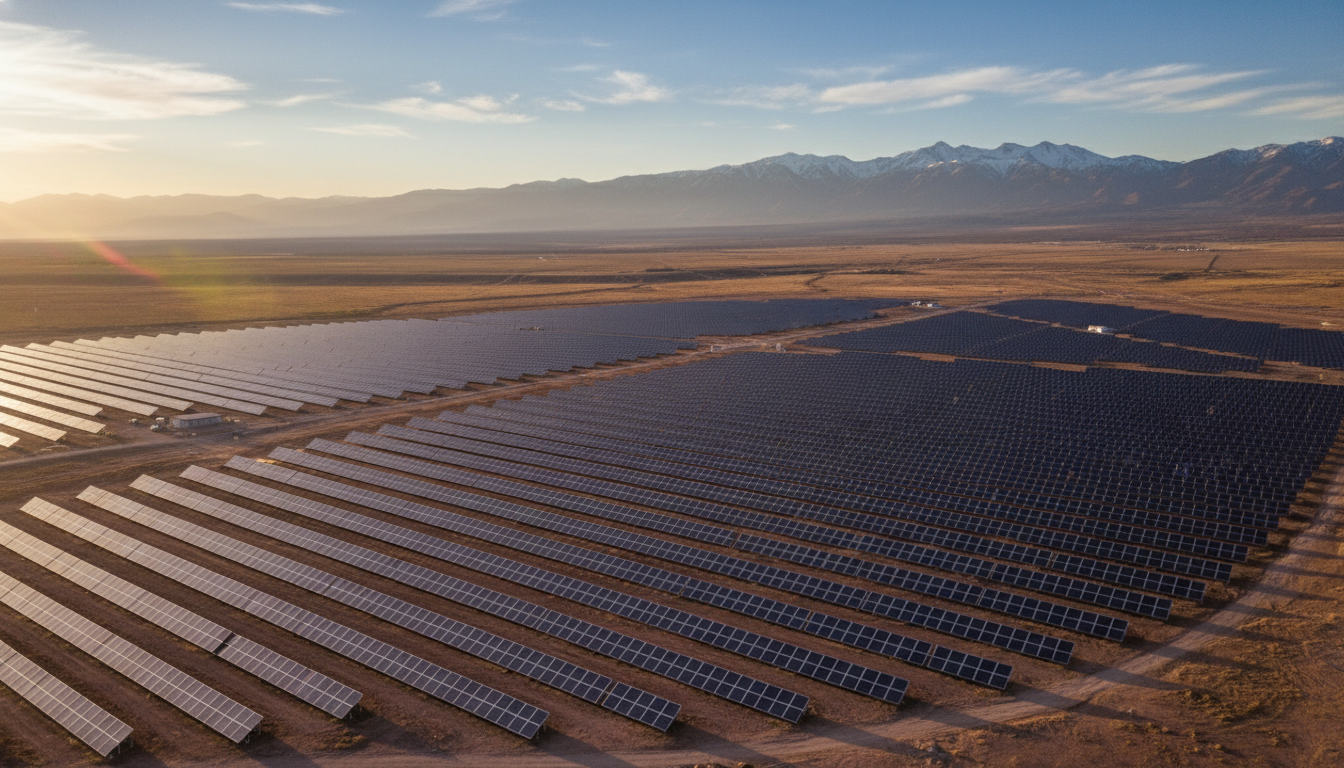

YPF Luz inaugurates park in Mendoza with 360 MW and 511 thousand bifacial panels
On May 15, 2026, the Argentine company YPF Luz inaugurated the solar park El Quemado in the department of Las Heras, in the province of Mendoza.
As reported by pv magazine International, it is one of the largest photovoltaic farms in operation in Argentina.
The complex has an installed capacity of 360 megawatts. It features more than 511 thousand bifacial solar panels spread over 620 hectares at the foot of the Andes Mountains.
-
Driver Crosses 100-Year-Old Railway Bridge Over Uruguay River, Encounters Rural Couple Preserving Traditional Farming Methods

-
Rural Producer Returns to Brazilian Farmland, Builds Family Agricultural Business with Children’s Support and Industry Backing
-
Goiás Couple Boosts Artisan Cheese Production from 25 to 70 Kilos Daily with Technical Support, Transforming Family Life in Rural Brazil
-
13-Year-Old Discovers Ancient Roman Ring Near Mount Carmel, Now Set for Display in Jerusalem




According to YPF Luz, the total investment in the project amounts to US$ 220 million.
The construction lasted 18 months, with a peak of 350 workers employed — 87% local labor.
El Quemado in Las Heras will supply the city of Mendoza and two neighboring departments
The solar complex is located in the department of Las Heras, Cuyo region. The energy generated supplies the city of Mendoza and the departments of Las Heras and Lavalle.
On the other hand, the chosen site offers ideal conditions for solar energy. The region records more than 300 sunny days per year and low cloudiness.
According to the feasibility study, the capacity factor reaches 31.4%. This is a high number for industrial-scale photovoltaic parks.
Park combines 511 thousand bifacial panels with 5,800 solar trackers and 1,170 inverters

The park’s architecture combines three main systems. Firstly, bifacial panels capture light both from the front and the rear side, reflected from the ground.
Similarly, 5,800 solar trackers adjust the inclination of the modules throughout the day. Then, 1,170 inverters convert direct current into alternating current for the grid.
As a result, the setup increases production by up to 12% compared to a park with fixed panels.
According to industry data, it is the most advanced technical configuration currently available on a commercial scale in Argentina.
Connection to the SADI network goes through GIS substation and 40 transformer stations
The photovoltaic farm integrates into the Argentine Interconnection System (SADI). According to the project design, the connection uses a main substation with GIS (Gas Insulated Switchgear) technology.
In other words, the GIS type allows for less space and greater safety than conventional open substations. Therefore, it is the international standard for large renewable parks.
Additionally, 40 secondary transformer stations distribute the generated energy before sending it to the main grid.
At that moment, the infrastructure enables future expansions if YPF Luz decides to expand the park.
- Capacity: 360 MW installed
- Panels: more than 511 thousand bifacial modules
- Area: 620 hectares (~870 soccer fields)
- Solar trackers: 5,800 units
- Inverters: 1,170
- Investment: US$ 220 million
- Construction: 18 months, 350 workers (87% local)
Emesa started the project and YPF Luz completed the construction of the El Quemado park

The project started with Emesa, the provincial energy company of Mendoza. According to the project’s history, YPF Luz later acquired the development and completed the construction.
In comparison, other Argentine provinces like San Juan and Salta are also investing in photovoltaic parks. On the other hand, Mendoza remains a regional hub with a diversified matrix.
In fact, Argentina increased its renewable capacity by more than 50% between 2020 and 2025.
As a result, the country is advancing its goal of decarbonizing the electricity sector by 2030.
Brazil also invests in large-scale solar parks like NEOM and NHF
Brazil maintains strong expansion of the solar matrix. According to data from Aneel, the country surpassed 50 gigawatts of photovoltaic capacity in 2025.
Compared to Argentina, Brazil has similar irradiation conditions in the Northeast.
Other major global energy projects include the launch of SpaceX’s Dragon CRS-34 on May 13, which involves solar panel systems in orbit.
Similarly, the region of Petrolina (PE) and Piauí hosts complexes of up to 1 gigawatt in operation.
At that moment, Brazil ranks tenth worldwide in installed solar capacity.
Next steps: YPF Luz plans to add batteries and expand the solar park’s capacity

YPF Luz is studying the expansion of the park with the addition of storage systems. Next, the goal is to include lithium batteries to regularize supply during the night.
According to the company, the next phase could add 100 MW of capacity. On the other hand, it depends on regulatory approval and financing lines.
According to the sector, Argentina has the third largest solar potential in Latin America. Therefore, projects like the development in the Andean region gain strategic regional relevance.
There are recognized limitations. Argentina’s economic volatility affected the schedules of other renewable projects.
In other words, historical inflation complicated long-term contracts. According to market data, several proposed parks underwent revisions in 2023 and 2024.
Similarly, international financing still requires specific guarantees. Therefore, projects like El Quemado depend on the country’s macroeconomic repositioning.
On the other hand, the push given by YPF Luz shows that parks of more than 300 MW remain viable. At that moment, the Argentine sector sends a positive signal to foreign investors.
According to regional analysts, new investments in solar energy generate direct and indirect jobs.
According to estimates from the Argentine Ministry of Energy, each 100 MW of installed solar mobilizes about 600 jobs during construction.
Compared to Chile, the main Latin American solar producer, Argentina still has reduced photovoltaic capacity. Therefore, the government’s goal is to double the installed base by 2030.
Will the recent inauguration of El Quemado consolidate Mendoza as Argentina’s new solar hub? The answer will begin to appear in the next regulatory auctions scheduled for the second half of 2026.
Will the recent macroeconomic stabilization allow Argentina to maintain the photovoltaic expansion pace we saw at El Quemado? The next decade will provide the answer.