






 Portuguese
  Spanish
  5 min of reading
  0 comments


Anthony Lima Dias, a 10-year-old student from Educandário Santa Therezinha, in Jequié, created an alternative method of multiplication during an evaluation on August 27, 2025. The reasoning was analyzed by teachers, formalized in a technical article, and recognized by the Municipal Chamber for the young man’s creativity and dedication to studies.
A case of multiplication within a school test drew attention in Jequié, Bahia, after Anthony Lima Dias, then 10 years old, found a different way to solve calculations in base 10. The reasoning emerged during a Mathematics evaluation conducted on August 27, 2025.
The story gained public recognition on April 29, 2026, when the Municipal Chamber of Jequié announced that councilman Duda Simões honored Anthony through a Motion of Applause. The student, a native of Jequié, is a student at Educandário Santa Therezinha and had the method associated with a formal demonstration in a technical article.
Discovery began within a Mathematics evaluation
According to the Municipal Chamber of Jequié, Anthony spontaneously created a different reasoning during a school evaluation. Instead of just following the traditional multiplication procedure, he reorganized the calculation in his own way, seeking a simpler way to reach the result.
-
Florida begins sending robotic rabbits to the Everglades swamps, where they mimic prey, use cameras, AI, and sensors to attract and locate invasive pythons hidden in the mud and vegetation.

-
Engineers in Brazil deploy a robot dog to enter pipelines of a R$ 134.7 million project, facing mud, sand, humidity, and toxic gases, and send data in real-time without exposing workers.
-
Brazilian family creates machine that transforms seawater into fresh water, produces up to 130 liters per hour, facilitates routine on vessels, and boosts family business along the country’s coast.
-
A doctor from Minas Gerais warns that sleeping with the fan pointed at the body all night is not as harmless as you think; it dries out the respiratory tract, causes mucus buildup, spreads dust mites, and can even irritate the cornea of the eyes.



The episode was not confined to the classroom. Upon arriving home, Anthony told his mother, Mábia Lima Chaves dos Santos, and his brother, Albert Lucas Lima Dias, that he had used a different method. From there, the family asked him to demonstrate the procedure on paper.
Family noticed something was out of the ordinary
In the report presented in the technical article, Anthony redid one of the calculations used in the evaluation, the multiplication 162 × 162. The family found the organization of the calculation strange because they did not recognize the traditional model taught at school.
After that, the procedure was tested with other numbers. The results continued to match the expected products, which led the family to record the demonstration on video. This step was decisive for the domestic curiosity to turn into a more structured mathematical investigation.
Video reached the school teacher
Anthony’s mother recorded videos of her son solving multiplications and sent the material to Ib Couto, a teacher associated with Educandário Santa Therezinha. The goal was to verify if that reasoning corresponded to any procedure already taught or known by the school.
According to the technical report, the teacher deemed it necessary to validate the method with someone who could continue the analysis. From this referral, the case reached Professor Dr. Marcus Vinícius da Conceição Morro, from the Federal Institute of Rondônia, who participated in the mathematical formalization.
Method reorganizes partial sums in base 10
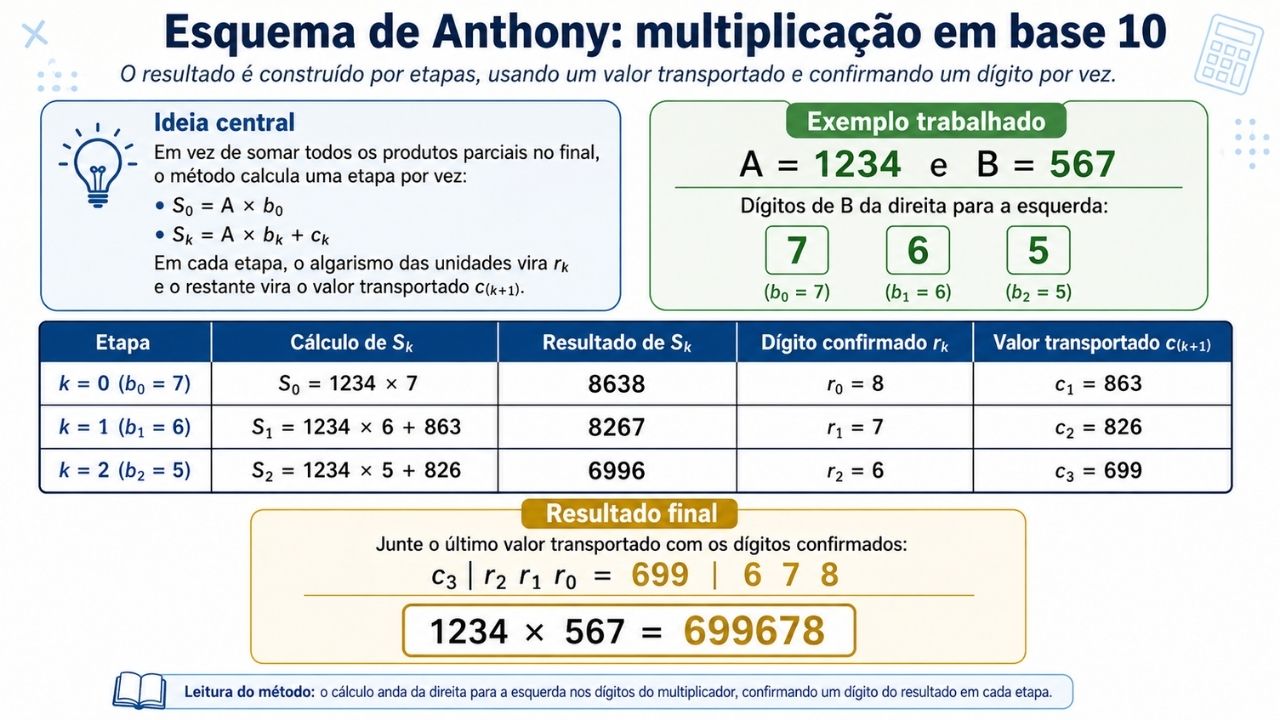
The technical article presents the procedure as an alternative algorithm for multiplication in base 10. In simple terms, the method reorganizes the interactions between the digits into a structured sequence of partial sums.
The difference from the traditional algorithm lies in the way partial products and carried values are handled. Instead of storing multiple lines to sum everything at the end, the method builds the result incrementally, confirming digits throughout the process.
Technical article brought formal demonstration
The technical work, titled “Formal Demonstration of an Alternative Algorithm for Multiplication in Base 10,” presents the method, defines notations, and demonstrates its mathematical correctness. Among the authors are Anthony Lima Dias, Albert Lucas Lima Dias, Ib Couto, Mábia Lima Chaves dos Santos, and Marcus Vinícius da Conceição Morro.
The demonstration shows that the procedure produces the same result as conventional multiplication for natural numbers in base 10. This point is important because it separates curiosity from technical recognition: it was not enough to seem to work, it was necessary to mathematically prove why it worked.
Comparison with the traditional algorithm explains the difference
In the traditional method, the student usually calculates partial products, shifts them according to the decimal position, and adds them at the end. This process is efficient but may require more visual organization and working memory, especially for children in the learning phase.
In the alternative algorithm described in the article, the calculation keeps only the carried value and the already confirmed digits of the result. The research itself states that this can reduce cognitive load and allow for more reliable mental or semi-written calculation in certain cases.
Child creativity became a public agenda in Jequié
The Municipal Chamber of Jequié highlighted Anthony’s creativity, dedication to studies, and contribution to mathematical knowledge. Councilman Duda Simões stated that the initiative highlights the potential of new generations and serves as an inspiration for students, teachers, and the community.
Anthony is the son of Mábia Lima Chaves dos Santos and Antônio Dias dos Santos, brother of Albert Lucas Lima Dias, and a student at Educandário Santa Therezinha. The public tribute placed a school discovery in an institutional space, bringing together basic education, family, teachers, and local recognition.
Care is not to turn the case into an exaggeration
Anthony’s case is relevant because it shows mathematical creativity and the formalization of an alternative algorithm. Even so, the correct reading is careful: the article does not claim that the method replaces all traditional teaching nor that it eliminates the importance of the algorithms already used in the classroom.
The value of the story lies in showing that a child can reorganize a known idea in an original way. In education, this matters because it reveals different cognitive paths for learning arithmetic, especially when teachers and family members observe the solution instead of discarding it for deviating from the standard.
Mathematics education benefits when it listens to the student’s reasoning
The story also raises a larger discussion about how schools deal with unexpected answers. In many exams, the focus is usually only on the final result; in this case, the path used by Anthony caught attention precisely because it did not follow the expected routine.
When a teacher observes the process, and not just the answer, they can identify creative strategies. The multiplication done by Anthony shows that children’s reasoning can carry important clues about learning, memory, logic, and mathematical organization.
When a common calculation ceases to be just a school task
A journey of the method by Anthony Lima Dias began with a common evaluation, went through the family, reached teachers, and was formalized in a technical article. What seemed like just a different way to solve an equation became an example of mathematical creativity born within the school.
The direct question that remains is: how many student ideas go unnoticed because they seem strange at first?
Do you think schools should value more the students’ own methods when they arrive at the correct result through a different path? Leave your opinion in the comments.


Be the first to react!