






 Portuguese
  Spanish


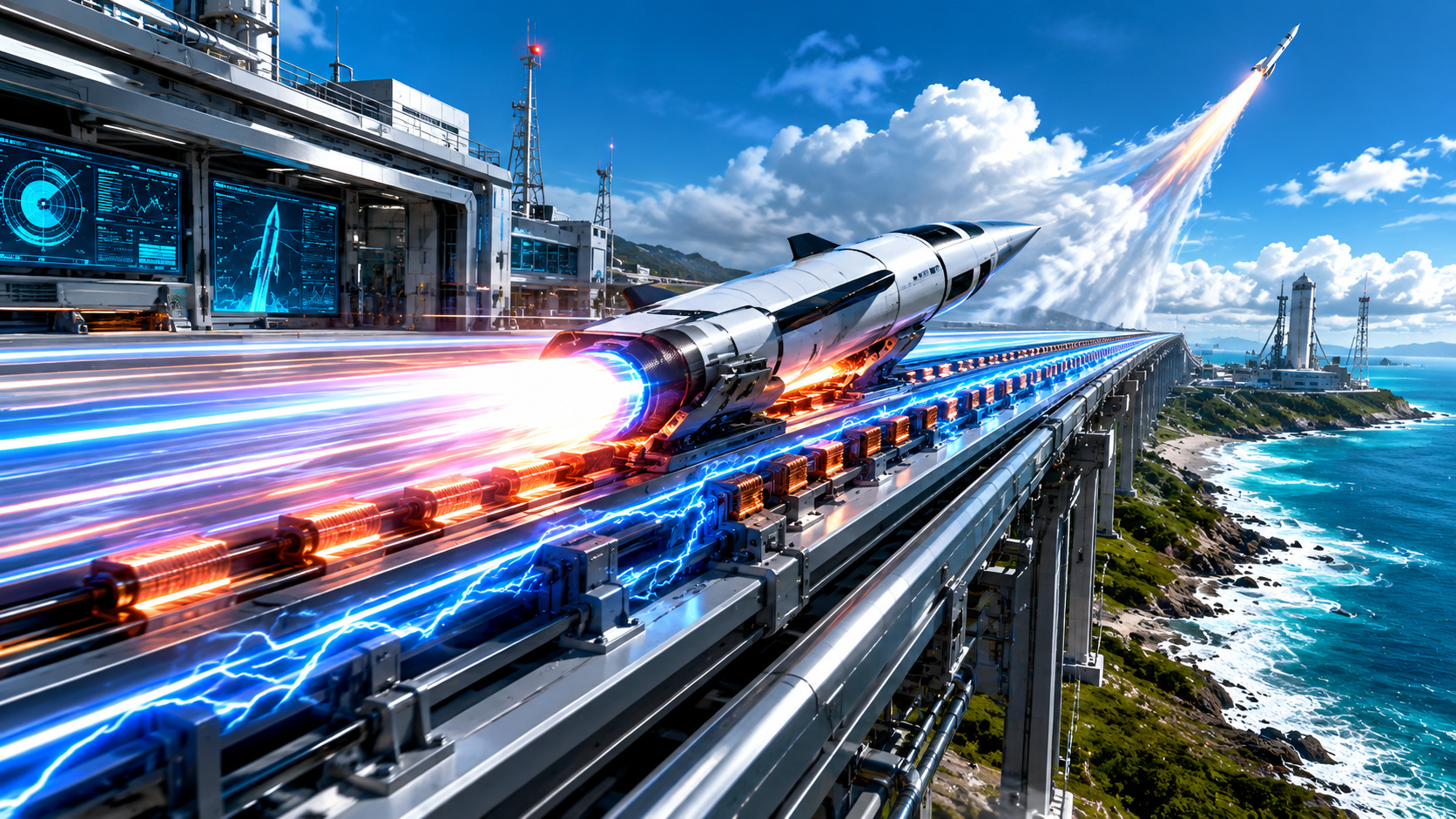

Auriga Space develops electromagnetic rail to accelerate rockets to hypersonic speeds and promises to make launches cheaper and more frequent.
A California startup called Auriga Space aims to tackle one of the biggest bottlenecks in the space industry with an unusual proposal: remove the most expensive and inefficient part of the rocket’s takeoff and transfer it to a ground-based electric-powered structure. Instead of relying on a conventional first stage, the company is developing an electromagnetic rail capable of accelerating a small rocket to hypersonic speeds before its own engine is activated.
According to TechCrunch, Auriga’s proposal is to use electricity-powered magnets to propel the vehicle to more than six times the speed of sound. The company argues that by shifting part of the initial launch effort to the ground, it can reduce propellant consumption, increase infrastructure reuse, and allow for a higher cadence of missions.
How Auriga Space’s electromagnetic rail works
The architecture described by the company generally resembles a linear system inspired by technologies like maglev, but applied to a much more extreme scenario.
-
ChatGPT Alerts FBI to Prevent Planned Murder of 8-Year-Old in Brazil’s Espírito Santo

-
Scientists Discover 125-Million-Year-Old “Pregnant Fossil” with Preserved Embryos and Microscopic Larvae Inside Mollusk in England

-
17-Year-Old Justin Bernstein Develops Bacteria to Produce Glass on Arctic Ice to Reflect Sunlight, Wins $50,000 U.S. Scholarship

-
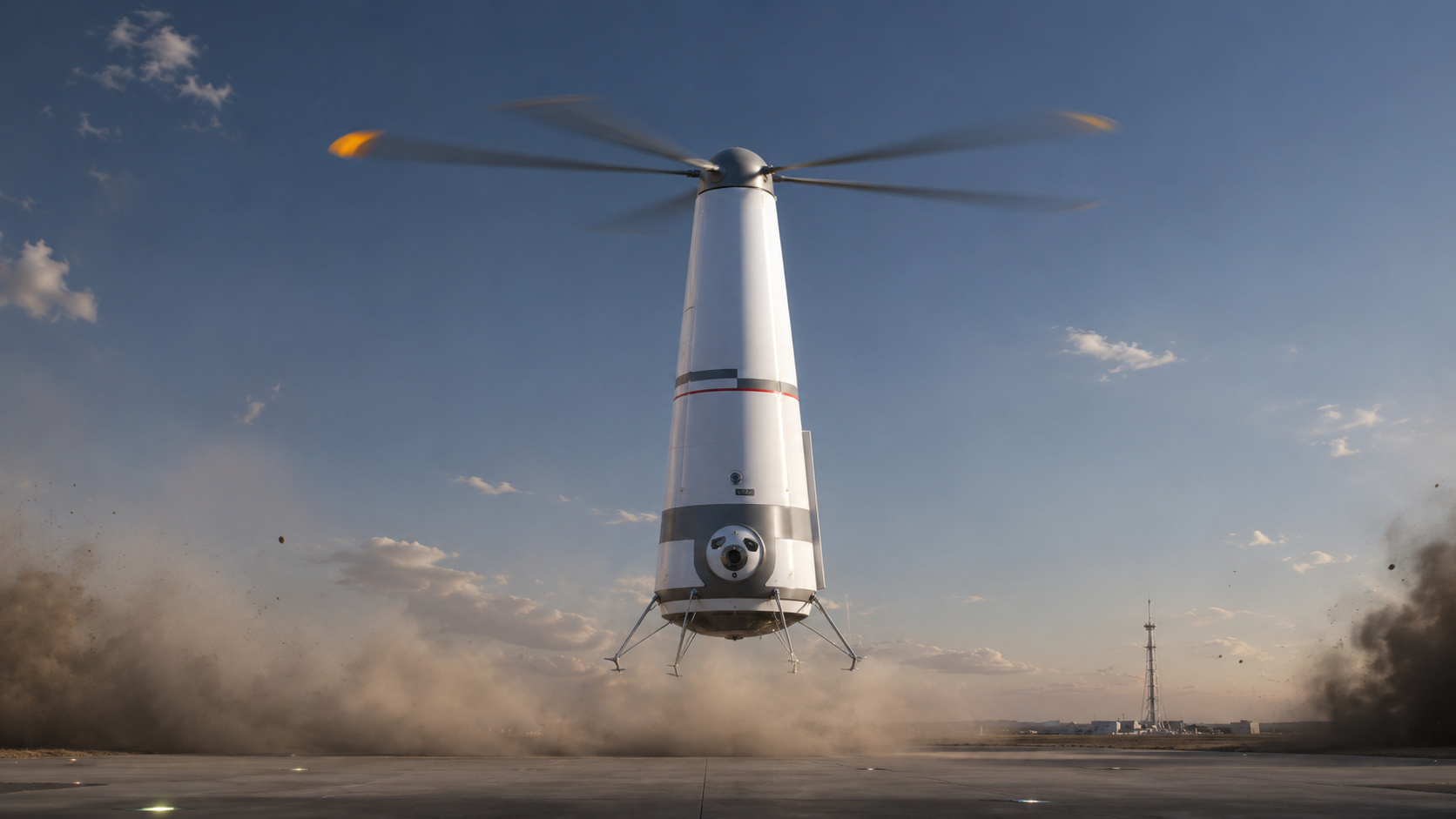
The 19-Meter Rocket-Helicopter: A Private Industry Prototype That Challenged Space Race Logic



Instead of transporting passengers, the rail uses controlled magnetic fields to accelerate a payload along a track until it leaves the structure at high speed and proceeds to the next phase of the mission.


The central point of the proposal is simple to understand. In traditional rockets, a large part of the launched mass is fuel used in the first minutes of flight, when the vehicle is still fighting against gravity and the denser atmosphere. Auriga wants to replace part of this effort with electric energy applied on the ground, where the infrastructure can be reused much more easily.
The company’s founder and CEO, Winnie Lai, summarized this problem to TechCrunch by stating that less than 2% of a rocket’s mass actually reaches space. It is this structural inefficiency that the startup is trying to address with its electromagnetic platform.
Why the idea has gained momentum again now
The concept of electromagnetic launch is not new, but Auriga claims that the technical landscape has changed. According to TechCrunch, recent advances in power electronics and operations with higher voltages and power have helped transform a historically difficult proposal into something more plausible from a technological and commercial standpoint.

On the official website, the company states that its platform uses electricity, not propellants, to accelerate payloads to hypersonic speeds. It also says that the system is designed to be scalable, reusable, and controllable, with applications ranging from hypersonic testing to on-demand orbital access.
This combination helps explain why the proposal draws attention. What once seemed like an elegant idea on paper is now beginning to be presented as a launch architecture with commercial, industrial, and strategic applications, although it is still far from being a consolidated orbital product.
Prometheus, Thor, and Zeus show that the project is still in stages
An important point to treat Auriga rigorously is to separate what is already in development from what is still a declared ambition. The complete orbital system is not yet ready, and the company describes its evolution in successive stages, with an initial focus on test infrastructure before reaching full space launch.
According to TechCrunch, the company intends to enter the market first with ground-based hypersonic tests. The text states that the latest grant from AFWERX will be used to commercialize a laboratory rail called Prometheus and, subsequently, an external accelerator for full-scale test articles called Thor, while the final orbital launcher is named Zeus.
Auriga’s product page reinforces this strategy by stating that its test systems promise ground flight data, with shorter turnaround times and the possibility of multiple tests per day. In the same material, the company says that Prometheus will be used for laboratory-scale experiments and that Thor is in development for larger payloads.
Ground-based hypersonic tests could become the startup’s first real business
Before proving it can put payloads into orbit, Auriga is trying to position itself as a provider of test infrastructure. This choice makes sense because it allows transforming a long-term space promise into a more immediate service, based on high-speed tests conducted on the ground.
In the official material, the company states that its hypersonic testing system can reproduce on land pressure and temperature conditions representative of real flight. It also claims that the platform was designed to test materials, coatings, structures, sensors, and electronics under high acceleration.
This path reduces the distance between the idea and revenue. Instead of waiting years for an operational orbital launcher, the startup tries to gain commercial traction with a high-value technical service, focused on validation, repetition, and development speed.
The biggest technical challenge is the G-force imposed on the load
The most delicate problem of the project is not in marketing, but in physics. TechCrunch itself reports that, even with a very long rail, the system must still impose high G-force loads on the vehicle, which may limit the type of satellite or hardware capable of surviving the launch.
The report says that the company has already conducted initial studies on the survival of satellite components under higher accelerations and concluded that certain components can withstand more than standard tests used to assume. Even so, the final architecture, including tunnel length and rocket size, is still being defined.
This means that the proposal remains technically promising but still carries a central uncertainty. The greater the acceleration required over a limited distance, the greater the structural pressure on the load. And this limit may practically define what the platform will be able to launch first.
Auriga Space funding shows that the bet has already moved beyond the drawing board
Auriga has not yet proven its concept on an orbital scale, but it has already managed to attract capital and contracts. TechCrunch reported that the company closed a seed round of US$ 4.6 million at the beginning of 2025 and added US$ 1.4 million in new contracts from AFWERX and SpaceWERX, reaching US$ 12.2 million between venture capital and funds linked to the Department of Defense.
On Aura’s official website, the company also confirms the Direct to Phase II SBIR contract of US$ 1.25 million announced in August 2024 to advance the development of Prometheus, described as a laboratory-scale electromagnetic accelerator. The company presents this step as a milestone to validate the physics and engineering of the larger system.
These resources do not solve the technical challenges, but they indicate that Auriga has moved beyond being just a conceptual hypothesis. It is already operating at a stage where investors and public programs have begun to support the attempt to transform electromagnetic launch into a product and infrastructure.
Electric launch also gains strength amid the environmental debate in the space sector
Another argument used in favor of the idea is the environmental impact. Since a significant portion of a traditional rocket’s fuel is consumed right at the start of the flight, an architecture that transfers more energy to the ground attempts to reduce the direct dependence on this initial chemical thrust.
This debate gained weight with the increase in the number of launches. In 2022, the NOAA reported that a significant growth in space activity could damage the ozone layer, highlighting that particles emitted by rockets can accumulate in the stratosphere and heat the surrounding air.
What is Really at Stake in the Race for the Cheapest Orbital Launch
Auriga’s ambition is great because the prize is also great. If ground infrastructure can replace a significant part of the initial launch phase, the space sector could gain a new equation of cost, frequency, and reuse, affecting access to space, hardware testing, and new system development.

But the company still needs to prove the most difficult stages. The final system is not closed, G-force limits remain a real challenge, and the gap between testing hypersonic articles on the ground and operating a regular orbital launcher is still huge.
Even so, the bet already stands out as one of the boldest in the new space race. If Prometheus and Thor confirm that the architecture works with repetition, control, and competitive cost, Auriga could cease to be just a futuristic curiosity and become a relevant player in the contest for cheaper and more frequent orbital access.


