






 Portuguese
  Spanish


The 16,000-liter cistern installed in the backyard of families in the Semi-arid region is replacing barrels, drums, and constant dependence on water trucks. According to gov.br, the Cisterns Program has delivered 121,240 units since 2023, with quality water for human consumption and more security during rural drought periods.
The cistern that now occupies space in the backyard of Daniela Oliveira, in Major Izidoro, Alagoas, represents a practical change in the routine of rural families in the Semi-arid region. Previously, water was stored in barrels, drums, and improvised reservoirs around the house.
The case was disclosed by gov.br on June 4, 2026, with an update on June 18, 2026. The publication states that the Cisterns Program, coordinated by the Government of Brazil through the Ministry of Development and Social Assistance, Family and Fight Against Hunger, the MDS, has already delivered 121,240 cisterns since 2023.
Water stored in the backyard changes the routine without relying solely on rain
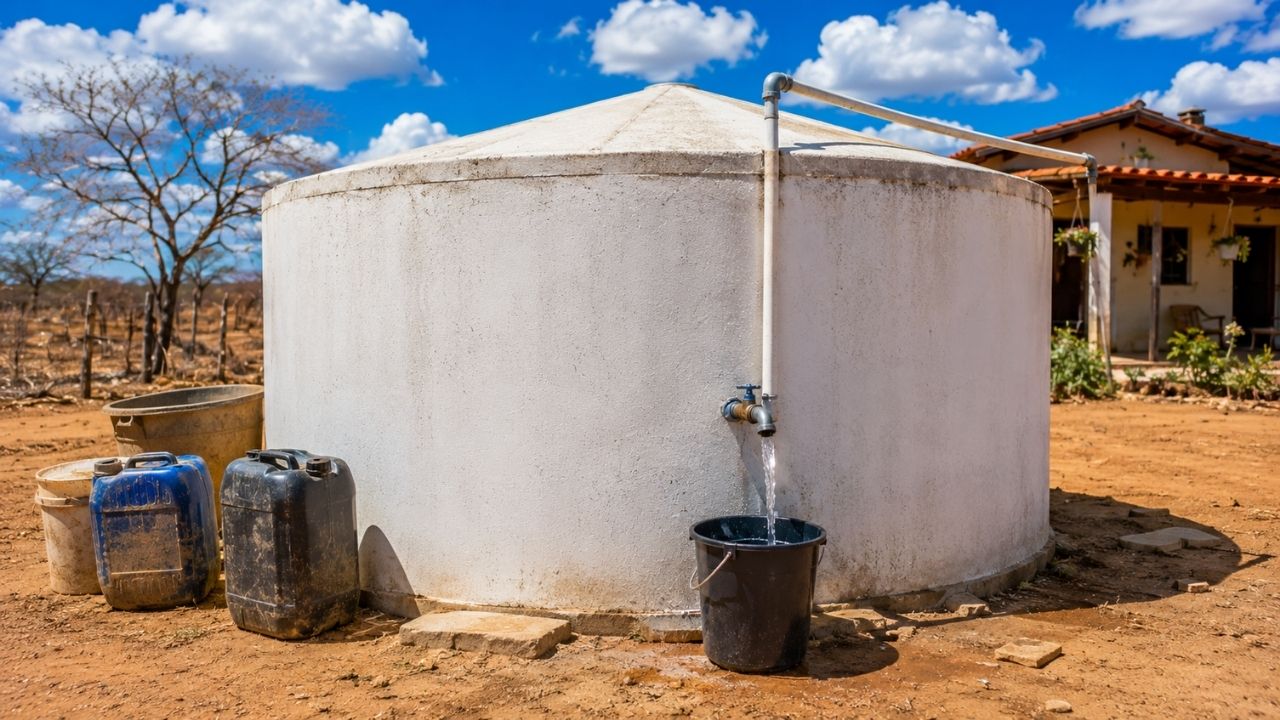
The cistern installed at Daniela Oliveira’s house has a capacity of 16,000 liters and is attached to the roof. The structure allows rainwater to be collected and stored in a protected manner, intended for human consumption during the dry months.
-
Tail of the Dragon: 318 Tight Curves in 18 km Make This Mountain Road a Psychological Challenge for Drivers and Tourists Alike

-
Brazilian Official Proposes Plan to Revive 223 km Railway, Connecting 13 Cities and Transporting 32,000 Passengers and 600 Containers Daily, Plus a Tourist Train in Just 2 Hours 20 Minutes.

-
China Completes Mountain-Top Airport After Major Engineering Feat Near Three Gorges
-
Small Brazilian Town in Santa Catarina Boasts Latin America’s Largest Wooden Church, Preserves German Traditions, and Offers Thermal Waters



According to the official publication, Daniela lives in Major Izidoro, a municipality in Alagoas, and began to get rid of the drums and improvised reservoirs she used to store water. She and 57 other families in the municipality received water cisterns for human consumption in 2025.
The central change is in the way water is stored, not just in the amount available. Instead of leaving barrels scattered around the property, the family now has a planned reservoir, installed next to the house and connected to the roof collection system.
This type of social technology is important because it reduces the exposure of water to makeshift storage conditions. The source states that the program’s reservoirs can range between 16,000 and 52,000 liters, ensuring the safety and quality of stored water for basic needs during droughts.
Program has delivered over 121,000 technologies since 2023
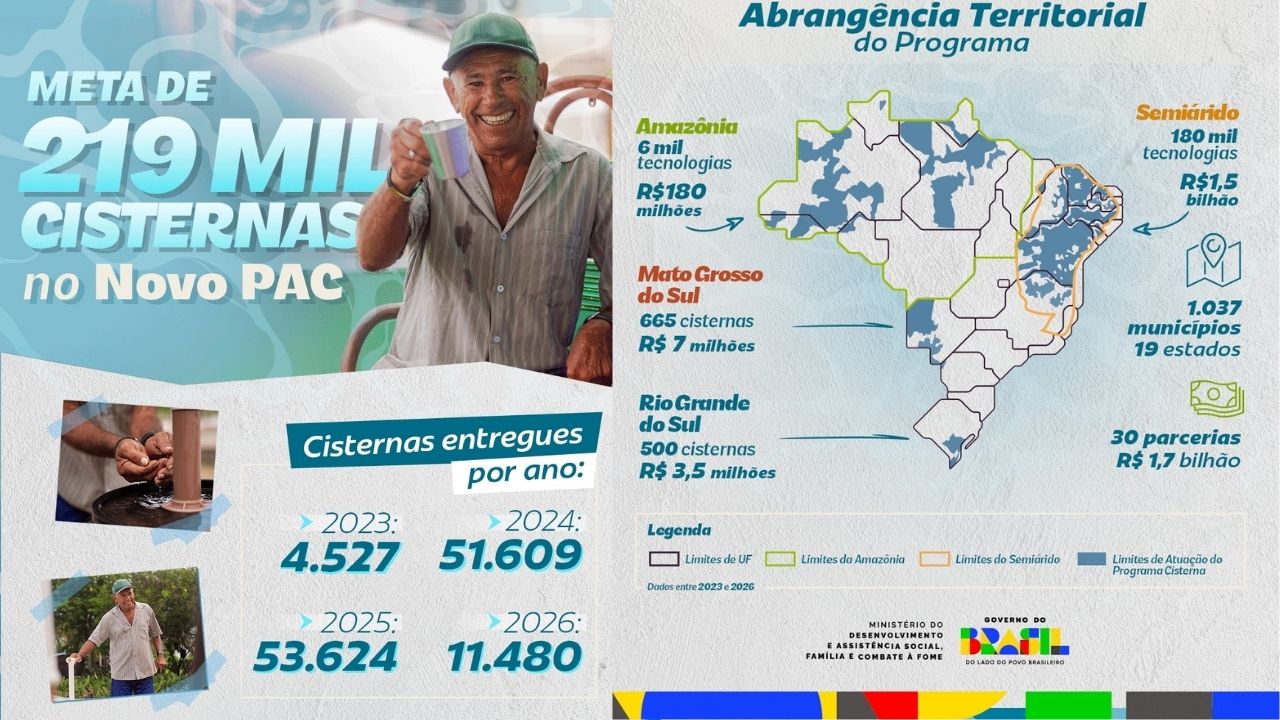
The Cisterns Program is being resumed as a public policy for water access for vulnerable rural populations. According to gov.br, since 2023, 121,240 cisterns have been delivered, mostly concentrated in the Semi-arid states.
The initiative is also present in the Amazon Region, where the model is adapted to the local reality, as well as in Mato Grosso do Sul and Rio Grande do Sul. The goal is to expand access to safe water for both human consumption and food production.
The number shows that the cistern has ceased to be just a domestic solution and has become part of a national-scale public policy. The technology is simple, but the reach depends on coordination, resources, local execution, and monitoring of the beneficiary families.
Gov.br also reports that about 190,000 cisterns and other water access technologies have been contracted through the New PAC. The goal is to reach 219,000 units, with an investment of R$ 1.7 billion in federal resources.
Resumption occurs after a period of decline in execution
The official publication compares the current stage of the Cisterns Program with the period between 2019 and 2022. During this interval, according to gov.br, 54,500 cisterns were delivered and R$ 194.2 million in resources were paid.
From 2023 onwards, the program regained scale, with deliveries and new contracts linked to the New PAC. This comparison helps the reader understand that the issue is not just about one family being served, but about an expanding public policy.
The context matters because access to water in the Semi-arid region depends on continuity. Cisterns need to be contracted, built, installed, and monitored by a network of executing entities, state governments, municipalities, and local agents.
In Alagoas, the text reports that 3,947 water access technologies were delivered in 2025. Major Izidoro appears as one of the municipalities served, with families that previously depended on makeshift storage and supply by water trucks.
Water trucks are still part of the reality for many families
In the Community of Sítio Bezerra, also in Major Izidoro, community health agent Tatiane Brito works in supporting social mobilization for the implementation of cisterns. She is part of the network of partners that helps connect families to the Cisterns Program.
According to Tatiane, many families depended on water trucks that distributed only a 200-liter drum per week, every eight days, per family. The information shows the limitation of emergency supply when compared to a fixed storage structure in their own backyard.
The cistern does not eliminate all the challenges of supply, but it changes the predictability of water within the home. Having your own reservoir allows for better organization of consumption, reduces travel, and decreases dependence on periodic deliveries.
The agent also relates the program to perceived impacts on local health, citing a decrease in problems such as diarrhea. As the account comes from a professional who has worked for 20 years as a community health agent, it reinforces the connection between safely stored water and quality of life.
Local network helps identify families and organize deliveries
The Cisterns Program operates with a network of executing partners. In Major Izidoro and nearby areas, the Regional Agricultural Cooperative of Palmeira dos Índios, Carpil, appears as the executing entity alongside the Government of Alagoas.
Fernando Lima dos Santos, a technician from Carpil in the region, explained to gov.br that the entity contacts the city hall, which indicates community leaders with potential for service. When there are no structured local organizations, the support of health agents becomes even more important.
The installation of a cistern depends on social mobilization before the physical work. It is necessary to assess demand, identify families, organize visits, explain stages, and ensure that the technology reaches those who truly need it.
The result of this assessment is passed on to the State Secretariat of Agriculture and Livestock of Alagoas, which executes an agreement signed with the Cisterns Program. The national coordination is carried out by the Government of Brazil, through the National Secretariat for Food and Nutritional Security of the MDS.
Simple technology connects water, health, and food security
The cistern is a social technology with simple operation but broad effect. It captures rainwater from the roof, stores it in a protected reservoir, and helps ensure quality water during drought periods, when other sources may become scarce or unstable.
In the Semi-arid region, this logic is especially relevant because rain does not always occur regularly. Storing water when it falls allows for getting through drier months with greater security for human consumption and, in other modalities, also for food production.
The value of the technology lies in the combination of simplicity, scale, and adaptation to the territory. The cistern does not rely on complex systems to function, but it needs to be well installed, well maintained, and integrated into the families’ routine.
At the same time, the program shows that solutions for living with drought do not need to come only from large projects. In many cases, a structure in the backyard can change the family’s relationship with water, provided there is maintenance, guidance, and continuity of public policy.
What the cistern reveals about living with the Semi-arid
The story of Daniela Oliveira and the families of Major Izidoro shows that access to water is not just a matter of infrastructure, but of routine. Improvised gallons and drums used to take up space in the house; now, the cistern concentrates storage in a structure made for this purpose.
The Cistern Program also highlights that living with the Semi-arid depends on solutions adapted to the territory. Drought continues to be part of the climatic reality, but the way water is captured, protected, and distributed can reduce vulnerabilities.
The question that remains is whether simple technologies like cisterns should advance even faster in rural areas that rely on water trucks and improvised storage. Data from gov.br shows expansion since 2023, but also indicates a large demand for new deliveries.
Do you think the water cistern in the backyard should be a priority in rural communities of the Semi-arid? Leave your opinion in the comments and tell us if simple technologies can make more of a difference than large projects far from the families’ routine.


