Portuguese
  Spanish


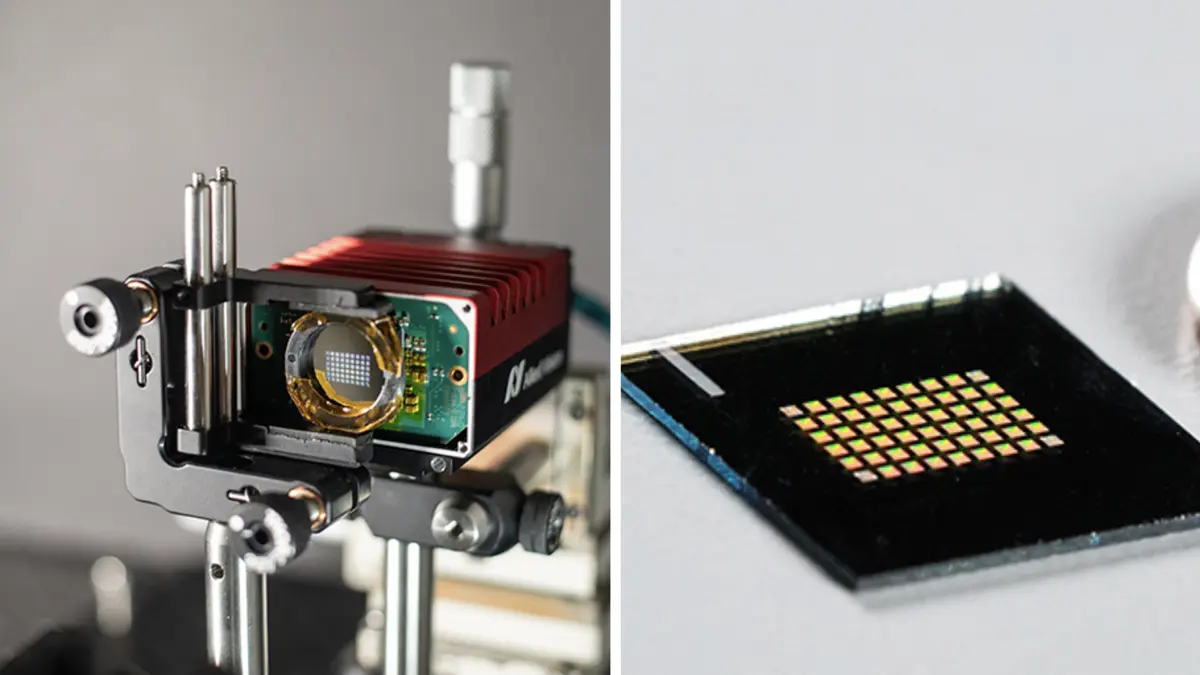


Scientists Created a Compact Camera with Innovative Optics, Accelerating Object Identification with Greater Speed and Energy Efficiency
Scientists from two of the leading universities in the United States, University of Washington and Princeton University, developed a revolutionary compact panoramic camera for computer vision.
Using an innovative approach, the new prototype reduces energy consumption and promises to identify objects at an impressive speed: the speed of light.
Computer Vision with a New Camera
Computer vision is a field of artificial intelligence that enables computers to reflect on and interpret images and videos.
-
China Establishes State Centers to Train Humanoid Robots, While the West Lags Behind with Makeshift Solutions

-
The Trap of Modern Technology: How Screen Overload and Digital Connections Can Impact Your Mental Health and Well-being
-
Wyoming Couple Grows Tropical Fruits Year-Round in -40°C Using Geothermal Greenhouse, Demonstrating Earth’s Heat Can Produce Oranges and Lemons in Snow Without Traditional Heating

-
Ship Returns from Brazilian Coast with Thirty Newly Discovered Life Forms



Traditionally, computer vision systems rely on electronic processing done by conventional hardware. However, researchers have found a way to perform part of this processing directly in the optics of the camera.
Arka Majumdar, a professor of electrical engineering and physics at the University of Washington, explains the innovation: “This is a completely new way of thinking about optics, very different from the traditional. The optics are designed along with the computational block, allowing transmission to be carried out optically.”
Instead of using a conventional glass or plastic lens, the new camera utilizes layers of 50 metalenses, which are lightweight, flat lenses composed of microscopic nanostructures.
These structures manipulate light and function as an optical neural network, an AI system inspired by the workings of the human brain.
Practical Advantages and Energy Efficiency
One of the main advantages of this approach is speed. The camera operates with processing done at the speed of light, allowing for identifying and classifying images more than 200 times faster than traditional neural networks, which use conventional hardware.
And it’s not just the speed that impresses; accuracy is comparable to the most advanced neural networks. Additionally, energy consumption is significantly reduced, as the camera’s optics use the incoming light to function, unlike traditional systems that rely on electricity.
Felix Heide, a professor at Princeton University, highlights the broad potential of this research. He mentions that applications can range from autonomous vehicles to medical devices and smartphones.
“Today, every iPhone has AI or vision technology. This work is still in its early stages, but it could benefit these devices in the future.”
The Impact on the Development of Autonomous Vehicles
The study, published in the journal Science Advances, presents a significant advance in optical computing.
With this integration of technology with the camera’s optics, the researchers developed a computer vision system capable of performing neural network calculations during image capture, even before recording them on the camera sensor. This enables real-time analysis with impressive accuracy.
The scientists are also looking to the future, with the expectation that the technology will play a crucial role in the navigation of autonomous vehicles.
As part of the next stage of research, they plan to test the prototype on more complex datasets and on problems that unlock greater computational power, such as object detection.
This type of technology is essential for autonomous cars to identify obstacles and make real-time decisions.