






 Portuguese
  Spanish


Resident of Angelina, in the interior of Santa Catarina, he learned the craft by watching his own father work with wood when he was still a child, at a time when farming and craftsmanship were intertwined in the family’s daily life
According to a report produced by the Vale Agrícola channel and published on October 10, 2022, Angelina, a small town in the interior of Santa Catarina, holds one of the last representatives of a craft that is becoming increasingly rare in Brazil. At 84 years old, Fredolino has been making wooden bowls for 72 years — that is, since childhood, when he learned the trade by watching his own father. It was he who taught him, as a boy, to transform raw logs into utensils that, for decades, were present in practically all domestic tasks of families in the interior of Santa Catarina.
In this learning process, two raw materials became protagonists: wood and iron. For almost a century, this combination was essential in rural life — the axe that felled the trees and the tool that helped transform logs into furniture and utensils were, at the same time, work instruments and a synonym of wealth, especially when handled with skill and knowledge. And few people know this handling as well as Fredolino.
From the native forest to the workshop: the cedar that transforms into a bowl
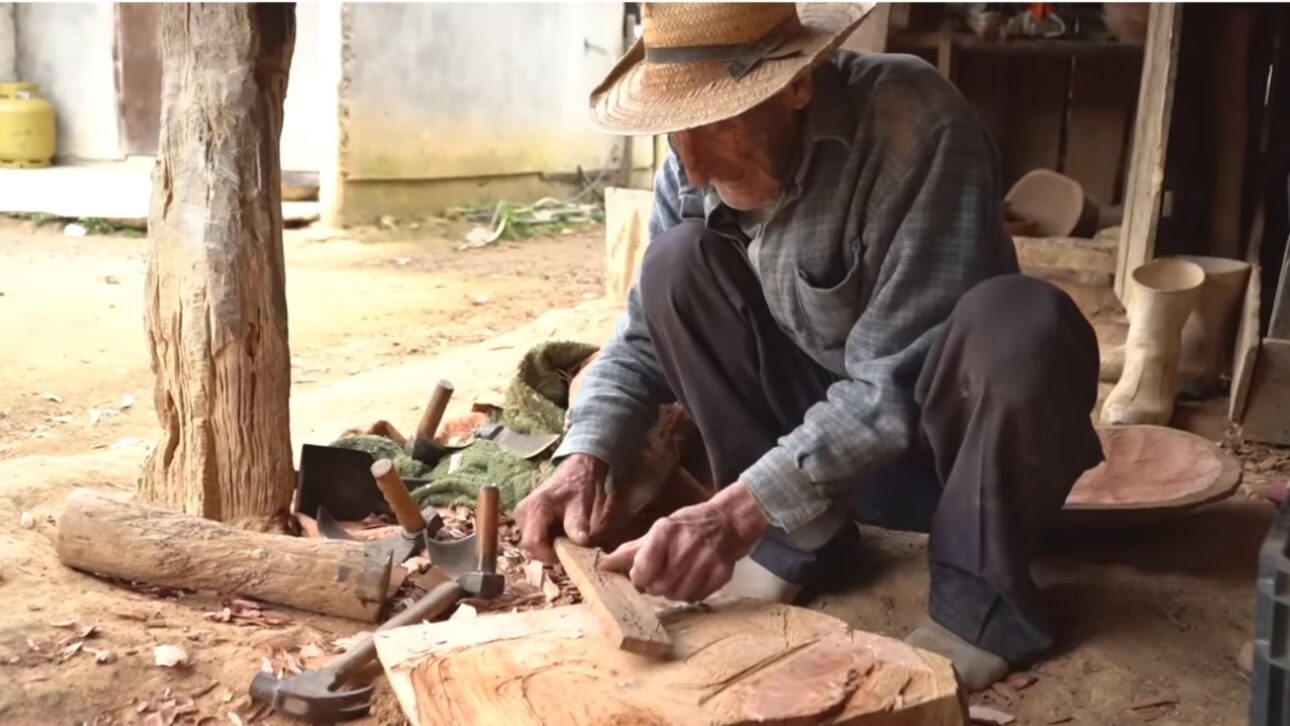
On the property where he lives, in Angelina, Fredolino uses cedar — one of the most resistant trees in the native forest — as the main raw material for his bowls. According to the artisan, the root of the tree is even better than the trunk for this type of work, as it allows the piece to be carved without seams, taking advantage of the natural shape of the wood.
-
70-Year-Old Brazilian Dentist Fulfills 20-Year Dream by Visiting Seven of the World’s Highest Peaks in the Himalayas

-
Heatwave in Europe Causes Drownings: France Reports 40 Victims as Temperatures Soar to 40°C, Experts Issue Surprising Warning
-
French Solar Mirror Array Concentrates Sunlight 16,000 Times, Reaching Temperatures Over 3,000°C

-
Brazil to Use Reinforced Concrete in $200.4 Million Mega Roundabout Project with Four Overpasses and Expanded Bridge, Set to Last 630 Days



The origin of this utensil, by the way, is uncertain. Some argue that the bowl is an adaptation of the clay basins used by indigenous peoples; others believe it emerged as a cheaper alternative for immigrant families, who could not afford to buy crockery or ready-made containers. Whatever the origin, the result is the same: for a long time, the bowl was used for practically everything inside a farmhouse — from washing food to serving meals.
This craft has been in Fredolino’s DNA since childhood. He remembers that his father, who learned to make wooden bowls before him, practically had no rest. “So I made that one until midnight, and early in the morning it arrived,” he said, recalling episodes where he finished a piece during the night to deliver it the next morning. Additionally, he remembers that the satisfied customer “reached into their pocket” to pay — an important gesture at a time when money was scarce, and the wooden bowl also functioned, in practice, as a kind of barter currency between families.
A life divided between the farm, the workshop, and a large family
Over time, Fredolino married Dona Maria, and the couple followed the same path that his parents had followed before: balancing farm work with wood craftsmanship. Together, they built their own house in a place known as Mangueirão and raised a large family — according to the couple’s account, they had between nine and ten children, with one born lifeless. Currently, eight are still alive.
Those were difficult times, as the couple themselves acknowledge. Even the smallest children had to accompany their parents to the farm, helping in any way they could. From that time, one of the family’s most striking memories comes: a scare with a snake that appeared near the crib of one of the children, at a time when taking care of children in the field also meant being alert to this kind of constant risk, common in the routine of those who lived — and still live — in direct contact with nature.
Nevertheless, the couple maintained their work routine for decades, always balancing agriculture, which ensured the family’s sustenance, with the production of wooden bowls, which supplemented their income and kept alive a tradition passed down from generation to generation.
Even retired, the tradition remains alive in Fredolino’s hands
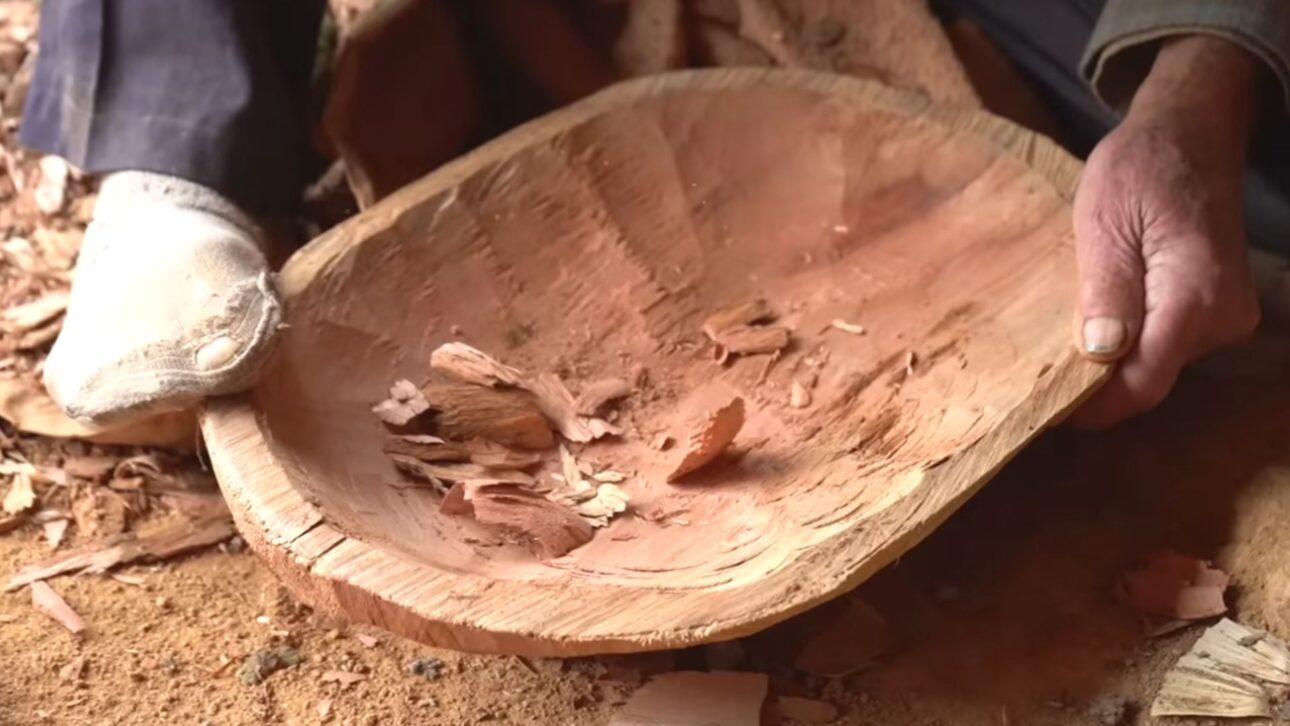
Now retired from the heavy farm work and with his children already grown, Fredolino makes a point of keeping the tradition of producing wooden bowls alive. He proudly shows pieces of different sizes: from small ones, used as fruit bowls, to larger ones, ideal for seasoning meats and serving barbecues — according to him, even better for the back than metal or plastic containers, as they are lighter to handle.
One detail stands out in each piece: the absence of seams, a direct result of the size of the root used in the carving. Interestingly, the same wood used in the making of the bowls also serves to make the handle of the axe used in the process — a kind of closed cycle between tool and final product.
In the finishing, time also tells a story of transformation. Currently, with the help of electric sanders and other modern tools, a bowl can be completed in a few days. In the past, however, the entire process was manual and consumed entire nights of work, by lamplight, until the piece was ready for use or sale.
Another interesting aspect raised during the conversation was the so-called rural legend about the bowls — the idea that the same container used to wash feet also served to make bread. Regarding this, the couple shared a real and humorous story: on a night when the house was undergoing renovations and Dona Maria was preparing bread, the family baby was placed inside a bowl to sleep nearby, as an improvised crib. The scene, filled with humor and simplicity, illustrates well how the utensil really served for almost everything within a farmhouse.


At that time, by the way, houses usually had several bowls, used for washing clothes, cleaning the house, and storing food. It was also common to gather between 25 and 30 people in work parties — collective practices in which, despite the heavy routine, everyone ate well, strengthening the bonds between neighbors and family members.
Among the objects kept by Fredolino, there is also a curious wooden bowling set made by himself decades ago, an item that, according to the craftsman, has already traveled to Rio Grande do Sul and returned to his property. The bowls themselves, by the way, also gained the country: the largest pieces have already been sold to buyers from cities like Brusque and other states, including Rio Grande do Sul, each with a different price, set by the craftsman himself.
Today, Fredolino takes about a day to complete each bowl. As Dona Maria can no longer help as before, he has come to rely on his grandchildren, especially when it comes to sawing the wood with the motor, after sketching the shape of the piece. He acknowledges, however, that the pace is slower — and that finding large logs like those of the past is becoming increasingly difficult. Therefore, the trend is that the next pieces will be smaller.
Despite having trained other people in the craft, Fredolino questions whether today’s youth are still interested in learning such a laborious technique. The doubt became even more evident when the reporter himself tried to reproduce the process: trying to imitate the craftsman’s movements, he cut the piece crookedly and felt, in practice, the strength needed to perform the work. Meanwhile, Fredolino continued carving the wood without even losing his breath, recognizing by the sound of the tool against the wood the ideal thickness of the piece — knowledge that only decades of practice can provide.
Making bowls, as Fredolino’s journey shows, is an art for the few. And seeing him still active, carving wood with the same dexterity as decades ago, is a sign of hope for the preservation of this history — not only his but of generations of families from the interior of Santa Catarina who built part of their identity around the farm, the wood, and the friendship between neighbors.
Will this type of profession still exist in a few decades, or is it doomed to disappear with Fredolino’s generation?


