






 Portuguese
  Spanish


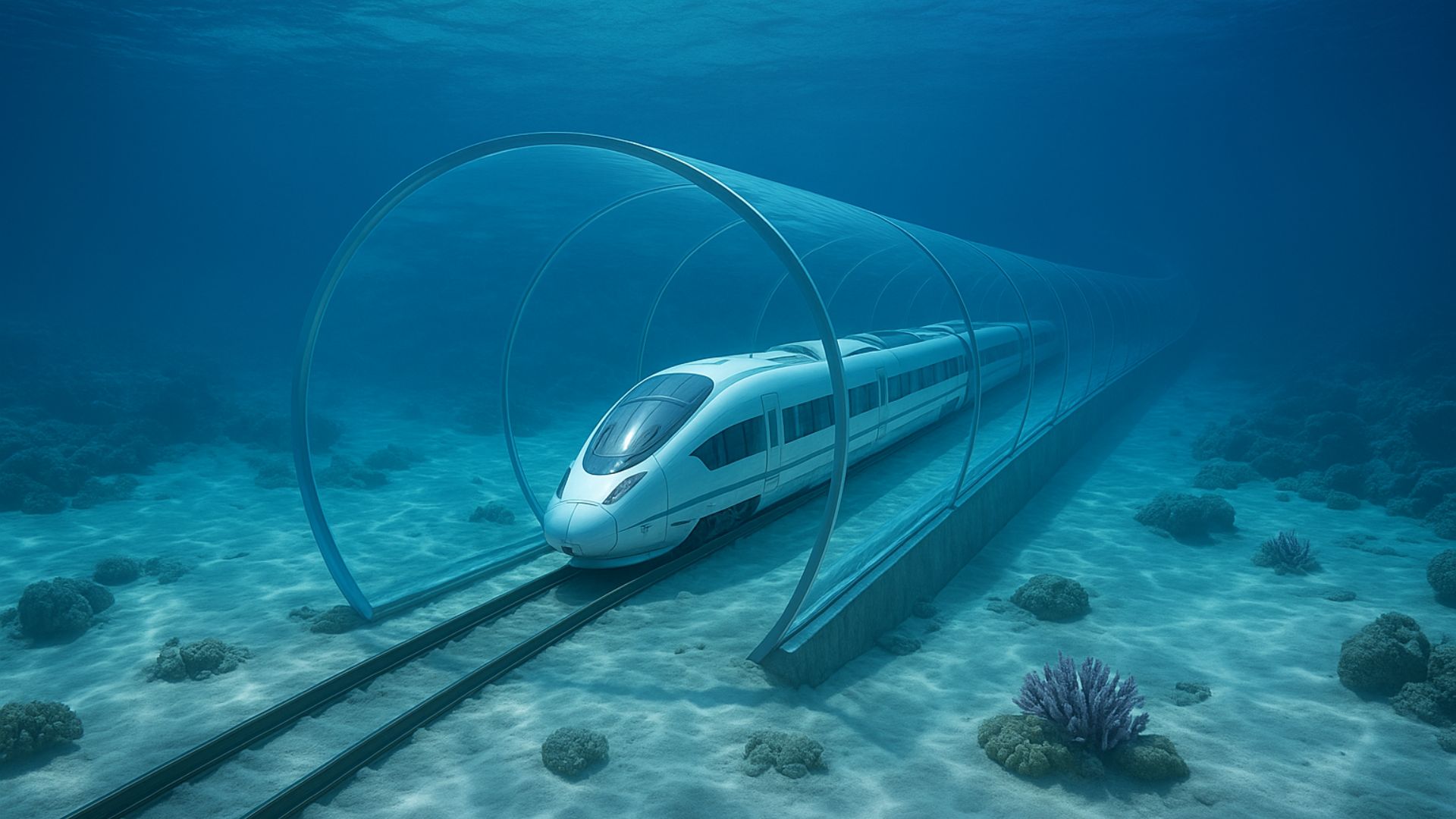


The Chinese Submarine Mega Tunnel Promises to Redefine Transport and Connect Two Strategic Regions With High Speed, Innovative Engineering and Billion-Dollar Logistical Impact.
China has taken another step in its strategy to expand transportation infrastructure by confirming progress on a 123-kilometer submarine rail tunnel beneath the Bohai Strait, designed to drastically shorten travel time between the northeast and east of the country and enhance the logistical integration of one of the most dynamic areas of the Chinese economy.
The corridor, which anticipates an investment of about 220 billion yuan, approximately US$ 36 billion, is expected to allow a crossing in about 40 minutes, integrating with the already existing high-speed train network.
Strategic Connection in the Bohai Strait
The so-called Bohai Strait Tunnel was conceived to link the port cities of Dalian, on the Liaodong Peninsula, and Yantai, on the Shandong Peninsula, both located on the northern coast of China.
-
UFG’s Innovative Use of Air Conditioner Drip Saves 400 Liters of Water Daily in Brazilian Public Building

-
China Builds Underwater Wall After Discovering Technology That Could Shift Military Balance in the Pacific, Study Reveals Why the Asian Power Reacted Now

-
After Over 8 Months in a Simulated Mars Habitat in Houston, 4 NASA Volunteers Communicate Almost Silently and Will Exit in October
-
Natural Phenomenon Turns Black Sea Turquoise Blue Due to Billions of Microscopic Organisms


Although some international coverage presents the project as a link between “two continents,” in practice, it connects two peninsulas of the same Chinese continental territory, crossing one of the busiest inland maritime routes in the country.
Today, those who need to travel between Dalian and Yantai by land face a long detour around the bay, covering about 1,400 kilometers of highways, or rely on ferries that take approximately eight hours to cross the strait.
The future submarine rail connection was specifically designed to replace these slower and more vulnerable alternatives to adverse weather conditions, ensuring greater predictability for passengers, cargo, and logistical chains.

In addition to facilitating regional mobility, the tunnel is viewed by Chinese authorities as part of a broader corridor that aims to strengthen the link between industrial hubs, consumption centers, and major ports in the north and east of the country.
The expectation is that the new axis will reduce bottlenecks in transport and help redistribute flows of goods that are currently concentrated on already saturated land and maritime routes.
Structure and Engineering of the Submarine Mega Tunnel
According to published planning studies, the tunnel will have approximately 123 kilometers in total length, of which about 90 kilometers will be completely submerged under the Bohai Strait.
This would place it, once completed, ahead of the combined length of the two longest underwater tunnels in operation today, Japan’s Seikan and the Eurotunnel.
The structural design is based on three parallel galleries.
- Two dedicated to high-speed tracks.
- A third, central one, intended for maintenance, technical systems, and escape routes.
The trains designed to operate on this link are expected to reach speeds of up to 250 km/h, directly integrating the tunnel into the high-speed networks of northern and eastern China.
In some operational scenarios, there is also provision for transporting vehicles in specific carriages, allowing cars and trucks to cross the strait on tracks instead of relying exclusively on ferries.
This would allow the journey between Dalian and Yantai, currently measured in hours, to be made in about 40 minutes, without the need to detour around the sea or face frequent interruptions due to storms or heavy fog.
Seismic and Environmental Challenges in the Bohai Strait
Although the project is part of a recent Chinese tradition of mega-infrastructure, building a tunnel of this magnitude under the Bohai Strait is regarded by experts as an unprecedented engineering challenge in the country.
The construction will have to traverse sections with high geological complexity and near historically associated seismic fault zones linked to major magnitude events.
The preliminary plans indicate that the tunnel should be built at least 30 meters below the seabed, in predominantly rocky layers.
This depth aims to reduce the risk of direct damage caused by earthquakes while simultaneously minimizing the pressure exerted by the water column on the structure.
The structural solution involves segmented lining rings, expansion joints capable of accommodating small displacements, and continuous monitoring of deformations.

In addition to seismic stability, the control of infiltrations and flooding is another central point.
In the Bohai, the project anticipates redundant systems for drainage, pumping, and waterproofing, combined with sensors distributed along the entire route to detect pressure variations, water presence, and structural changes.
Operational safety also requires high-capacity ventilation, strict smoke control in case of fire, and refuge points connected to the central service tunnel, allowing gradual evacuation in emergency situations.
Economic Impact and Logistical Projections
Beyond technological symbolism, the Bohai Strait Tunnel is treated by regional authorities as an investment with a direct impact on the region’s competitiveness.
Studies cited by Chinese media estimate annual revenue around 20 billion yuan after it goes into operation, combining ticket sales and fees charged for transporting vehicles and cargo.
By shortening the connection between two major ports, the corridor aims to provide a more predictable route for moving goods between industrial parks in the northeast, consumption hubs in the east, and maritime routes linking China to South Korea and Japan.
For logistics operators, the promise is reduced costs, less reliance on weather, and greater flexibility to combine maritime, rail, and road transport in a single flow.
The project also aligns with China’s strategy to consolidate internal transport corridors connected to external initiatives related to trade with Europe and other Asian markets.


What Is Needed for the Start of Construction
Despite having existed for decades in successive versions, the Bohai Strait Tunnel gained new momentum after being included in planning documents and submitted to the agency responsible for evaluating major infrastructure projects.
Updated proposals have been sent to the National Development and Reform Commission, and recent reports describe the project as being in the stage of detailed and feasibility studies, with a timeline of 10 to 15 years for completion from the actual start of construction.
This means that the concrete schedule for excavations, contracts, and implementation stages still depends on regulatory and engineering decisions.
Meanwhile, research groups continue to assess environmental impacts on the Bohai Strait and the Changshan archipelago, including effects on ecosystems, shipping traffic, and protected areas.
As the project progresses, interest grows in understanding how China intends to balance technological ambition and risk mitigation in one of the most ambitious projects planned for the coming decades.





This is a disaster waiting to happen. I think ALL of the members of the CCP should be the first one to ride this future disaster movie
I wish hem best best luck and sucsess
Your illustration shows the train literally ON the seabed, but the article states that it will run in a tunnel at least 30 meters BELOW the seabed. Which is it?
Destroying the nature n the seismic.tat s why flooding rises thru South East Asia.Previously no such floods.