Portuguese
  Spanish


At 376 meters, NGUYA is the largest floating LNG plant ever built in China and has just set sail for Congo, Africa. The unit will produce 2.4 million tons of liquefied natural gas per year for the Italian company Eni and was erected in record time in Chinese shipyards.
Imagine a factory the size of almost four football fields, but floating at sea. That’s roughly what NGUYA is, the largest floating LNG plant ever built in China, measuring 376 meters in length, which has just crossed oceans heading towards the African coast. The information was released by the Chinese state agency Global Times.
The giant’s destination is Congo. NGUYA was commissioned by the Italian oil company Eni for the Congo LNG project and will anchor at sea, near the city of Pointe-Noire, to transform natural gas into LNG right there, far from the mainland. The capacity is enormous: 2.4 million tons of liquefied natural gas per year.
And there’s a record within the record. Besides being the largest of its kind made in China, NGUYA was built at lightning speed, from contract to voyage, setting a benchmark that the gas sector itself considers a reference. It’s energy, naval engineering, and gas geopolitics navigating together in a single structure.
-
Innovative Project Demonstrates How to Build a Modular, Eco-Friendly Cabin Using Recycled Timber Logs

-
Transform Your Bathroom with Paint, Mirrors, LED Lighting, and Accessories for a Quick, Cost-Effective Makeover
-
Couple Converts 1925 Detroit Bank into Home, Earns $40,000 Annually on Airbnb

-
Tired of Seeing People Sleep in the Cold, London, Canada Opens First Modular Shelter for Homeless with 60 Cabins, Heating, Meals, and Dog Area




NGUYA, the largest floating LNG plant made in China
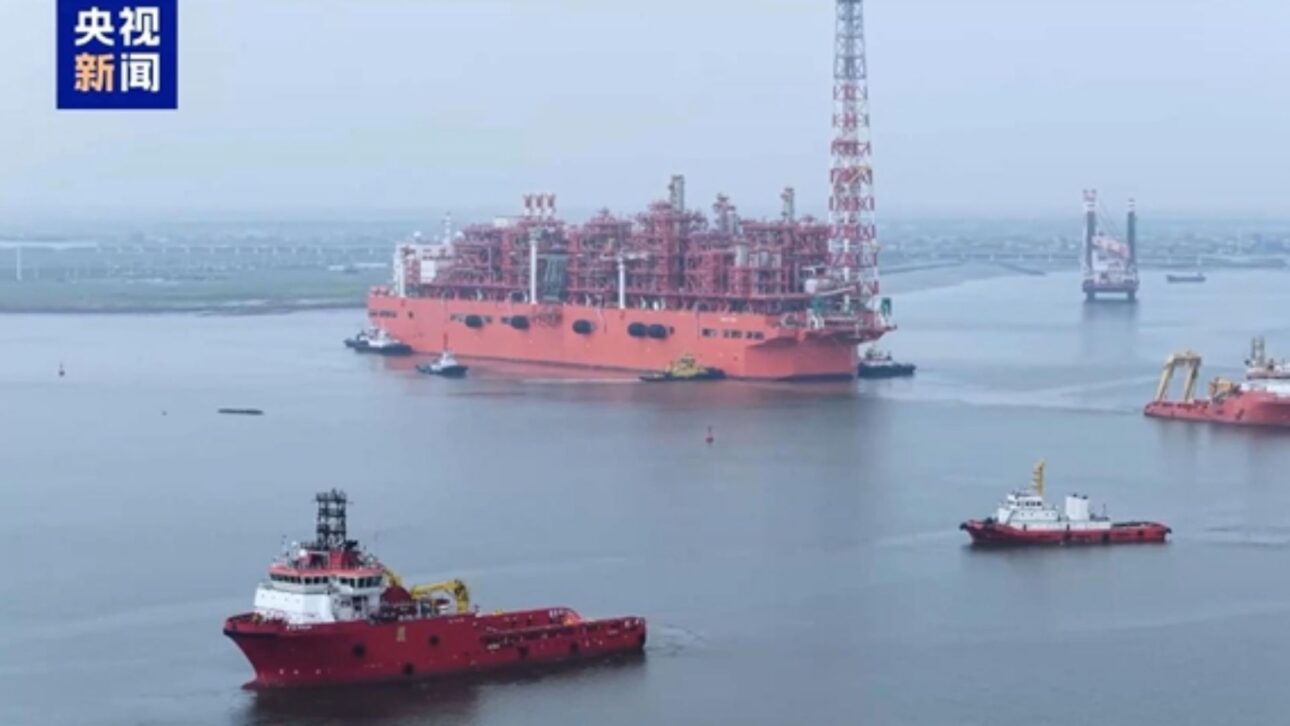
The structure’s numbers are impressive. NGUYA is 376 meters long, 60 meters wide, and 35 meters high, with the capacity to store 180,000 cubic meters of LNG and an additional 45,000 cubic meters of liquefied petroleum gas. It is a floating industrial city, designed to face the open sea for years.
The title it carries is specific. According to the Global Times, the NGUYA is the largest floating LNG factory ever built entirely in China, a milestone for the country’s naval and energy industry. It was assembled by Wison New Energies at the Nantong shipyard in Jiangsu province and represents a leap in China’s capacity to manufacture large offshore equipment.
It’s worth noting the magnitude of the achievement accurately. The NGUYA is the largest in China, not the largest in the world, an important distinction that the record itself makes clear. Even so, building a floating LNG factory of this size places China in a small club of countries capable of erecting such complex structures.
To visualize, a comparison is worthwhile. The 376 meters of the NGUYA are equivalent to almost four football fields lined up, or a skyscraper lying on the waves. It is such a large structure that, docked in a port, it would make any ship next to it look like a miniature, and yet it was made to sail thousands of kilometers and operate in open sea for years.
What is a Floating LNG Factory (FLNG)?
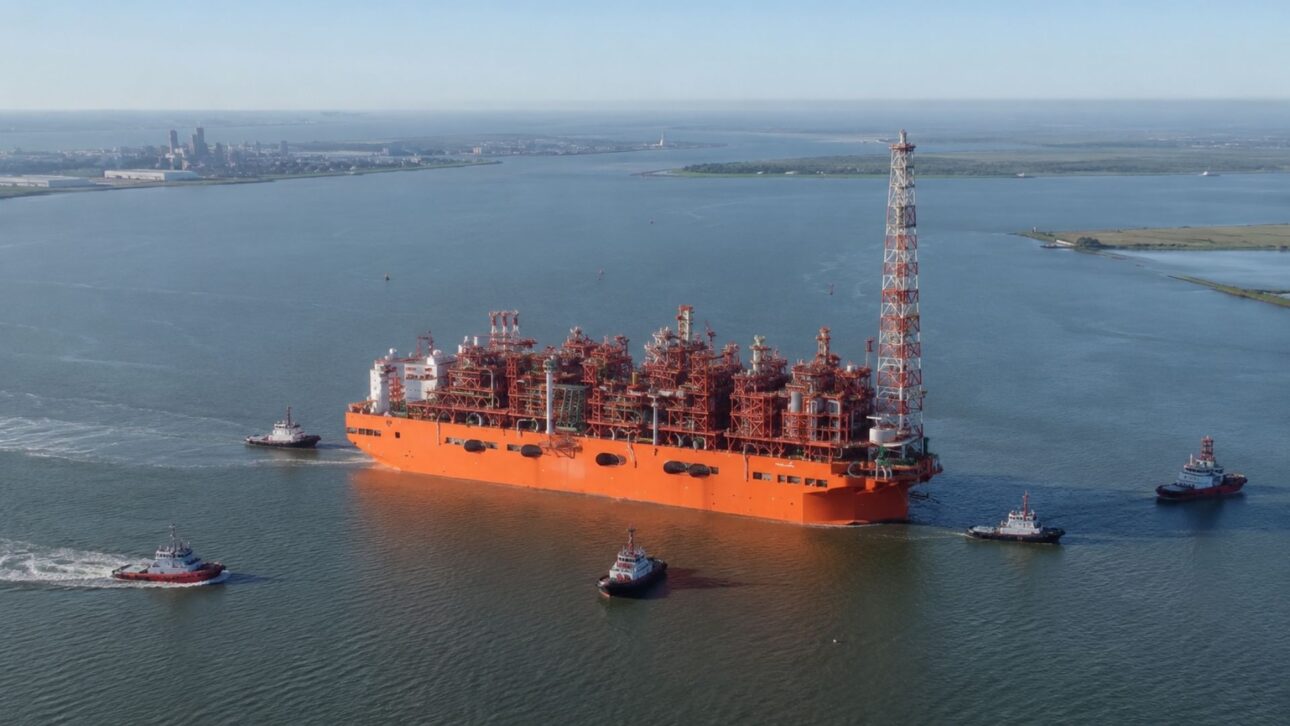
It’s worth explaining the concept because it is the key to everything. A floating LNG factory, known by the acronym FLNG, is a unit that does at sea what was previously only done on land: receiving natural gas extracted from the ocean floor, cooling it to about minus 162 degrees until it becomes liquid, storing it, and transferring it to ships. All this aboard a single structure anchored over the gas field.
The advantage is avoiding a giant construction on land. Instead of building long pipelines and a liquefaction plant on the coast, the company takes the factory to the deposit in the middle of the sea. This reduces cost, time, and impact, and allows for the exploitation of gas reserves far from the coast that would otherwise remain untapped.
When the gas becomes liquid, it shrinks and travels. LNG occupies about 600 times less volume than gas in its natural state, making it possible to transport it by ship anywhere in the world. It is this physical magic that the NGUYA will perform in the Congo sea, transforming gas that would remain trapped underground into exportable energy.
2.4 million tons per year for Eni
The projected production places the NGUYA in the elite of gas units. The floating LNG factory is designed to deliver 2.4 million tons of liquefied natural gas per year, a volume capable of supplying entire markets across the ocean. Each shipment that leaves there becomes fuel for power plants, industries, and homes.
The owner of the business is a European giant. The unit was commissioned by Eni, an Italian oil company present in several producing countries, which sees natural gas as a central bet for the energy transition. For Eni, having its own floating LNG plant means controlling the gas chain from the well to the ship, without relying on onshore infrastructure.
NGUYA will not work alone in Congo. According to Eni, it joins Tango FLNG, a smaller unit already operating in the country, and together they increase the LNG production capacity of the Congo LNG project to about 3 million tons per year. It is the second phase of a plan that transforms Congo into a new gas exporter.
Heading to Congo: Eni’s gas project in Africa
The destination of NGUYA tells a story of energy geopolitics. The unit will operate at sea near Pointe-Noire, on the coast of the Republic of Congo, a Central African country that has started to bet on natural gas as an economic engine. The Congo LNG project is Eni’s bet to extract from the seabed a resource that was underutilized.
The logic is clear for both sides. Congo gains royalties, jobs, and prominence in the energy market, while Eni gains another source of gas to supply Europe, which has been seeking new suppliers after the energy crisis of recent years. The floating LNG plant is the piece that enables this meeting of interests.
Anchoring such a structure at sea is not trivial. NGUYA was positioned dozens of kilometers from the coast, in deep waters, anchored to the seabed to withstand waves and currents during years of operation. It is cutting-edge engineering serving a single purpose: not letting Congo’s gas remain idle underwater.
The project’s schedule shows the oil company’s ambition. Eni has been assembling Congo LNG in phases, and the arrival of NGUYA marks precisely the second stage, which multiplies the country’s gas production. With both units operating, Congo establishes itself as an LNG exporter to the international market, a move that Eni has been repeating in other parts of Africa.
Built in record time: 33 months from contract to sea
The speed of the construction is almost as impressive as its size. Wison New Energies signed the contract with Eni at the end of 2022 and delivered NGUYA in about 33 months, from paper to launch, even a month ahead of schedule. For such a complex structure, it is considered a record time in the LNG sector.
This pace says a lot about the Chinese industry. Building a floating LNG plant involves thousands of workers, liquefaction systems, cryogenic tanks, and extreme safety, and doing all this quickly without losing quality requires a robust industrial chain. China demonstrated this capability by beating NGUYA’s schedule.
The record has market value, not just pride. The faster the floating LNG factory is ready, the sooner the gas starts generating revenue, which changes the equation of any energy project. Delivering ahead of schedule is, in essence, delivering money sooner to Eni and to Congo.
To understand the record, just look at the industry standard. Floating LNG factory projects usually take four to six years between contract and delivery, and delays are common, given the complexity. Doing this in about 33 months, and still ahead of schedule, is the kind of milestone that changes the timeline in the gas world and impresses even competitors.
Why has China become a powerhouse in floating LNG factories?
The NGUYA is not an isolated case, but rather a symptom of a turnaround. For years, the construction of floating LNG units was dominated by South Korean shipyards. China entered this competition with force, investing heavily in shipyards, technology, and labor to capture an expensive and strategic market.
The combination of price and deadline is the Chinese weapon. Shipyards like Wison can offer giant structures at competitive costs and in short timeframes, attracting oil companies from around the world. Each project delivered, like the NGUYA, serves as a business card for the next international contract.
There is also a national strategy behind it. Dominating the manufacturing of floating LNG factories places China at the center of the global gas chain, a sector expected to grow in the coming decades as a transition fuel. Exporting these structures is exporting cutting-edge technology and energy influence at the same time.
The largest in China, but not in the world: the comparison with the Prelude
Here comes an important clarification to avoid exaggerating the record. The NGUYA is the largest floating LNG factory ever built in China, but it is not the largest in the world. That title belongs to the Prelude, by the Anglo-Dutch Shell, an even larger unit, built in South Korea.
The difference in scale is considerable. The Prelude is about 488 meters long, much more than the 376 meters of the NGUYA, and has a higher production capacity, around 3.6 million tons of products per year. For a long time, it was cited as the largest floating structure ever made by humans.
This does not diminish the Chinese achievement, it just places it in the right context. Being the largest floating LNG factory in China, breaking a deadline record, is already a significant milestone and shows the country catching up with the historical leaders of the sector. The NGUYA’s record is national and of speed, not of world size, and telling this correctly is part of taking the information seriously.
Technology and low carbon on board
The NGUYA impresses not only by its size but by what it carries inside. According to Wison New Energies, the unit debuted in a floating LNG plant with a combination of liquefaction technology and storage tanks not previously used in this type of structure, which helps make it more efficient and safe.
There is also a concern with emissions. The unit was equipped with engines that can burn more than one type of fuel and with systems that reuse the heat generated in operation, features that reduce energy waste and carbon emissions. In a sector under environmental pressure, these details matter.
This reflects the ambiguous place of LNG in the transition. Natural gas pollutes less than coal and oil when generating energy, and for this reason, it is treated by many companies as a transition fuel. Equipping a floating LNG plant with low-carbon technology is how Eni and China respond to those demanding cleaner gas.
What this has to do with Brazil and the gas market
The case is of close interest to those following energy in Brazil. The country has enormous reserves of natural gas associated with pre-salt oil, much of which is still underutilized due to a lack of infrastructure to transport and process this gas at sea. A floating LNG plant is exactly the type of solution that could unlock part of this potential.
There is a specific problem that the technology would help solve. Part of the gas associated with pre-salt oil is still reinjected into the well or burned due to a lack of transportation infrastructure, a waste of energy and a source of emissions. A floating LNG plant installed over these fields could capture this gas and transform it into a product, instead of discarding it in the middle of the ocean.
Brazil is also a player in the LNG market. The country imports liquefied natural gas to complement supply during droughts when hydroelectric plants produce less and closely follows the global race for this fuel. Understanding who manufactures and operates LNG units is understanding the board on which Brazil sits.
Finally, there is the industrial lesson. The Chinese rise in the construction of floating LNG plants shows how investing in shipyards and technology can transform a country into a global supplier of expensive equipment. For the Brazilian naval industry, which has seen better days, the example of NGUYA is both a warning and an inspiration.
Did you know that there are factories that float on the sea?
The NGUYA proves the size that the gas industry has reached: a 376-meter floating LNG plant, the largest ever built in China, capable of producing 2.4 million tons per year and delivered in record time for the Italian Eni to operate in the Congo Sea. All of this floating, far from any port.
And you, did you imagine it was possible to build a gas factory the size of four football fields and have it sail to Africa? Share in the comments what impresses you most about this engineering and if you think Brazil should invest in floating LNG factories to take advantage of the pre-salt gas.