Portuguese
  Spanish


Discover how tiny living beings altered the landscape of the Black Sea in 2026, in a spectacle captured by astronauts and satellites.
The satellite PACE recorded an impressive transformation at the border between Europe and Asia, where the traditionally dark waters of the Black Sea gained an unusual and vibrant turquoise blue hue.
The natural phenomenon, which could be seen kilometers away by astronauts and orbital instruments, occurs due to the massive blooming of coccolithophores, a type of microscopic phytoplankton.
Scientists use remote sensing technologies to monitor the behavior of these species from a distance, circumventing limitations of direct sample collections to understand how the proliferation of these microorganisms alters the environmental dynamics of the region during the northern hemisphere’s spring.
-
Scientists Develop Innovative Material That Converts Visible Light to Ultraviolet, Unlocking New Possibilities for Optical Equipment and Advanced Communications

-
2011 Japan Earthquake Sent Seismic Waves to Earth’s Core, Returning in 15 Minutes and Shifting Entire Country Simultaneously, Scientists Reveal

-
NASA captures heart-shaped pink lagoon in Argentina’s salt flats
-
To Aid Mars Missions, 12 Volunteers to Spend 60 Days in Bed Without Getting Up, Earning €18,000 in Study Starting 2026


Space monitoring in the Bosphorus Strait
Orbital data demonstrated that the reach of this aesthetic change went beyond the usual boundaries of the sea.
On May 27, photographs taken from space had already detected the same turquoise hue in the Bosphorus Strait, a channel that cuts through the city of Istanbul, Turkey.
The behavior of the microorganisms in the region followed a well-defined dynamic:
- Navigation flow: The phytoplankton spread following the strong currents on both sides of the channel;
- Water connection: The colored patch advanced from the Black Sea towards the Sea of Marmara;
- Overcoming barriers: The sensors bypassed geographical restrictions to study the behavior of the species from a distance.
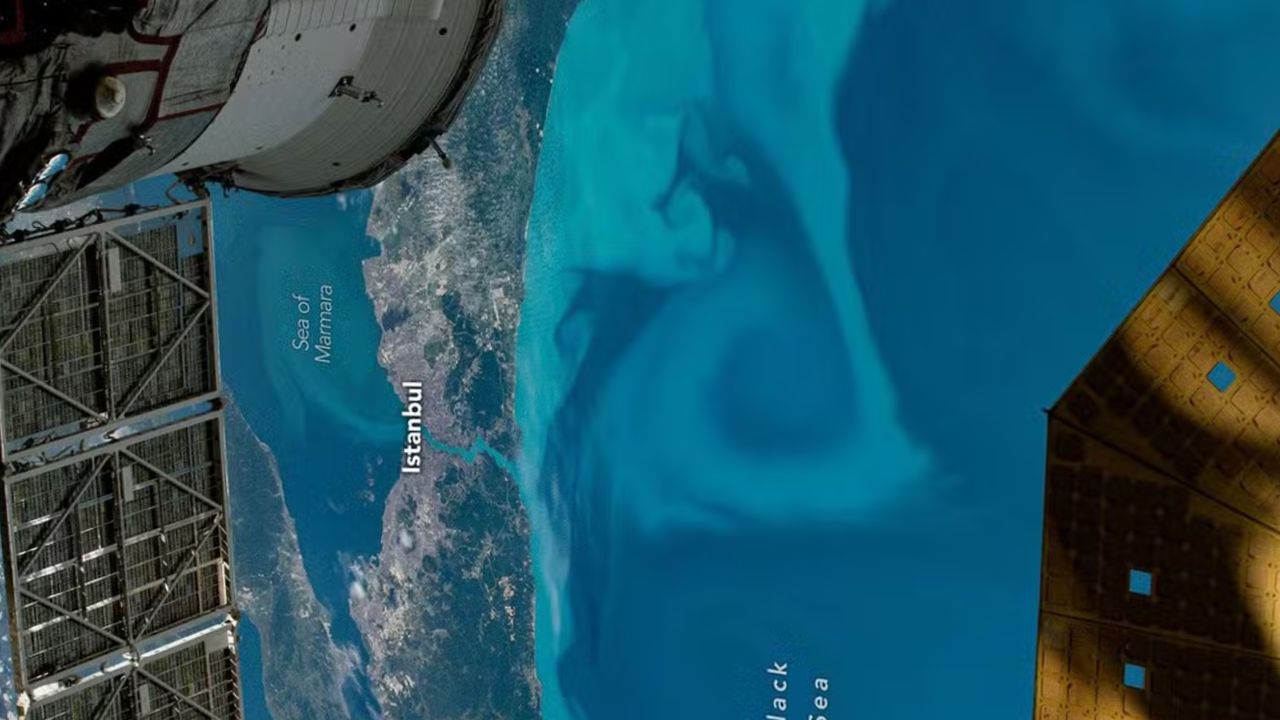
The microscopic beings behind the turquoise coloration
Although the color stain is gigantic and visible from space, the agents causing this visual “makeover” are completely invisible to the naked eye.
They are coccolithophores, a type of phytoplankton whose tiny bodies have a very specific physiognomy: they are completely covered by calcium carbonate plates.
When these organisms come together in large blooms, the calcareous material of their structures collectively reflects solar brightness.
This physical reaction gives the surface waters a milky-blue and somewhat murky appearance, generating the turquoise hue that varies in intensity each season.
The algae cycle and the origin of the sea’s name
This chromatic mutation follows a natural schedule linked to the seasons in the northern hemisphere.
The proliferation of coccolithophores occurs specifically during a transition period:
- Spring and summer: The calcareous beings multiply intensely between June and July;
- Autumn and winter: The surface darkens again due to the dominance of another group, the diatoms;
- Structural difference: Unlike coccolithophores, diatoms are microscopic algae protected by silica shells.
The importance of the phenomenon for the planet’s balance
Beyond the visual spectacle captured by space lenses, the life and death cycle of these microorganisms has a vital environmental function, as they directly contribute to the ocean’s carbon cycle.
As researchers point out, the blooms act as a climate regulator. When the phytoplankton die, a significant portion of the carbon they absorbed in life sinks and is deposited on the deep seabed.
Once at the ocean floor, this carbon can remain stored for extremely long periods, preventing the gas from returning to the atmosphere and helping control environmental balance.
Source: Revista Galileu