





 Portuguese
  English
  Spanish
  5 min of reading
  0 comments


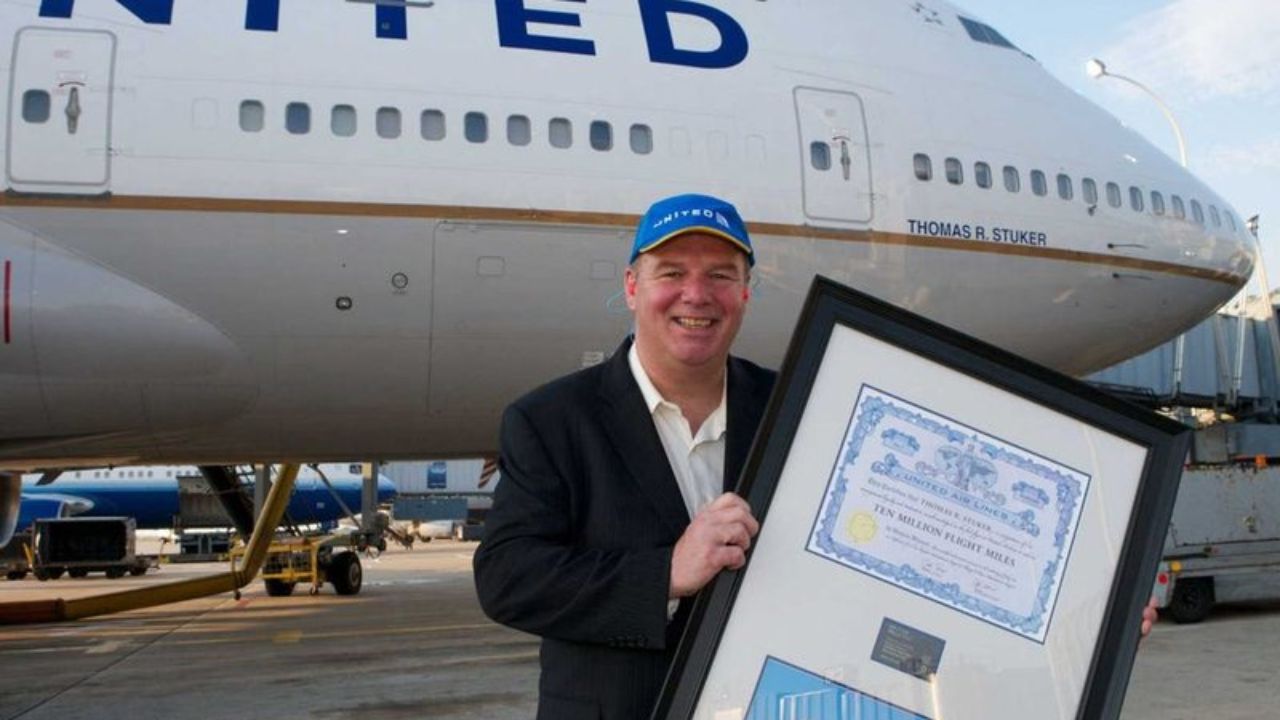
Legendary Investment Return: The Case of Tom Stuker and the Unlimited Risk Lesson That Cost Millions to American Airlines
What happens when a customer buys a genuinely ‘lifetime pass’ from an airline and decides to use it to the fullest? The answer lies in a fascinating and costly corporate saga that splits into two paths: United Airlines, which celebrates its superuser, and American Airlines, which sued theirs. The legendary Tom Stuker, a car dealership consultant from New Jersey, embodies the financial nightmare of the “unlimited” promise in the airline industry.
Stuker made what he calls the “best investment” of his life: the purchase of a ‘lifetime pass’ from United Airlines in 1990. The acquisition cost is consistently reported at US$ 290,000 (or US$ 510,000 with the companion pass). The financial return is staggering: just in 2019, the value of his 373 flights would have cost US$ 2.44 million (about R$ 11.7 million), validating the R$ 12 million savings mentioned in the planning. Financially, Stuker’s return in 2019, 29 years after the purchase, was over 800% on the base cost of US$ 290,000.
The Investment of US$ 290,000: The Legend of Tom Stuker and the 800% Return
The heart of Tom Stuker’s story lies in the audacity of his investment and the magnitude of his usage. In 1990, United Airlines sold a ‘lifetime pass’ to Stuker for US$ 290,000. While some sources cite a cost of US$ 510,000 for the companion option, Stuker, a car dealership consultant, transformed this expense into a long-term liability for the airline.
-
A refrigerator in the middle of the street in Poland is feeding those who are hungry and teaching children to share: the project already has 1,600 refrigerators spread across the country, and people leave soup, bread, and beets for strangers to take for free.

-
While Finland sees student performance decline in international assessments and tries to recover results with changes in education, countries like Brazil continue to draw inspiration from its educational model.

-
Brazil removes 18 million tons of sand from the seabed in a mega-operation costing R$ 333 million, paving the way for larger ships and turning the dredging itself into coastal reinforcement in the largest beach widening ever undertaken in the country.

-
A Catarinense repaired a Tesla battery that no one in Brazil knew how to fix, avoiding a loss of 150 thousand reais for the owner, and before that, had already built an electric car with notebook batteries controlled by a video game controller.

Quantifying Stuker’s Return on Investment (ROI) illustrates United’s initial miscalculation. The value of his flights, US$ 2.44 million (R$ 11.7 million), just in 2019, is the most crucial financial metric. Assuming the base cost of US$ 290,000, the return that single year was 841%, solidifying the investment as a “long-tail liability” for the company. For United Airlines, the program turned into a financially growing obligation that the airline chose to absorb.
The Mileage Decoding: Over 900 Trips Around the World


The popular metric that Stuker traveled the equivalent of “400 trips around the world” is already significantly outdated, serving as a previous milestone. This mark was reached when Stuker flew 10 million miles, around 2011.
However, the use of Stuker’s ‘lifetime pass’ continued to accelerate. By June 2023, he had flown almost 37 million kilometers, equivalent to 23 million miles. Reports from 2024 indicate he is nearing 24 million miles. This accumulated mileage equates to approximately 920 trips around the world, confirming his status as the most-traveled passenger on the planet.
Why United Transforms a Liability Into a Marketing Asset
United Airlines adopted a radically different strategic approach from its competitors: it celebrates him. Despite the obvious financial cost, United turned him into a public relations asset. The airline recognized him with the status “Global Services for Life” (GS for Life), its highest elite level, and even named aircraft in his honor.
Strategic analysis suggests that United determined that Stuker’s value as a “brand ambassador” and the “most frequent flyer in the world” outweighed his annual cost. His usage pattern, which included flying to Austraila over 400 times for his consulting work, was deemed legitimate. He also used his accumulated miles for extraordinary benefits, such as construction materials, proving that the contract was extremely valuable and, more importantly, that the usage was not fraudulent.
The Counterpoint: The Financial Disaster of American Airlines with the AAirpass
To understand United’s tolerance with Stuker, it’s essential to examine the parallel and disastrous program from American Airlines (AA), the “AAirpass”. Launched in 1981, the unlimited AAirpass was not conceived as a loyalty program, but as a fundraising tool during a time of financial difficulties and extremely high-interest rates.
AA needed a “quick cash infusion” and the AAirpass was the solution: essentially a loan of US$ 250,000 from its wealthiest customers, betting that the Time Value of Money (TVM) would outweigh the cost of future travel. It was a catastrophic risk modeling error. The company’s financial panic can be traced to the soaring AAirpass price, which rose from US$ 250,000 in 1981 to US$ 1.01 million in 1993, before its sales were halted in 1994.
The Fatal Flaw: The Real Cost of Unlimited Use
The AAirpass program was publicly termed a “great disaster” for the airline. The issue was not just the lost revenue; it was the cash costs associated with each free flight: AA was required to pay taxes and airport fees for each segment of a free flight.
Moreover, in a fundamental design failure, the program allowed the accumulation of loyalty miles. Customers like Steven Rothstein and Jacques Vroom accumulated tens of millions of miles in free flights. An internal investigation by American Airlines found that only two passengers, Rothstein and Vroom, were costing the airline more than US$ 1 million per year, each.
The Revocation: When Contract Fraud Takes Down the ‘lifetime pass’
Facing astronomical losses and financial difficulties, American Airlines targeted its most prolific users in the late 2000s. Steven Rothstein, who cost more than US$ 21 million to AA, and Jacques Vroom, who accumulated nearly 38 million miles, had their passes revoked abruptly in 2008.
AA’s legal justification to void a lifetime contract was “fraudulent activity”. In the litigation Rothstein v. American Airlines, the airline accused the banker of:
- Fictitious Names: Booking the companion seat with fake names like “Bag Rothstein” (Baggage Rothstein). AA claimed the purpose was to ensure an empty seat next to him, fraudulently blocking inventory.
- Speculative Bookings: Making thousands of reservations for companions who had no intention of traveling and canceling them at the last minute, which was framed as inventory manipulation.
Rothstein’s defense, which argued that AA had tolerated these practices for years, failed. In 2011, the U.S. District Court granted summary judgment IN FAVOR of American Airlines. The court determined that booking a seat in the name of “Bag” was, in fact, fraudulent, and the “fraudulent use” clause in Paragraph 12 of the contract was valid. In Vroom’s case, the allegation was that he was selling his companion seat, monetizing a non-transferable benefit.
None of American Airlines’ superusers were able to recover their ‘lifetime airline pass’. The lesson learned by the industry was clear: the importance of strict terms and conditions to prevent abuse and the futility of trying to price the “infinite.”
The Stuker-United versus Rothstein-American Airlines case shows that the difference between being a “PR hero” or a “sued fraudster” can lie in a single contractual clause. Do you believe that the promise of “unlimited” service should always be honored, or do companies have the right to revoke the contract in the face of such extreme use? Share your opinion in the comments and let us know what your main destination would be if you had a ‘lifetime airline pass’ today.









-

-

-

-

-

-

27 pessoas reagiram a isso.