






 Portuguese
  Spanish


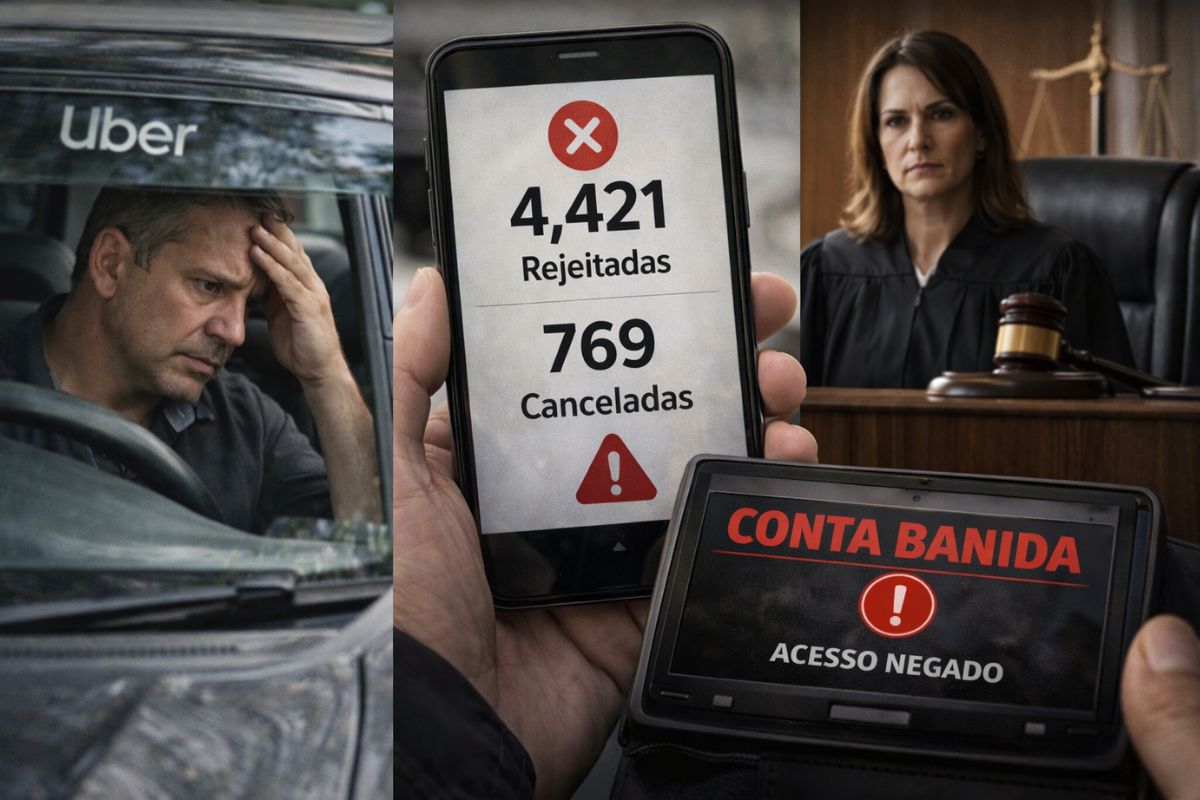


Although Uber allows occasional refusals, the case ruled in the Paulista coast shows that extreme repetition can be interpreted as contractual abuse: after thousands of denials and hundreds of cancellations, a driver lost count, had reinstatement and indemnification requests denied, and became a reference for the entire category.
At Uber, a driver was dismissed after refusing 4,421 rides and canceling 769 requests in just one month, according to records presented in the case analyzed by the court of Mongaguá, in the interior of São Paulo. The unusual volume became the center of the legal dispute and repositioned the debate on the real limits of autonomy on the platform.
The one who sought to overturn the ban was the driver himself, with requests for reinstatement and indemnification for moral damages and lost profits. Judge Lígia Dal Colletto Bueno upheld the ban, understanding that the repeated practice compromised the functioning of the service and contradicted the objective good faith expected in the contractual relationship.
What Weighed in the Case Ruled in Mongaguá
The data that caught the most attention in the Uber case was not an isolated refusal, but the scale of the conduct in a short span: 4,421 refusals and 769 cancellations in one month.
-
Brazil to Enforce New Rules on Betting Ads for 2026 World Cup, Mandating Warnings on Addiction and Financial Risks

-
Brazil to Gradually Increase Annual Revenue Cap for Microentrepreneurs to Between $130,000 and $140,000 by 2028
-
Toll Fees Drop by Up to 50% in São Paulo State’s Interior, Now as Low as $1.70
-
Brazil’s Central Bank Warns: Inflation Projected to Hit 5.2% in 2026, Exceeding Target Ceiling of 4.5%, with Risk of Missing Target Rising from 30% to 79%


In a digital platform environment, this type of pattern ceases to represent simple individual preference and begins to signal a permanent operational routine, with a direct impact on service dynamics.
In the action, the defense argued that the ban was unjustified, while the company presented a detailed history of account usage.
This contrast between the allegation and digital traceability was decisive: when there is consistent record of repeated behavior, the legal debate tends to shift from the driver’s subjective perception to the objective adherence to the rules accepted in the registration.
Refusal at Uber: Operational Freedom Does Not Equal Unlimited Refusal
The decision itself recognizes that Uber drivers can occasionally refuse rides. This point is central to avoid a simplistic reading of the case.
The problem arises when refusal ceases to be an exception and becomes a continuous method, creating a mismatch between what the contract tolerates as a specific choice and what it sees as a deviation from the purpose of the service.
In practical terms, the judge framed the behavior as an abuse of right, because extreme repetition harms the operational logic of the platform.
The legal boundary appears in the pattern, not in the isolated act: a refusal can be justifiable; thousands, accompanied by hundreds of cancellations in the same period, begin to compromise predictability, trust, and efficiency of the operation.
Why Objective Good Faith Gained Protagonism in the Decision
By upholding the dismissal from Uber, the judge emphasized objective good faith, a concept that requires coherence between the use of the app and the purpose of the contract.
This is not about removing all autonomy from the driver, but about preventing contractual freedom from being used in a way that is incompatible with the service offered to the passenger and with the platform’s community rules.
This reasoning also explains the denial of requests for reinstatement and indemnification. If the company proves that there was repeated non-compliance with accepted conditions, the Judiciary tends to validate the ban as a contractually legitimate measure.
The consequence is clear: without evidence of abuse by the platform, the strength of the operational records presented in the case prevails.
The Warning for App Drivers Goes Beyond This Case
The case of Uber in Mongaguá does not eliminate the right to refuse rides, but repositions the risk for those who turn refusal into a permanent strategy. The practical message for drivers is objective: it is not just about whether they can refuse, but how often, in what pattern, and with what effects on the continuous provision of service.
There is also an educational effect for professional routines. Management of acceptance and cancellation has become a matter of survival on the platform.
Instead of treating refusals as an automatic mechanism in daily life, the driver now needs clearer operational criteria, balance between autonomy and contractual rules, and constant reading of internal policies to reduce the risk of permanent dismissal.
The decision reinforces a point that many professionals have already perceived in practice: at Uber, occasional refusal remains possible, but massive and repeated refusal can be understood as contractual violation, with maintenance of the ban even after attempts at judicial return.
The case answers, at the same time, who was affected, how much was refused, where it occurred, and why the ban was upheld.
In your view, what would be a fair limit between the driver’s autonomy and commitment to the platform’s functioning: distance of the ride, value, travel time to pick-up, or monthly cancellation rate? And, in real routine, which rule do you consider the most difficult to balance without compromising income and permanence on the app?


Corridas de 4,62 isso eles não falam né trabalhar de graça aí não vai
Uber bandida quer escraviza motorista forçando a rodar 1 real o km
Sou usuária e concordo com o motorista NÃO ACEITAR a corrida se não for conveniente para ele, porém, CANCELAR depois de ter aceito, acho um desaforo, pois antes de aceitar ele recebe as informações de localização, valor, etc., então daí acho muito certo da Uber banir este tipo de motorista.