Portuguese
  Spanish


Wu Yulu, self-taught Chinese inventor, created dozens of robots with scrap, left a village near Beijing and gained international recognition.
In the outskirts of Beijing, in a rural village, Wu Yulu turned scrap into international notoriety. Without formal education beyond primary school, the Chinese farmer became known for building handcrafted robots with wires, screws, wheels, plastic barrels, and repurposed parts, in a work that spanned decades and took him out of anonymity.
The recognition came because his machines were not mere ornaments. Reuters reported that Wu’s robots could serve tea, light cigarettes, paint pictures and even pull him in a kind of mechanical rickshaw, while the inventor called these creations his “children” and continued to expand a metallic family that, by 2015, already reached 60 robots.
Wu Yulu started without technical training and learned robotics through trial and error
Wu Yulu’s story is striking precisely because it was born far from universities, laboratories, and research centers.
-
Telescope Set to Discover 100,000 New Planets Arrives at Launch Site, Ushering in a New Era of Astronomy

-
Humanoid Robots Transition from Demonstrations to Real Work in Factories
-
Anti-poaching patrol in Thailand accidentally discovers hidden cave with 2,000-year-old petroglyphs, geometric engravings, and mysterious three-finger patterns on sandstone walls.

-
Russia Deploys Largest Nuclear Icebreaker in Arctic Capable of Breaking Through Three-Meter-Thick Ice



Reuters reported in 2010 that he did not receive education after primary school, while China Daily reported in 2015 that he had dropped out of school very early, before dedicating his life to inventing machines.
Without theoretical training, Wu learned empirically. In an interview with Reuters, he summarized this obsession by saying that, from a young age, his greatest interest was using his mind, especially with machines, fascinated by everything that moved.
Reuters recorded that his first really simple contraption began to take steps in 1986, a milestone he himself treated as the beginning of the journey that would transform him into the most unlikely of Chinese rural inventors.
Scrap robots became the trademark of the Chinese inventor
What made Wu Yulu famous was the combination of the precariousness of materials and the complexity of the result. According to Reuters, he made robots with wire, screws, and scrap, and these machines could perform actions that surprised the public, such as serving tea, offering fire to smokers, and painting.
Over time, the prototypes ceased to be isolated experiments and began to form a recognizable set. In 2010, Reuters reported that he had already built more than 47 robots; five years later, China Daily pointed out that this number had already reached 60, showing that the farmer’s improvised workshop continued producing even after fame.
This growth was not just quantitative. Wu also said he wanted robots to be increasingly useful to humans, and Reuters reported projects such as a robot that gave massages and another designed to help cut meat during food preparation.
The metal family that made Wu Yulu call machines his children
The most striking dimension of this journey may not lie in mechanics, but in the emotional relationship Wu created with his inventions.
In Reuters reports, he treated the robots as “children” and even described one of his most famous models as the thirty-second child, a life-sized machine that pulled him through the village.
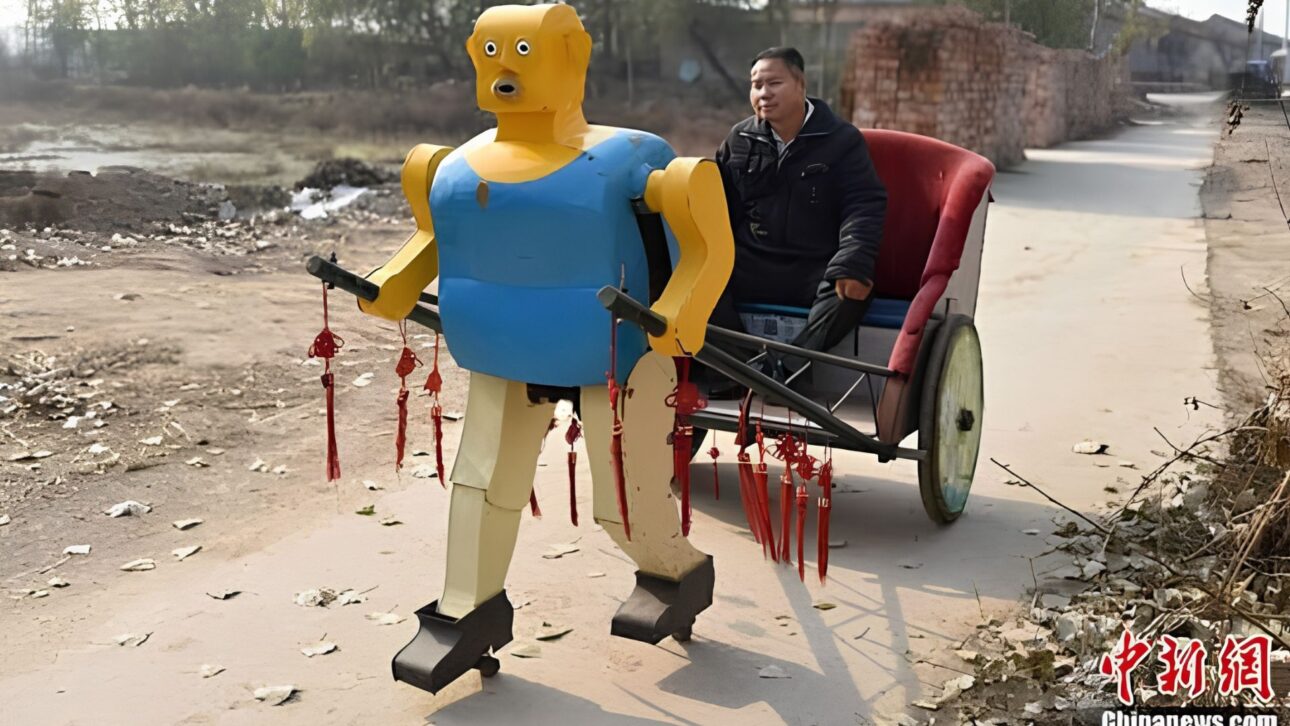
This robot, built as a kind of mechanical rickshaw, helped consolidate the inventor’s public image. Reuters described the scene of Wu being transported by the talking contraption, while the machine loudly announced that Wu Yulu was its father and that it was taking him for a ride around the city.
This detail helped transform the story into something more than a technical curiosity. Wu’s robots were not presented as cold industrial products, but as extensions of the inventor’s own life, built with affection, persistence, and a very personal logic of kinship between man and machine.
The price of obsession with robots almost destroyed his house and family
Wu Yulu’s dedication to robotics came at a high cost. In 2009, Reuters reported that he set his own house on fire, was hit by battery acid, suffered burns on his face and chest, and was hospitalized due to explosions and accidents related to his experiments with his machines.
The financial impact was also severe. The same report stated that he incurred debts with friends and relatives and that, at one point, this liability reached 90 thousand yuan, a heavy amount for the rural reality in which he lived.


The pressure hit domestic life hard. Reuters reported that Wu’s wife even considered leaving him after years of living with destruction, financial strain, and an obsession that consumed practically everything around, although later the inventor’s own notoriety helped alleviate part of this crisis.
From the fields to the Shanghai Expo, the leap that took Wu Yulu to the world
For a long time, Wu was seen only as a local eccentricity. This began to change when the Chinese and foreign press started to pay more attention to that self-taught farmer who built functional machines in his backyard, turning an obsessive hobby into a symbol of popular inventiveness.
The turning point came in 2010, when he gained space at the World Expo in Shanghai. Reuters reported that his creations attracted attention before and during the event, at a time when Wu was already becoming a known name in China and was starting to receive interest from international media.
This visibility also expanded beyond the country. According to Reuters, his colorful robots had already been exhibited in Japan, Korea, and Hong Kong, proving that the rural inventor from Mawu had long surpassed the boundaries of the village where he began assembling scrap and imagining movement.
Innovation without a degree turned Wu Yulu into a symbol of improvised creativity
Wu Yulu’s journey gained strength because it challenges a central idea of contemporary innovation: that only major technological centers produce relevant inventors. In his case, the creative drive emerged in the countryside, amidst financial limitations, mechanical improvisation, and a practical curiosity that never depended on academic titles.

Even after gaining fame, the essence of the work remained the same. China Daily showed that, decades after the first robot, Wu continued to be active and refining his creations, now with the help of his son in more complex tasks, indicating that his home workshop never stopped evolving.
In the end, Wu Yulu’s story remains powerful because it combines three rare elements in the same character: humble origins, extreme persistence, and real invention. Instead of waiting for ideal conditions, he built a unique path with what he had at hand and taught scrap, literally, to walk.