Portuguese
  Spanish


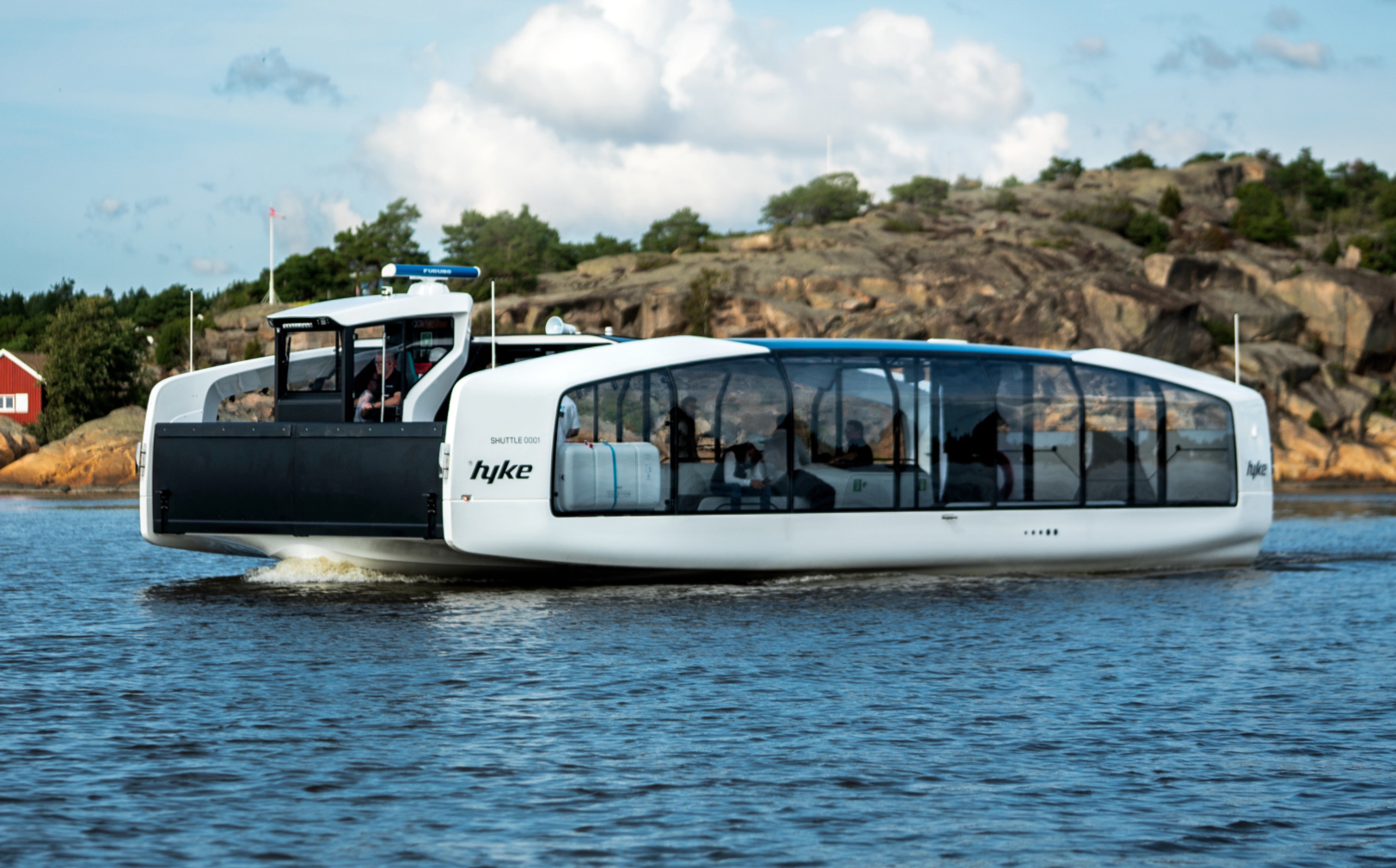


Hyke F-15 electric ferry has already transported over 41,000 passengers in Norway and consumes up to 8 times less energy than diesel boats.
Between November 2023, when the electric ferry test project was presented at the Fredrikstad Living Lab by the European SUM program, and April 2024, when the Norwegian manufacturer Hyke officially launched the public route of the Hyke F-15 Shuttle in the city of Fredrikstad, Norway, the vessel ceased to be just a technological promise and began operating in the daily transport of the population. In a report published on April 23, 2026, the Electrive website reported that the model, presented in 2023, entered daily operation on the Bekkhus–Vaterland route starting in April 2024.
Operational data helps explain why the case has come to be treated as one of the most concrete examples of real electrification of urban waterway transport in Europe. According to Electrive‘s findings, the ferry operated daily between April 2024 and July 2025 and transported over 41,000 passengers during this period, on a short urban crossing of about 225 meters with an average travel time of approximately two minutes.
Unlike many projects that remain restricted to the demonstration phase, the Hyke F-15 Shuttle did not remain an isolated prototype. It was put into daily public service, integrated into the local mobility network, to test under real conditions whether a light electric vessel could function as part of urban public transport.
-
Longest Solar Eclipse of the Century Will Turn Day to Night for Over 6 Minutes, Allowing Star Gazing; Won’t Recur for 156 Years

-
Brazilian Researcher Develops Protein Supplement from Tilapia Waste, Combining Innovation and Sustainability with Economic Potential

-
Women in São Paulo Unknowingly Tracked by Coin-Sized Tags Hidden in Cars and Belongings, Raising Stalking Concerns
-
Near a $750 million AI data center in Brazil, a resident’s well runs dry, leaving her unable to afford the $25,000 needed for repairs.


15-meter vessel designed for energy efficiency and urban operation
The Hyke F-15 was designed with a focus on efficiency and adaptation to urban environments. Approximately 15 meters long, the ferry was designed to operate in canals, rivers, and coastal areas with limited infrastructure, eliminating the need for large terminals or complex adaptations.
The vessel uses all-electric propulsion, powered by rechargeable batteries, eliminating the need for combustion engines.
Furthermore, the hull design was optimized to reduce hydrodynamic resistance, improving energy performance. This set of characteristics allows the ferry to operate with significantly lower consumption compared to traditional vessels.
Electric ferry’s energy consumption can be up to eight times lower than diesel boats
One of the most relevant data points of the project is energy efficiency. According to manufacturer information and technical reports, the Hyke F-15 can consume up to eight times less energy than equivalent diesel-powered vessels.
This difference is associated with several factors:
- More efficient electric motors
- Reduction of mechanical losses
- Optimized hull design
- Operation on short and controlled routes
In practice, this means lower operational cost and significant emission reduction.
Silent operation reduces urban impact and improves passenger experience
Another important differential of the electric ferry is the noise level. Diesel engines generate constant vibration and noise, especially in aquatic environments where sound propagates easily. The Hyke F-15’s electric system, on the other hand, operates almost silently.

This brings benefits for both passengers and the urban environment. In densely populated areas, noise reduction contributes to improving quality of life, while in natural regions it helps minimize the impact on aquatic fauna.
Operational silence is one of the factors that make electric transport more suitable for urban environments.
Electric ferry integrates into public transport systems and expands mobility in coastal cities
The use of the Hyke F-15 in Fredrikstad demonstrates a strategic point: integration with public transport. Instead of operating as an isolated service, the ferry was incorporated into the urban system, acting as an extension of land routes.
This model allows for:
- Reduce urban road congestion
- Utilize canals and rivers as transport corridors
- Lessen pressure on land infrastructure
In this context, water ceases to be an obstacle and becomes part of the mobility solution.
Compact design allows operation in areas where large vessels cannot operate
Another relevant aspect of the project is the reduced size of the vessel. At 15 meters, the Hyke F-15 can operate in areas where larger ferries would not be viable, such as narrow canals or regions with limited infrastructure.


This flexibility expands the number of possible routes and allows the system to be adapted to different cities. The combination of compact size and electric propulsion makes the model versatile for different urban contexts.
The electrification of maritime transport is considered one of the important challenges of the energy transition. Diesel vessels are responsible for greenhouse gas emissions and local pollutants, especially in port and urban areas.
The Hyke F-15, by operating with electricity, eliminates direct emissions during operation. This factor positions the electric ferry as part of transport decarbonization strategies.
Norwegian model can serve as a reference for other cities worldwide
The experience in Fredrikstad is seen as a replicable example. Cities with rivers, canals, or coastal areas can adopt similar models, adapting electric vessels to their local needs.
Countries with a strong urban presence in coastal regions, such as Brazil, the United States, and Asian countries, can benefit from this type of solution.

The Norwegian case shows that water transport can be integrated into modern urban mobility. Despite advances, the model also presents challenges. The battery autonomy is still limited compared to fossil fuels, which restricts its use to short routes. Furthermore, the need for charging infrastructure may require initial investments.
These factors indicate that the technology is currently more suitable for specific urban routes. Even with these limitations, technological advancement tends to expand the possibilities of use.
Given this scenario, can urban water transport gain ground in the coming decades?
The Hyke F-15 shows that electric water transport is already an operational reality. With high energy efficiency, low environmental impact, and integration with urban systems, the model points to a new form of mobility in cities with access to water.
The direct question that arises is: if rivers and canals can function as clean and efficient corridors, to what extent can urban water transport expand and compete with buses and cars in the coming decades?