Portuguese
  Spanish


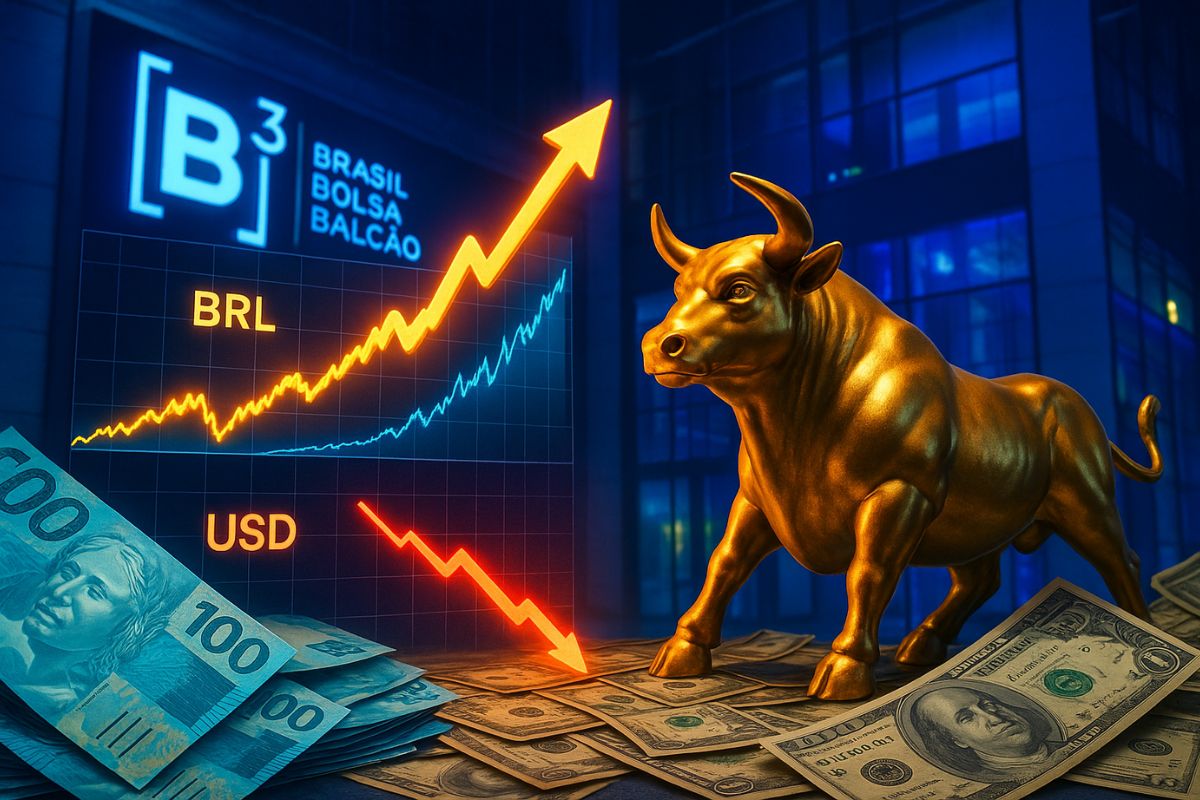


Despite the Record in Reais, the Brazilian Stock Market Today Is Worth Almost Half of Its 2011 Peak in Dollars, According to Rob Correa, Which May Indicate That the True Potential Has Not Yet Begun.
The narrative that the Brazilian stock market is experiencing its best moment in history because the Ibovespa has surpassed 142,000 points in reais does not show the full reality. In dollars, the index is worth a little over 26,000 points, compared to 45,000 in 2011, which means it is still undervalued on the global stage. For analyst Rob Correa, this mismatch creates a rare opportunity for attentive investors.
This phenomenon is not new. Whenever Brazil adopts fiscal discipline and structural reforms, foreign capital returns in large amounts, triggering cycles of strong appreciation. The question, according to Correa, is whether the internal and external environment will be able to repeat this movement in the coming years.
Super Cycles That Marked History
Two periods show how the Brazilian stock market reacts strongly to economic adjustments.
-
Payment Infrastructure Expert Highlights Diverse Realities in Latin American E-commerce, with Card Usage Ranging from 89% in Ecuador to 50% in Colombia

-
Brazil’s Central Bank’s Tight Monetary Policy Risks Stifling Both Production and Demand Amid High Inflation and Fiscal Imbalance

-
Over a Century After the Sinking, US Takes Legal Action to Stop Auction of Over 100 Titanic Artifacts

-
Chinese Rail Port in Inner Mongolia Surpasses 25,000 China-Europe Trains, Connecting 75 Routes Across Over 10 Countries, Showcasing Central Corridor as a Strong Land Alternative to Long Sea Routes


Between 2002 and 2007, after Lula’s election and the boom in commodities driven by China, the Ibovespa multiplied historically.
Then, between 2016 and 2020, with measures like the spending cap and the pension reform, the index jumped from 39,000 to 120,000 points, a 200% appreciation.
Rob Correa points out that these movements always depend on fiscal and political confidence, without which the cycle can be lost.
For him, the 2026 elections will be decisive: if the next government signals fiscal responsibility, the Brazilian stock market could experience a new boom comparable to the great previous cycles.
The Role of the International Scenario
In addition to internal decisions, the global environment is crucial.
The Federal Reserve (Fed) keeps U.S. interest rates around 5.5%, but has already indicated cuts that could bring rates to 4% or even 2% by 2025.
With lower interest rates in the U.S., investors tend to migrate to emerging countries, in search of higher returns, which directly favors Brazil.
This flow of external capital could further boost the Brazilian stock market in dollars, raising the value of national stocks on a global scale.
Rate Cuts Open Space for Appreciation
Within the country, the environment also appears favorable.
The Selic is at 15%, but the projected inflation for 2025 is only 4.8%. This means the real interest rate is around 10%, one of the highest in the world.
For Rob Correa, this level is unsustainable and creates room for deeper cuts in the basic interest rate.
Historically, each cycle of Selic rate cuts has favored the stock market.
Data from the Central Bank shows that the Ibovespa advanced on average 20% in the six months following the start of interest rate cuts, reinforcing the current positive expectation.
Three Factors for a New Cycle


In Rob Correa’s view, Brazil today combines three decisive elements: a cheap Brazilian stock market in dollars, the Selic on a downward trajectory, and the Fed about to loosen its monetary policy.
This combination creates a scenario similar to the great super cycles of the past.
The warning, however, is clear: these periods of euphoria also bring traps. Investors without discipline and risk management may lose money even in an apparently favorable environment.
In your opinion, is the Brazilian stock market really cheap in dollars and ready for a new super cycle of appreciation or could political risks hinder this movement? Do you think the global interest rate scenario will favor Brazil? Leave your opinion in the comments — we want to hear from those who follow this market in practice.