






 Portuguese
  Spanish


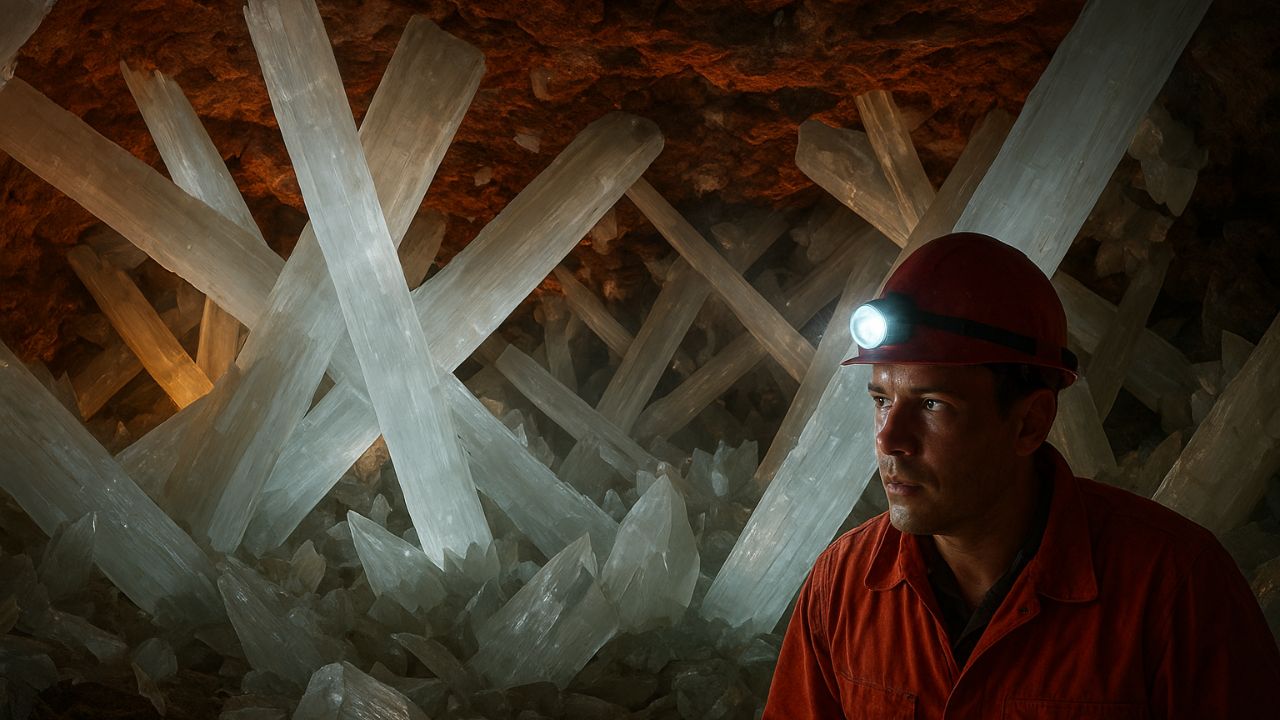


This Cave Discovered in 2000, Known as the Naica Crystal Cave, Operates in Extreme Heat of 58°C, a Lethal Environment That Allowed Geological Formation.
An accidentally discovered cave by miners in Naica, Mexico, revealed one of the most impressive geological treasures on the planet. Located 300 meters deep, the Cueva de los Cristales (Cave of the Crystals) houses the largest formations of selenite (gypsum) in the world, with translucent beams reaching up to 12 meters long and weighing an estimated 55 tons. The discovery, which occurred in 2000, opened a portal to a world that seemed straight out of science fiction.
However, this underground sanctuary is also one of the most hostile locations on Earth. With temperatures reaching 58°C and humidity close to 100%, the environment is lethal for unprotected humans. Paradoxically, it was these extreme conditions that allowed not only the growth of giant crystals over half a million years, but also the preservation of ancestral life forms, redefining what we know about biology and the search for extraterrestrial life.
The Genesis of the Giants: Heat and Geological Patience
The formation of these colossal crystals is the result of a rare geological convergence that took millions of years. As detailed by the portal Turismo.ig, the cave is situated above a magma chamber that, about 26 million years ago, heated the groundwater. This water became supersaturated with minerals, specifically anhydrite (a form of calcium sulfate without water).
-
Phone Falls from Plane at 300 Meters in Rio de Janeiro, Continues Recording for 15 Seconds, Found by Environmentalist Next Day in Unbelievable Twist

-
8-Year-Old Finds 900-Year-Old Viking Bronze Buckle on Swedish Beach While Fossil Hunting
-
8-Year-Old Who Ran Barefoot Wins Race in Brazil with Shoes Gifted by Famous Athlete, Becomes Symbol of Hope but Family Seeks Support to Sustain Athletic Dream
-
Couple Transforms Abandoned Farm in São Paulo into Major Poultry Operation with 295,000 Birds and Plans for Expansion


The secret to gigantism was time and temperature. Turismo.ig explains that, around 500,000 years ago, the water temperature dropped to the ideal range, between 54°C and 58°C. In this perfect and incredibly stable thermal window, anhydrite slowly dissolved, providing ‘nourishment’ for the gypsum (selenite) crystals to grow. The growth rate was infinitesimal, estimated at the thickness of a sheet of paper every 200 years, allowing them to reach monumental sizes over half a million years.
The Translucent Hell: Why Naica is Lethal?
A post shared by Mexico a través de una lente (@mexicoatravesdeunalente)
The beauty of Naica hides a deadly environment. The discovered cave maintains conditions that the human body simply cannot withstand for more than a few minutes. Sources such as the site Tempo describe the atmosphere as a ‘hell’: temperatures reaching 60°C and a relative humidity of almost 100%. In this scenario, sweat does not evaporate, preventing the body from cooling and quickly leading to uncontrolled hyperthermia.
The most immediate and insidious danger, as reported by Tempo, is the risk of drowning in the air itself. When a person breathes air at 60°C and 100% humidity, it encounters the lungs, which are at 37°C (cooler). This causes the immediate condensation of vapor into liquid within the alveoli. Essentially, breathing begins to fill the lungs with water, a process that can quickly kill an unprotected individual. For this reason, scientists required special cooling suits and autonomous air systems, limiting their time in the cave to less than an hour.
Extinct Life: NASA’s Biological Discovery
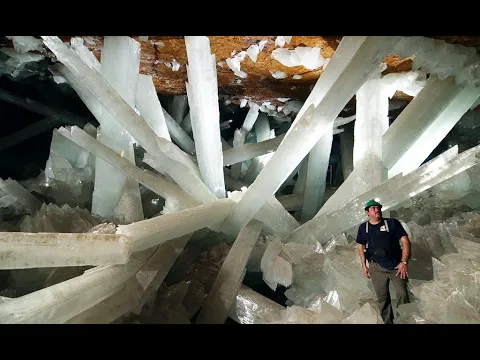

Beyond geology, the cave discovered in Naica held biological secrets that intrigued astrobiologists. A study led by NASA, and reported by Exame, investigated the interiors of the giant crystals. Upon drilling them under sterile conditions, scientists found tiny fluid pockets trapped inside, containing ancestral microbes that had been isolated from the outside world.
The most impressive thing, according to Exame, was that the team of scientists managed to ‘revive’ these microorganisms in the lab. Analyses indicate that they had been in a dormant state, trapped inside the crystal, for a period between 10,000 and 60,000 years. These organisms, genetically distinct from nearly everything we know, survived not on light, but through chemosynthesis, feeding on the minerals of the cave, such as sulfite and copper.
This discovery has profound implications for astrobiology. The ability of life to survive in stasis for millennia, protected within minerals in such an extreme environment, suggests that similar scenarios may exist elsewhere in the solar system. Exame highlights this connection, as life may be ‘hidden’ in a similar way beneath the surface of Mars or on the icy moons of Jupiter and Saturn, waiting for conditions to awaken.
The Submerged Legacy: Where is the Cave Today?
The golden age of human exploration of Naica was spectacular, but brief. The discovered cave was only accessible because the mining company, Industrias Peñoles, continuously pumped millions of liters of water to keep the working tunnels dry. In 2015, mining operations were suspended due to economic factors and flooding difficulties in other areas. As a result, the pumps were turned off.
Without artificial pumping, nature quickly took its course. The heated, mineral-rich groundwater began to rise and completely flooded the Cave of the Crystals once again. Today, it is inaccessible, submerged in its natural state. Although it seems a tragic loss for science, the scientific community views the flooding as the greatest act of preservation possible. The water protects the fragile crystals from physical damage, vandalism, or degradation that the air could cause. Returned to its liquid cradle, the cave is now protected, perhaps even restarting its infinitesimal growth, waiting for future generations that might have non-invasive technology to study it again.
The history of the Naica Cave shows us a delicate balance between the wonder of discovery and the need for preservation. In your opinion, should sites of scientific significance and such extreme beauty be kept accessible for study, even with the risks and costs, or was the decision to let it flood the most correct one to protect this geological treasure? Share your perspective in the comments.


Que valor para nós teria algo que não podemos explorar ou conhecer, qual a sua razão de existir?
Very well presented. Every quote was awesome and thanks for sharing the content. Keep sharing and keep motivating others.