Portuguese
  Spanish


While The World Looks At Stealth Fighters And Attack Drones, China Identifies As Its Greatest Concern A Cold War Giant: The B-52 Stratofortress, The Oldest Nuclear Bomber Still In Operation And A Living Legend Of US Military Deterrence.
In popular imagination, the greatest aerial threat to the United States would be some radar-invisible fighter or a swarm of supersonic drones guided by artificial intelligence. But for the Chinese military, the biggest nightmare still has the face, weight, and roar of the 1950s. It is the legendary B-52 Stratofortress — an intercontinental bomber that defies time, enemies, and even logic, and also the oldest military aircraft in the world.
More than 70 years after its first flight, the nuclear bomber B-52 remains active, capable of carrying nuclear warheads, cruise missiles, and causing destruction on a continental scale. Amid the silent arms race between the US and China, this “monster” is seen as the greatest symbol of American strategic deterrence, far ahead of any drone or next-generation aircraft.
What Makes The B-52 Such A Durable Threat? Meet The Oldest Military Aircraft In The World


Created in the 1950s, the B-52 Stratofortress — the oldest military aircraft in the world, was designed to drop nuclear bombs from high altitudes, with a range capable of crossing oceans without the need for refueling. But it has evolved. Today, the aircraft can:
-
Cape Verde’s World Cup Surprise: Betting on Electric Cars, a 5 MW Solar Plant, and an Ambitious Plan to Transform Energy for 600,000 Residents

-
Man Finds 1,469 Ancient Roman Silver Coins While Metal Detecting in Romania
-
Young Brazilian Siblings Go Viral for Catching Giant Fish, Launch Sport Fishing Project
-
72-Year-Old Retired Professor from Rural Brazil Recites 247 Digits of Pi in One Minute, Setting National Memory Record


- Carry up to 32 tons of armament, including cruise missiles with nuclear warheads;
- Perform non-stop missions of 14,000 km;
- Fly for over 60 hours with aerial refueling;
- Be continuously modernized, with avionics, radar systems, and armaments from the 21st century.
In 2024, the US Air Force announced a new round of upgrades for the B-52, which include more efficient engines, electronic warfare systems, and hypersonic armaments. The plan is to keep it operational until 2050, completing a century of activity — something unprecedented in the history of military aviation.
A Threat More Psychological Than Technological?
For many analysts, the B-52 is not just a weapon: it is a statement. Its presence in military exercises near China and North Korea has a clear goal: to show that the US nuclear deterrent capability is always ready, always flying.
Recently, Chinese military authorities classified the B-52 as “the most symbolic threat of American nuclear doctrine”, precisely for combining three key elements:
- Massive Destructive Power: nuclear warheads capable of destroying entire cities;
- Strategic Penetration Capability: global range, in-flight refueling, and multiple attack options;
- Historical Legacy: a machine that has already survived the Cold War, Vietnam, Iraq, Afghanistan, and now enters a new era.
B-52: The Flying Legend That “Never Dies”
The B-52 is the oldest military aircraft still in active service. No other aircraft — be it fighter, drone, or bomber — has accumulated as many flight hours, missions, and such time under the spotlight of global nuclear strategy.
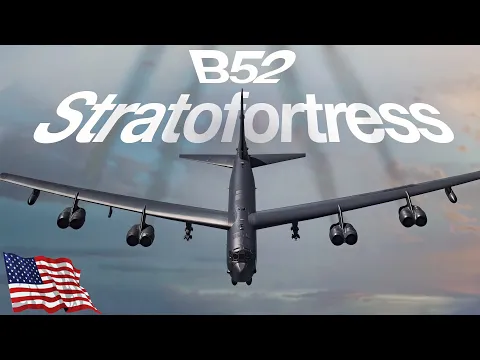
Currently, 76 units are active in the US Air Force, continuously modernized under the “B-52J” program, which plans to install new Rolls-Royce F130 engines, replacing the TF33 models from the 1960s.
These new engines will ensure:
- 30% reduction in fuel consumption;
- Lower thermal and radar signature;
- More range and less maintenance.
This way, the B-52 can operate more efficiently than ever — even after 70 years of service.
China’s Fear: It’s Not The Plane Itself, But What It Represents
For the Chinese military, the fear comes not only from the nuclear warheads the B-52 can carry. The real fear is what this aircraft represents: persistence, escalation, and immediate response.
In times of tension in the South China Sea, Taiwan, and the expansion of US bases in Asia, seeing a B-52 on the radar is a reminder that the US is ready to escalate the conflict if necessary. And with a fleet that can fly for 14 hours without landing, there is no safe place enough to ignore it.
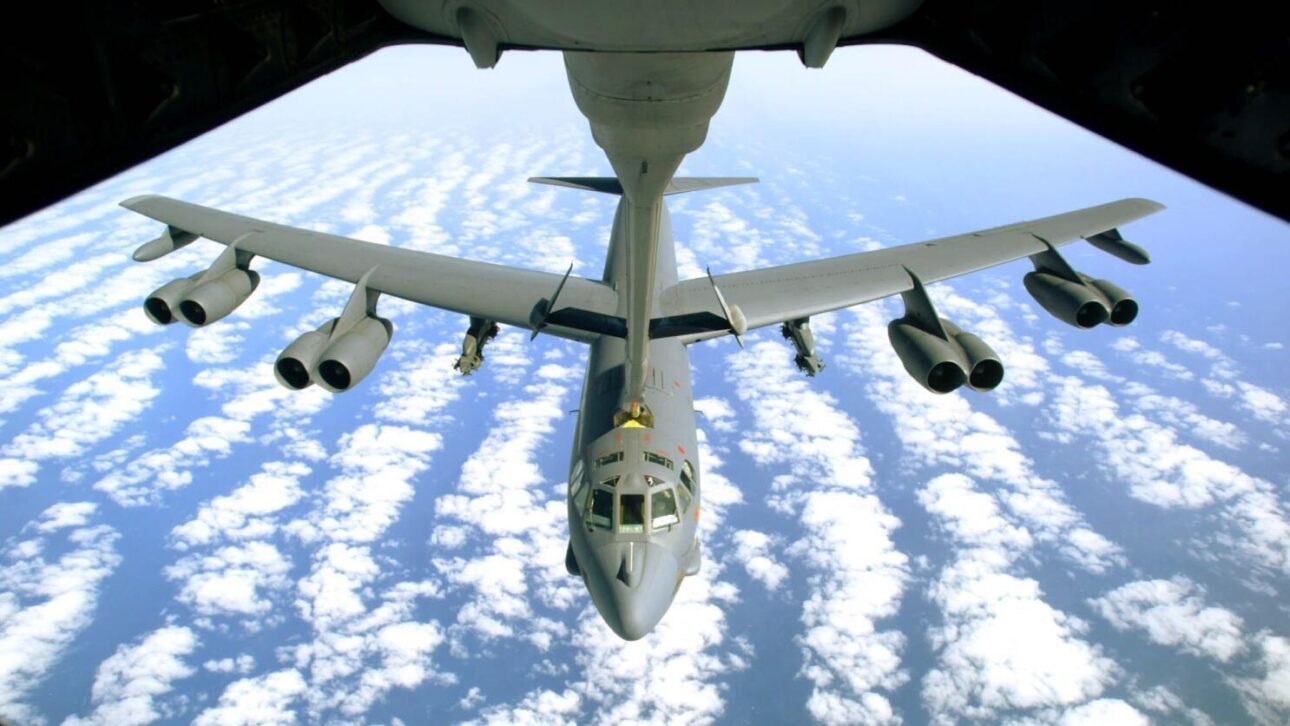
Moreover, the B-52 is fully integrated into the American nuclear command system, capable of responding quickly to any threat with strategic weaponry.
But Isn’t It Obsolete?
Surprisingly, no. Despite its classic appearance and its 8 visible engines, the B-52 has undergone more than a dozen upgrades. Today, it:
- Uses satellite-guided and artificial intelligence weapons;
- Integrates digital networks with drones and satellites;
- Operates in conventional bombing and electronic attack missions;
- Has access to stealth cruise missiles with ranges of thousands of kilometers.
In other words: the aircraft may be old, but its systems are state-of-the-art.
While the defense world races to catch up with technological innovations, such as stealth fighters, lasers, and military AI, the US continues to fly with a veteran that has seen it all and remains feared.
The B-52 Stratofortress is more than a bomber — it is a living symbol of nuclear deterrence and persistent military power. And when an adversary like China classifies it as its greatest aerial concern, it says a lot about its significance.
In a world of invisible threats and hybrid wars, the old giant with 8 engines remains the most real and tangible nightmare in the sky.
Source: Xataka