Portuguese
  Spanish


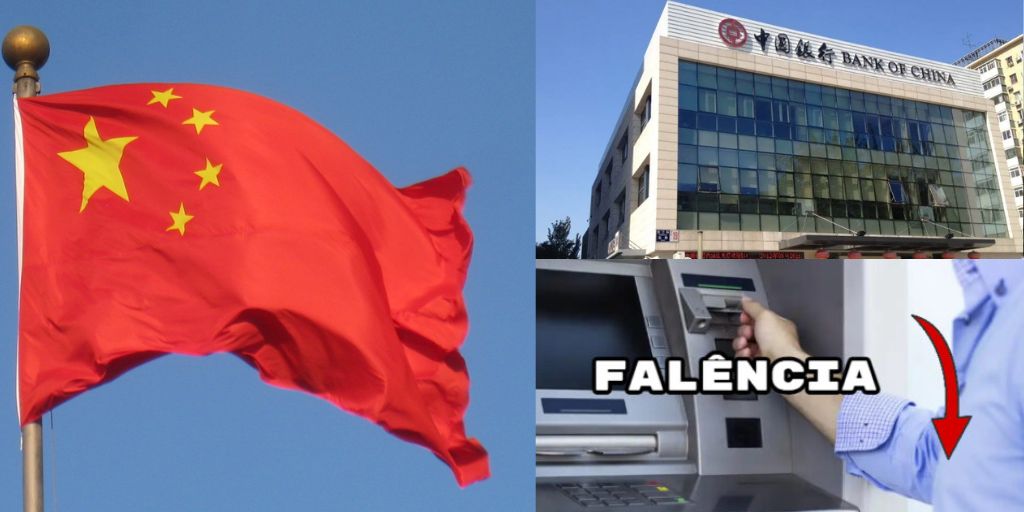

An Alarming News Has Surfaced Recently: Chinese Banks Are Disappearing. According to Raul Sena of the Investor Sardinha channel, this phenomenon may have significant consequences for global markets and, in particular, for Brazilian investors.
Raul Sena reveals that, “in just one week, it was reported that 40 banks in China abruptly closed their doors.” These banks were absorbed by larger institutions in a maneuver orchestrated by the Chinese government to avoid a systemic collapse.
The root cause of this crisis is the accumulation of bad loans, that is, credits granted without proper risk assessment and that have not been paid. To illustrate the problem, Raul makes an analogy with the movie “The Big Short,” highlighting that Chinese banks overestimated their clients’ repayment capacity.
He explains that “banks usually lend much more money than they actually have.” This is possible because the banking system operates on a leverage model, where deposits are used as a basis for much larger loans.
-
Havan Competitor Expands in Brazil with 170 Stores, Offering Everything from Stationery to Asian Food and Focusing on Affordable Products to Attract Shoppers

-
Norway’s $2 Trillion Dilemma: How Oil Revenue Created a Massive Savings Fund with Too Much Money to Spend

-
Microsoft Lays Off 4,800 Employees, Cuts 20% of Xbox Staff Amid AI Pressure on Major Tech Firm

-
Brazil’s ANP Opens 86 New Oil Blocks in the Equatorial Margin, Expanding the Amazon River Mouth Frontier





The Chinese Banking System and Its Peculiarities
In China, the use of physical cash is becoming increasingly rare. “There are Chinese people who have never seen a yuan note in their lives,” says Raul Sena. The country has adopted highly digitized payment methods, such as facial and fingerprint recognition. This technological advancement has allowed for greater efficiency but has also made the system vulnerable to economic fluctuations.
Small banks, in particular, are the most affected. They often lend to the middle class and small businesses, sectors that are the first to feel the effects of an economic slowdown. Raul Sena explains that “these small banks lend absurd amounts of money to construction companies and local governments.”
With the recent crisis in the construction sector, many of these companies were unable to pay back their loans, creating a domino effect.
The Role of the Chinese Government in the Crisis
To deal with the situation, the Chinese government encouraged the merger of smaller banks with larger institutions. “Of the 40 institutions that failed, 36 were absorbed by a single large bank,” says Raul Sena.
Although the People’s Bank of China claims that 98% of the country’s banks are in good condition, the reality may be quite different. International rating agencies suggest that the crisis in Chinese banks may last up to a decade, with accumulated debts already amounting to US$ 14 billion.
Impacts for Brazil and the World
The question many are asking is: how could this crisis in China affect us? China is Brazil’s largest trading partner, especially in the commodities sector.
“Brazil sells a lot of soybeans, iron ore, and other products to China,” highlights Raul Sena. An economic crisis in China could reduce demand for these products, negatively impacting the Brazilian economy.
Moreover, the impact on financial markets could be significant. Major investors, like Warren Buffett, are already adjusting their positions in Chinese companies, such as BYD, due to economic uncertainties.
In this sense, the YouTuber warns that, for investors who were considering entering the Chinese market, “it may be a great time to observe the opportunities that will arise there.” However, he emphasizes the importance of being cautious, given the history of lack of transparency in the figures presented by Chinese companies.
Investment Opportunities: A Cautious Eye
Despite the risks, Raul Sena sees a possible opportunity for attentive investors. “If we have a great opportunity now, we may make allocations,” he suggests, referring to the buying potential in a bear market. Nonetheless, he also recognizes that many investors may choose not to invest in China, preferring more stable markets like the United States or Europe.
Regardless, the current situation is a reminder that the financial market is globally interconnected. Issues in a major economy like China’s can have significant repercussions in other countries.
Additionally, Raul Sena reflects that “China is today the country that produces for the entire planet; it’s the workshop of the world.” Thus, any significant change in the Chinese economy can have global impacts.