






 Portuguese
  Spanish


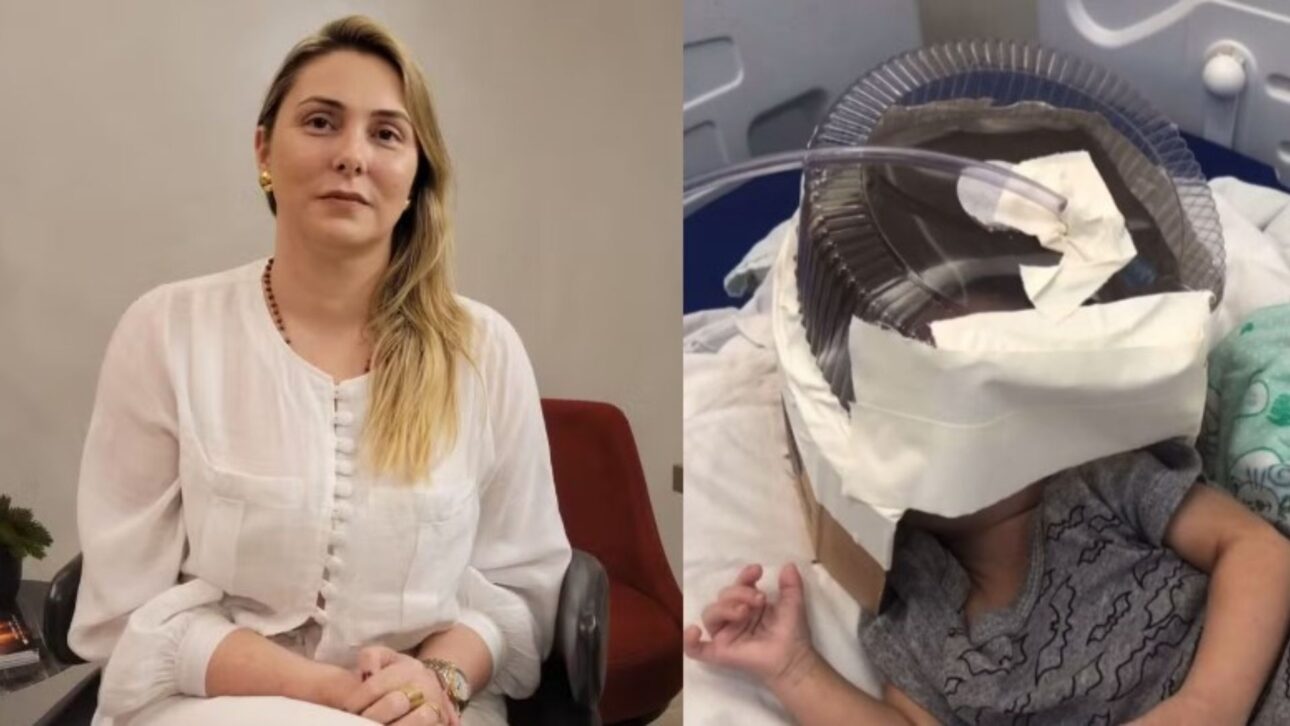
Faced with a baby with purplish skin and without the right equipment at hand, Dr. Ellenn Salviano improvised an oxygen helmet with a cake container. The gesture, made in a city in the interior of Potiguar, gained repercussion and exposed the routine of those working at the forefront of the SUS.
It was Monday morning, June 10, 2024, when Dr. Ellenn Salviano took over the shift at the municipal hospital of Santa Cruz, in the Agreste of Rio Grande do Norte, and found a 3-month-old baby in serious condition. The child was already cyanotic, the purplish coloration that indicates poor blood oxygenation, and had purple spots on the body. The appropriate equipment to assist was missing, and time was running against.
The solution came from where no one expected. Salviano and her team used a cake container lid as an improvised oxygen helmet, keeping the baby stable until borrowed materials arrived. The case was reported by g1 RN, in a story by Igor Jácome, and spread across the country due to the unlikely combination of a household object with a life-or-death situation. The child spent about four hours with the device before being transferred.
The improvisation that held the baby for four hours
The next step would be intubation, a procedure that, in the doctor’s own words, would be very difficult for the patient and would reduce the chances of survival.
-
In the Caucasus Mountains, a Community Preserves a Language So Rare Few Outsiders Can Understand It

-
Slovakia’s Ice Cave Holds Over 110,000 m³ of Frozen Wonders, Boasts Walls Up to 27 Meters Thick, and Was Among the First Electrified Caves Globally

-
Street Cleaner Accidentally Receives $200,000 Transfer, Returns Unexpected Fortune to Rightful Owner
-
Australian Space Agency Investigates Six Mysterious Metal Spheres Found on Queensland Beach, Isolating Area Over Possible Space Debris Risk





Without the conventional oxygen helmet in the unit, the cake container became the barrier between the child and a possible cardiac arrest. The team relied on improvisation to buy time.
And time came. The child spent about four hours with the adapted equipment until the hospital received materials borrowed from the Ana Bezerra University Hospital, in Santa Cruz itself.
According to Salviano, the interval was enough to aid in recovery, and the baby regained oxygenation to levels she described as almost normal.
After that, he was transferred to the Varela Santiago Hospital in Natal.
Who is Ellenn Salviano
Her journey deviates from the common script. At 41 years old, a native of São Miguel, in the Alto Oeste region of Rio Grande do Norte, Salviano graduated in medicine in 2015 from a private university in the state, but she was already a law graduate before that.
It was three years between her law degree and being accepted into medicine, a turnaround she sums up by saying it changed her life. She now lives in Natal and is transitioning her career, specializing in clinical cardiology.
Her work routine is impressive for the number of fronts.
She has been an on-call doctor at the municipal hospital of Santa Cruz on Mondays for almost eight years, works at the Metropolitan Samu on Tuesdays, at the Hospital of Pirangi in Parnamirim on Fridays, and also takes shifts in the red room of a UPA in Parnamirim and in a private hospital in Natal, without a fixed day.
During the Covid-19 pandemic, she was part of the ICU team at the municipal hospital. She mainly attends to adults but ends up receiving children and babies in serious situations.
The tough routine of those who work in the SUS
For Salviano, the biggest professional challenge has a name: public service. She says that in private practice she has everything at hand, while in the SUS she has to leave home every day thinking about how to reinvent herself in the face of a lack of resources.
The doctor calls the group she works with a “dog team,” because, according to her, what arrives does not choose time or severity. The phrase sums up the constant improvisation climate at the system’s frontline.
Even in this scenario, she says it is not necessary to choose the patient.
The problem arrives and the team finds a way, with or without oxygen, to ensure possible assistance, she stated to g1.
It’s a statement that helps understand the cake packaging episode not as an isolated case of genius, but as a reflection of a culture of making do with what’s available.
Between shifts and family
Away from the hospital, Salviano balances the work marathon with life at home.
Married for 22 years to a lawyer, she is the mother of three children, aged 6, 7, and 18, and the eldest intends to follow his mother’s career in medicine.
She credits her family with the possibility of giving her best at work, describing her husband as a partner and great father. As she spends many days away, she points to family trips as her greatest leisure time.
It was thinking about this responsibility that she explained the action taken in Santa Cruz.
Upon leaving home and leaving her own children, she said she takes on the commitment to care for someone else’s child, and therefore could not look at that mother and say nothing could be done.
The doctor remembered how easy it is to communicate a bad outcome by claiming that the hospital is not maternal-infant, that resources are lacking, and that the SUS has no vacancy. She chose the opposite path.
The account of those who accompanied the transfer
Those who saw the result up close confirmed the effectiveness of the improvisation.
Dr. Francisco Júnior, from Samu, participated in the transfer of the baby from Santa Cruz to Natal and assessed that the adaptation with the cake packaging improved the child’s conditions.
The professional stated that the improvisation was fundamental for the baby to breathe well again and have good oxygen penetration in the lungs. The observation reinforces the account of the team that provided the initial care.
The patient’s journey had begun days earlier.
The child was admitted to the municipal hospital of Santa Cruz on Saturday, June 8, 2024, with severe respiratory distress, nasal congestion, fever, vomiting, and diarrhea.
Only on Monday morning, when taking over the shift, did Salviano notice the worsening and decided to act.
The sequence of days shows how the child’s condition deteriorated before the improvisation that helped stabilize them.
The episode in the interior of Rio Grande do Norte became a symbol of a reality that many health professionals know closely.
A cake packaging does not replace hospital equipment, and no team should have to resort to this type of solution, but it was what was available to keep a baby alive until help arrived.
The case of Ellenn Salviano mixes competence, composure, and the harsh routine of those who work at the forefront of the SUS.
And you, what do you think about situations like this, where there is a lack of structure and an abundance of improvisation in public health? Have you experienced or closely followed the reality of the SUS, either as a patient, family member, or professional? Share your experience in the comments. This is a delicate topic, touching on pain, faith, and different opinions, so we ask for respect for those who think and feel differently.


