Portuguese
  Spanish


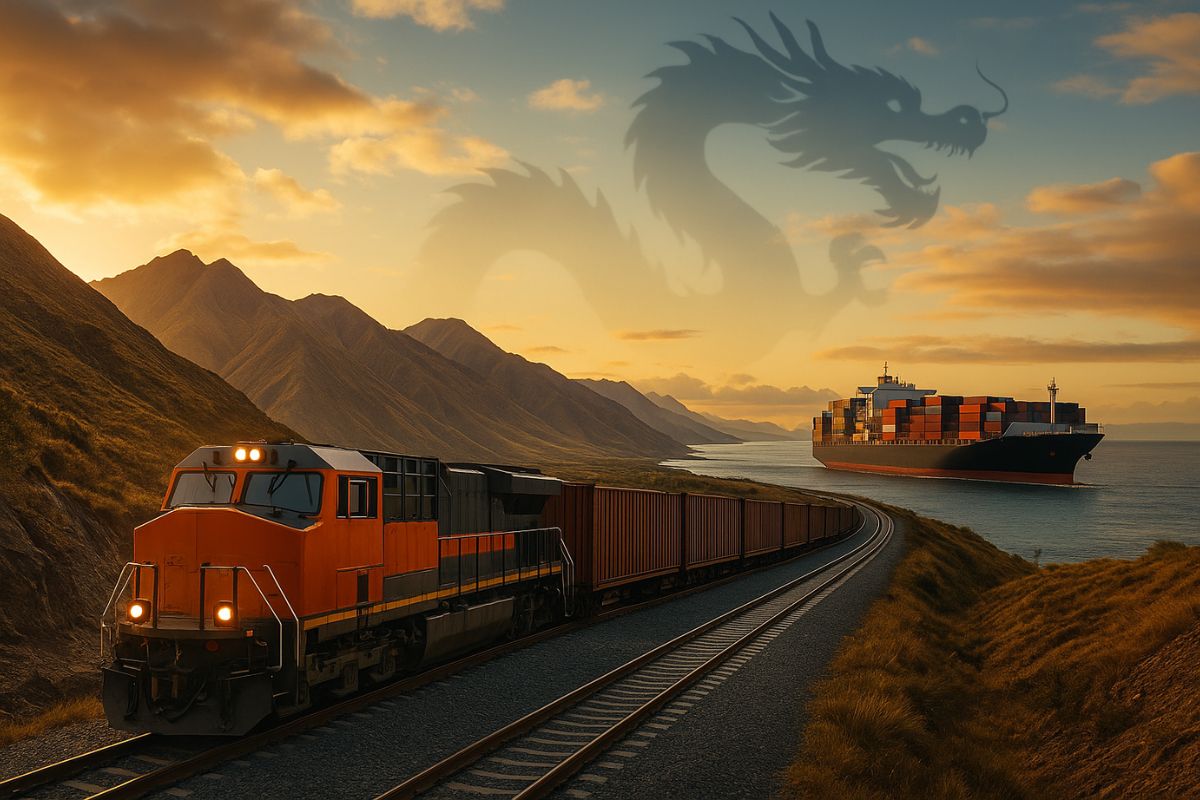

Brazil And China Advance In 100-Billion-Dollar Transoceanic Railway That Shortens Exports By 12 Days But May Increase Dependence On Beijing
The Brazil–Peru railway is presented as one of the biggest promises for logistical integration in South America. The project could reduce logistics costs by up to 30% and shorten the route of Brazilian exports to Asia by 12 days, turning the Midwest into a global hub for grains and minerals. However, experts warn that the billion-dollar project could also deepen Brazil’s reliance on Chinese financing, which already controls the port of Chancay in Peru, the final point of the corridor.
What The Agreement Signed In 2025 Provides
On July 7, 2025, Brazil and China signed an agreement to begin feasibility studies for the transoceanic railway, estimated at 100 billion dollars (about R$ 500 billion). On the Brazilian side, coordination will be handled by Infra SA, linked to the Ministry of Transportation; on the Chinese side, by the China Railway Economic Planning Institute, a branch of the world’s largest railway state-owned company.
The planned route starts at the port of Ilhéus (BA), crosses through Goiás, Mato Grosso, Rondônia, and Acre, crosses the border into Peru, and continues through the Andes to the Pacific. For Brazil, the project promises international competitiveness, job creation, and regional integration. For China, it ensures direct access to agricultural and mineral commodities without relying on the Panama Canal.
-
Brazil’s 2026 Tax Refund: Record 9.58 Million Filers in Largest Payout Ever, But a Key Detail on Priority Recipients Draws Nationwide Attention

-
Itaú Alters Hybrid Work Model, Increasing Office Days from 2028, Prompting Employees to Adjust to New Routine
-
Facing Labor Shortage, Japan Plans to Invest $34 Million to Attract Foreign Workers in Construction, Healthcare, Industry, and Commerce

-
Brazilian City Makes Remarkable Leap, Becomes 4th Wealthiest in the Country with GDP of R$ 134.1 Billion




Logistical Advantages For Brazil
Today, a ship departing from Santos or Paranaguá takes an average of 40 days to reach Asia. With the railway to the Pacific, the time would drop to 28 days, in addition to reducing costs by up to 30% for transporting soybeans, corn, beef, and iron ore.
Another strategic point is that the railway could attract private investments in concessions on B3 and strengthen exports from the agribusiness in the Midwest, a region that holds a significant portion of national production. Intermodal terminals along the railway line are also expected to stimulate local economies, creating logistical hubs in the interior.
The Risk Of Dependency On Chinese Financing
Despite the potential, the challenge lies in Chinese financing. Brazil has not formally joined the New Silk Road, but Beijing is already the main investor in ports, railways, and energy in the region. The example of countries like Sri Lanka, which lost control of the Hambantota port for 99 years after failing to repay debts, raises a red flag.
Additionally, there are technical obstacles. On the Brazilian side, sections such as the Fiol (West-East Integration Railway) and Fico (Midwest Integration Railway) have not yet been completed. In Peru, it will be necessary to build railway lines at altitudes above 4,000 meters, which increases the cost and complexity of the project.
An Opportunity Or A Strategic Risk?
The Brazil–Peru railway could reposition Brazil as a continental logistical hub, but it also risks turning it merely into a “shortcut” for Chinese exports, without adding value to the national industry. The governance of the project, the division of profits, and Brazil’s participation in the operation will be crucial to avoid the project becoming just another expensive and underutilized megaproject, as happened with the interoceanic highway inaugurated in 2011.
The railway corridor connecting Brazil and Peru could be the biggest logistical leap in the country’s recent history, but it depends on how Chinese financing will be negotiated and what will be the real role of Brazil in managing the project.
And you, do you believe that this railway will strengthen Brazil as a logistical power or merely increase dependence on Beijing? Leave your opinion in the comments — your insight could enrich this strategic debate.