





 English
  6 min of reading
  0 comments


More than 300 pieces gathered in Rome connect the ruins of the ancient city, the Trojan War, the journey of Aeneas, and the legendary origin of the Romans
The city that inspired poems, films, and one of the most well-known war stories in the world will be presented in the heart of ancient Rome through objects recovered from excavations. Turkey sent more than 220 artifacts from 19 museums for a major exhibition installed at the Colosseum Archaeological Park.
Named “Troy and Rome. Myths, legends, and stories of the ancient Mediterranean,” the exhibition will open to the public at 3 PM on June 12, 2026 and will remain on display until October 18. Visitors will be greeted by a monumental replica of the Trojan Horse, a symbol chosen to introduce a journey of about three millennia.
According to the Italian Ministry of Culture, the complete set will have more than 300 pieces, including approximately 80 objects from Italian collections. Among the items provided by Turkey, 50 had never been presented to the Italian public before.
-
Scientists from Russia and Egypt have proven that the aquatic fern is capable of cleaning soils contaminated by heavy metals and even boosting rice cultivation, which yielded almost 64% more in tests.

-
Teams were cleaning the basement of one of Istanbul’s most famous monuments when they revealed tunnels, cisterns, and seven water channels connected to ancient Constantinople.
-
10 million trees transform settlements in the interior of São Paulo into a forest factory; the project reconnects the Atlantic Forest, generates income with agroforestry coffee, and aims to restore an area equivalent to the city of New York.

-
Tired of streets with identical houses, an English city created a neighborhood where residents design their own homes, mixing round windows, sloped roofs, colorful facades, and projects that almost never repeat.



The proposal goes beyond reproducing the narrative of Greek warriors hidden inside a wooden horse. The exhibition aims to separate what belongs to literary tradition from what can be proven by archaeology, showing that Troy was a real city, rebuilt several times and occupied by different peoples.
Exhibition at the Colosseum gathers pieces from 19 Turkish museums
The details released by the Ministry of Culture and Tourism of Turkey indicate 221 artifacts provided to the project, of which 99 belong to the Troy Museum, located in the province of Çanakkale. The objects underwent conservation, documentation, insurance, and preparation procedures for international transport.
Experts worked for months in regional laboratories to assess the condition of each piece. This care is necessary because many objects are made of metals, ceramics, and ancient stones that can suffer damage from changes in temperature, humidity, vibration, and lighting.
According to the Colosseum Archaeological Park, the exhibition is included in the access ticket to the archaeological complex. The project was organized after a cultural cooperation agreement signed by Italy and Turkey in April 2025, followed by a specific technical understanding in December of that year.
Giant Trojan Horse opens path between history and mythology
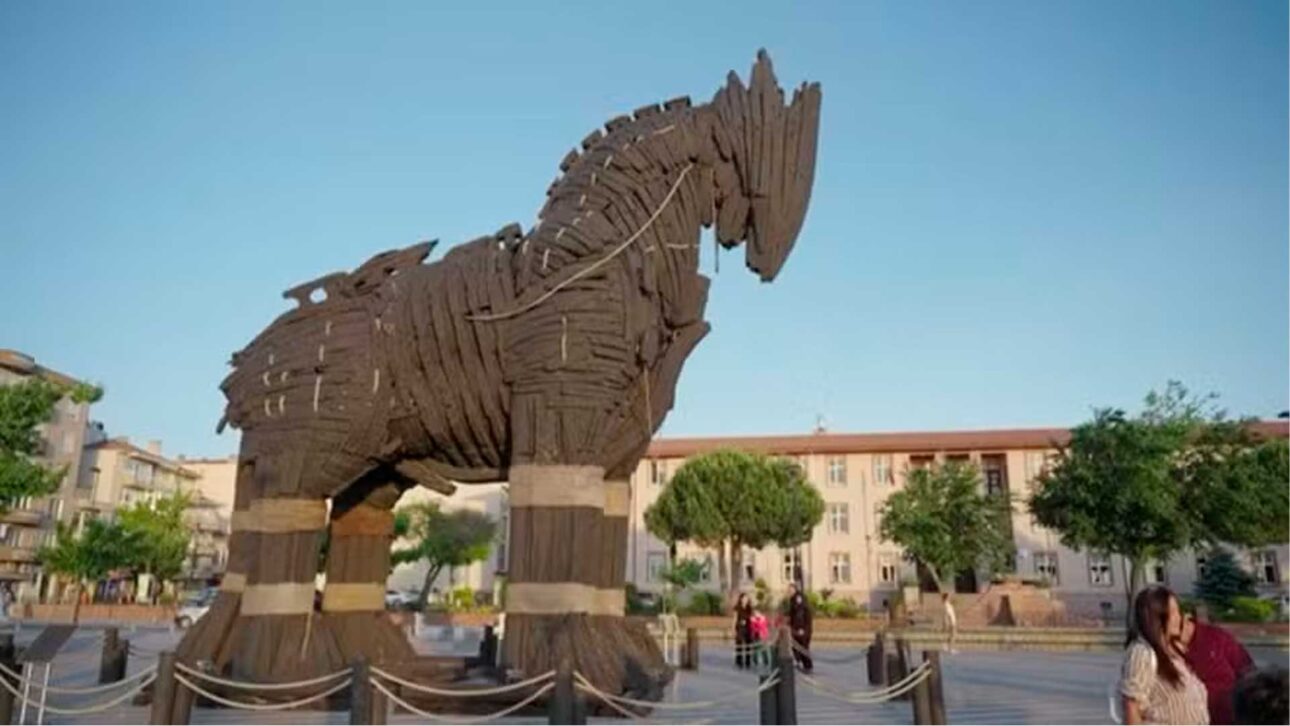
The monumental replica of the Trojan Horse serves as the gateway to the exhibition. It represents the episode where Greek soldiers supposedly hid inside a wooden structure to cross the city’s walls, according to tradition passed down through different works of Antiquity.
Although it is usually directly associated with the Iliad, the horse does not appear in the segment of the war narrated by Homer’s poem. The Iliad focuses mainly on Achilles’ wrath and events occurring before the city’s destruction, while the stratagem was developed in other texts of the so-called Trojan cycle and later revisited in the Odyssey and the Aeneid.
After the horse, the first section reconstructs the geography, architecture, and history of the archaeological site. The public will find materials related to the Hittite world and the societies that lived in Anatolia during the third and second millennia BC.
The second part presents the Trojan War from the perspective of the Trojans. Characters like Priam, Hector, Cassandra, Helen, Paris, Achilles, Agamemnon, and Menelaus are used to explain how literature, religion, memory, and political disputes intertwined over the centuries.
The final two sections follow Aeneas’s escape after the city’s fall and the construction of Rome’s legendary origin. The journey ends with Romulus, the founding of the Roman capital, and how rulers during Emperor Augustus’s time used the supposed Trojan ancestry to strengthen their political identity.
Seal with ancient writing is among the objects sent to Rome
One of the pieces of greatest historical importance is a bronze seal with hieroglyphic signs, discovered in 1995. Although small and less striking than sculptures or weapons, the object helps researchers understand Troy’s connections with the peoples of Anatolia.
In an interview with AFP, the director of the Troy Museum, Sinem Düzgören, explained that the seal is considered the only written record found at the site in an Anatolian language. The collection also includes arrowheads, spears, knives, and stones used in slings, weapons similar to those mentioned in traditions about the conflict.
Ruins prove that Troy existed, but do not confirm the entire legend
Troy was not just an isolated city that disappeared after a single war. The site comprises layers of settlements built on top of each other, with walls, gates, residential areas, administrative buildings, and structures erected in different periods.
UNESCO reports that the site has about four thousand years of history and records a sequence of occupation exceeding three thousand years. Located on Mount Hisarlık, near the southern entrance of the Dardanelles Strait, the city occupied a strategic position between Anatolia, the Aegean Sea, the Balkans, and the Black Sea.
The excavations that made Troy world-famous began in 1870, under the command of German archaeologist Heinrich Schliemann. The methods used at that time are criticized today because the accelerated search for treasures destroyed parts of some archaeological layers.
Discovering the ruins, however, does not mean that all events attributed to Homer have been confirmed. The remains demonstrate that fortified cities existed, periods of destruction, and relations with other societies, but the duration of the war, the heroes, and the Trojan Horse remain in the realm of literary tradition.
Troy was a contact point between Anatolia and the Mediterranean
The location helps explain why Troy was occupied and rebuilt so many times. Close to an important maritime passage, the city could control trade routes, military movements, and the circulation of goods between different regions.
The objects presented at the Colosseum show that the local population maintained contacts with the Anatolian, Aegean, and Mediterranean worlds. Instead of seeing Troy only as a Greek city described by Homer, the exhibition highlights its roots in Anatolia and the transformations it underwent during centuries of occupation.
The site was included in the World Heritage List in 1998. For UNESCO, its importance lies not only in the remains of walls and constructions but also in the influence that Troy exerted on literature and the arts for more than two millennia.
Aeneas created a legendary link between Troy and the origin of Rome
After the destruction of Troy, Aeneas is said to have escaped carrying his father and leading a group of survivors. The Aeneid, written by the Roman poet Virgil in the first century BC, follows his journey across the Mediterranean until reaching the Italian peninsula.
The tradition does not claim that Aeneas directly founded Rome. He appears as an ancestor of a lineage that, many generations later, would lead to the brothers Romulus and Remus, presented by Roman mythology as central figures in the creation of the city.
This connection allowed Rome to present itself as the heir of an ancient and respected civilization. The myth also brought the Romans closer to the universe narrated by Homer, transforming a Trojan defeat into a starting point for the emergence of a new power in the Mediterranean.
Loan of artifacts strengthens partnership between Italy and Turkey
The movement of more than 220 archaeological objects between countries requires agreements on conservation, security, transportation, and return. The pieces remain the property of Turkish institutions and must return to their museums after the exhibition ends.
For Italy and Turkey, the project also functions as an act of cultural diplomacy. By installing artifacts from Troy in the Colosseum, the organizers bring together two of the most well-known archaeological sites in the world and present to the public a shared history between Anatolia and the Italian peninsula.




Be the first to react!