Portuguese
  Spanish


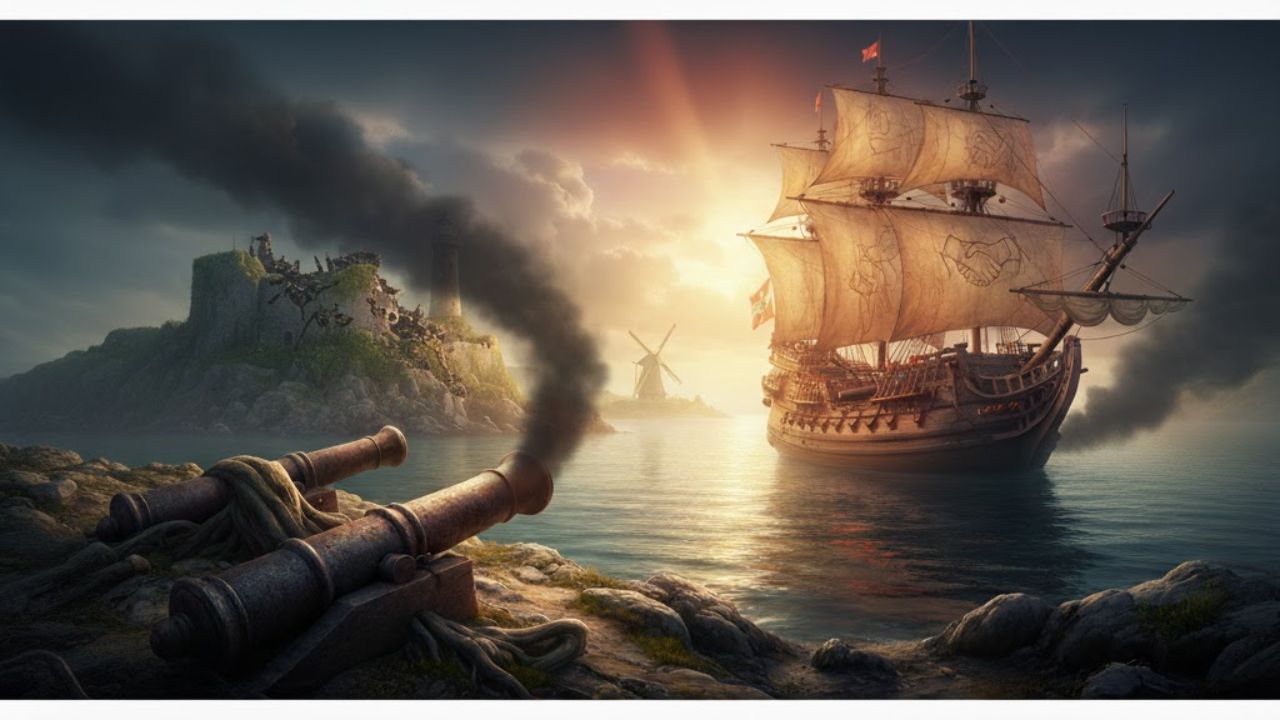


Official Dispute Between the Netherlands and the Scilly Isles Began in 1651 and Only Had a Peace Treaty Signed in 1986, Ending a Technical Three-Century War.
On April 17, 1986, one of the most curious chapters in world diplomatic history was finally closed. A war that technically lasted 335 years came to an end without a single real battle having occurred or a single life being lost throughout the period. The conflict involved the nation of the Netherlands and the small British archipelago of the Scilly Isles.
Known as Bellum Dormiens, or “Sleeping War,” the conflict formally began in 1651 during the turmoil of the English Civil War, but was quickly forgotten by the authorities. It was only three centuries later that a local historian rediscovered the bureaucratic oversight, leading to the signing of an official peace treaty that transformed a local legend into an internationally recognized historical fact.
The Origin of the Conflict in the English Civil War
To understand how this unusual war began, we must go back to the setting of the Second English Civil War (1642-1651). The Parliamentarian forces, led by Oliver Cromwell, had cornered the Royalist opposition loyal to King Charles I within the kingdom’s limits. The last Royalist stronghold was precisely the archipelago of the Scilly Isles, under the command of Sir John Grenville.
-
Father Lives with 3 Children on a 15-Meter Off-Grid Houseboat, Reduces Living Costs to £500 a Month, and Filters Canal Water with a £300 System He Built

-
In 1961, Hollywood held a unique audition with 152 black cats to cast the perfect feline for the horror film The Black Cat.

-
Brazilian Truck Driver in the U.S. Earns $11,200 Commission on Heavy Haul, Highlights High Income Potential and Demands of the Job

-
Teen without prom date invites pet cat to dance, goes viral with tuxedo and pink dress photoshoot




However, Scilly was not just a refuge. The Royalist fleet based there began to engage in acts of piracy, attacking Dutch merchant ships. The Netherlands, at the time, had allied with Cromwell’s Parliamentarians to maintain good relations with the new English leadership. Viewing this as betrayal, the Royalists in Scilly intensified their attacks, causing significant economic damage to the Dutch and generating the casus belli (cause for war).
The Declaration of War of 1651
In response to the attacks, on March 30, 1651, the Dutch Admiral Maarten Harpertszoon Tromp arrived at Scilly with a fleet of twelve war ships. He demanded reparations for the ships and goods seized by the Royalists. As he did not receive a satisfactory response, Tromp declared war specifically on the Scilly Isles.
This declaration was an act of surgical precision: as the rest of England was under the control of the Parliamentarians (allies of the Dutch), Tromp could not declare war on the entire nation. Historians still debate the legal validity of this act, questioning whether an admiral had the authority for such a declaration or if Scilly could be considered a sovereign entity. In practice, it was a tactical solution to justify military actions against the Royalist pirates.
The End of Hostilities and the Forgetting

Interestingly, the active war lasted only about three months. In June 1651, the English Parliamentarian fleet, commanded by Admiral Robert Blake, arrived at the archipelago and forced the Royalists to surrender. With the threat neutralized by their own English allies, the Dutch fleet departed without firing a single shot.
The bureaucratic problem arose because, in the confusion, the Dutch “forgot to declare peace”. Although later treaties between England and the Netherlands implicitly resolved larger conflicts, no document ever specifically mentioned the declaration of war made against Scilly. Thus, technically, the state of conflict remained unresolved for centuries.
The Historic Peace Treaty of 1986
The resolution only came in 1985 when Roy Duncan, historian and Chairman of the Council of the Scilly Isles, decided to investigate the local legend that the islands were still at war. He wrote to the Dutch Embassy in London, which, after checking its records, confirmed the anomaly: there was no record of a peace treaty.
On April 17, 1986, the Dutch ambassador Jonkheer Rein Huydecoper visited the islands to formally sign the end of the conflict. In good humor, the ambassador joked that it must have been “horrible” for the inhabitants to know that “we could have attacked at any moment” over the last 335 years, lightly sealing the end of the longest and most peaceful war in history.
Did you already know this historical curiosity about a war that lasted centuries without any combat? Leave your opinion in the comments; we want to know what you think about this diplomatic oversight!