





 Portuguese
  English
  Spanish
  5 min of reading
  1 comment


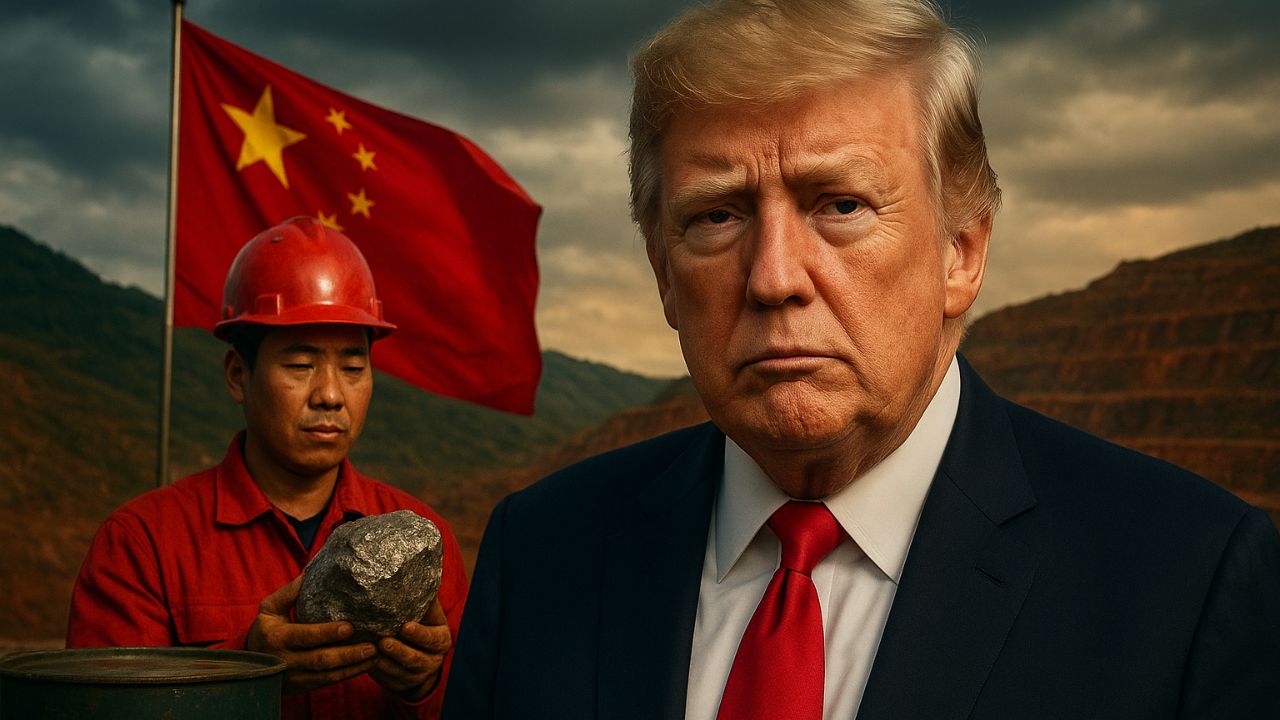


The Restriction on the Export of Essential Minerals for Technology and Defense Exposes the Vulnerability of the U.S. in the Trade War and Reveals Trump’s True Weakness Before Crucial Negotiations.
With the publication of the “Announcement No. 62 of 2025”, the Chinese government has redefined the rules of the trade war with the United States, shaking a truce that was already proving fragile. As detailed by Época Negócios, the measure imposes broad restrictions on the export of rare earths, a group of 17 chemical elements vital to the high-tech industry. In doing so, Beijing not only reinforced its control over the global supply of these minerals but also surgically exposed Trump’s weakness: the deep American dependence on components that only China can supply at scale.
The strategic maneuver comes at a time of high tension, with a meeting scheduled between American President Donald Trump and Chinese leader Xi Jinping. The U.S. reaction was immediate, with threats of additional tariffs of 100% on Chinese products and new export controls. China, in turn, accuses the Americans of causing “unnecessary panic”, stating that licenses will be approved for civilian use. However, the message was clear and placed the Chinese delegation in a position of advantage for the upcoming negotiations.
The Chinese Monopoly and Western Dependency
The strength of China in this dispute is no coincidence, but the result of decades of strategic planning. The country holds a near monopoly not only in extraction but mainly in the refining of rare earths, the complex process of separating them from other minerals. According to consultancy Newland Global Group, Chinese exports of these materials account for around 70% of the global supply, being crucial for the manufacturing of magnets used in electric vehicle motors, wind turbines, and countless other technological components.
-
SpaceX sets share price at $135 and targets a historic $75 billion IPO to debut on Nasdaq with a trillion-dollar market value

-
While the world rushes to mine lithium from Congo and Chile, Brazil sits on one of the largest reserves and has barely begun to explore.

-
Heir worked at thirteen in an ice cream factory without revealing he was the owner’s son; today, at twenty-five, he leads the best-selling ice cream brand for home consumption in the Northeast, grosses almost R$ 300 million, has 145 stores, and competes with multinationals with regional flavors.
-
Lock manufacturer from Rio Grande do Sul invests R$ 150 million to surpass R$ 1 billion in revenue, create 200 jobs, and double storage capacity, while choosing Santa Catarina to set up a new logistics center and speed up deliveries in Southern Brazil.


American dependency is even more critical in the defense sector. A single F-35 fighter jet, for example, requires more than 400 kilograms of rare earths in its radar systems, engines, and stealth coatings. As pointed out by Época Negócios, this vulnerability is not limited to military hardware, extending to consumer products like smartphones and solar panels. Marina Zhang of the University of Technology Sydney states that China has built a knowledge base and a research and development network that is years ahead of any competitor, making the replacement of its supply chain a monumental task.
A ‘Bazooka’ in the Global Supply Chain
The Trump administration’s response to the restrictions was harsh, reflecting the seriousness of the situation. U.S. Treasury Secretary Scott Bessent described the Chinese action bluntly: “This is China against the world. They have pointed a bazooka at the supply chains and the industrial base of the entire free world, and we will not allow it”. The threat to impose a 100% tariff on Chinese products and to impose controls on the export of strategic software shows that the U.S. is willing to escalate the conflict, even if it generates global economic instability.
On the Chinese side, the stance is one of calm and control. A spokesperson for the Ministry of Commerce stated that the measures are legitimate and that license requests for civilian purposes will be approved, accusing the U.S. of “deliberately provoking misunderstandings”. To increase pressure, both nations have also imposed new port fees on each other’s ships, ending months of relative calm in the trade dispute. According to experts interviewed by Época Negócios, the moment chosen by China was calculated to frustrate the negotiation schedule that the Americans hoped to control.
The Global Race for Alternatives and Brazil’s Potential
In the face of China’s demonstration of strength, the world is accelerating the search for alternative sources of rare earths. Australia, with large reserves of its own, is seen as a potential rival, but its production infrastructure is still limited, making processing expensive and time-consuming. Professor Marina Zhang estimates that, even with a coordinated effort, “it will take at least five years for the U.S. and its allies to catch up to China” in processing capacity.
In this scenario, Brazil emerges as a player with great potential. Reports such as the U.S. Mineral Commodity Summaries estimate that the country holds up to 23% of the known rare earth reserves in the world. Professor Sidney Ribeiro from Unesp explained to BBC News Brazil that the country already has decades of academic research and active mining in states like Minas Gerais and Goiás. However, the challenge is enormous: many reserves are in environmentally sensitive areas, like the Amazon, and the extraction process is complex and risky, as these elements often occur alongside radioactive materials like thorium and uranium.
More Strategy Than Economics: China’s Advantage at the Negotiating Table
Although the restrictions may seem like a risky bet, the direct economic impact for China is minimal. According to Época Negócios, rare earths represent an insignificant share of China’s GDP of US$ 18.7 trillion, with some estimates valuing it at less than 0.1% of GDP. Professor Sophia Kalantzakos from New York University highlights that, while the economic weight is small, its strategic value is “enormous”, as it gives Beijing disproportionate leverage.
By controlling access to these minerals, China is not seeking an immediate financial gain, but rather organizing its pieces before trade negotiations. The measure is seen by analysts as “its best immediate instrument” to pressure Washington to concede in other areas, such as reducing tariffs that affect its manufactured goods. China has shown that it is willing to absorb the impact of the trade war to achieve its long-term goals, while the U.S. now needs to deal with a vulnerability that directly affects its national security and technological leadership.
Do you agree with this change? Do you think it impacts the market? Leave your opinion in the comments, we want to hear from those who live this in practice.






Fantastic site Lots of helpful information here I am sending it to some friends ans additionally sharing in delicious And of course thanks for your effort