Portuguese
  Spanish


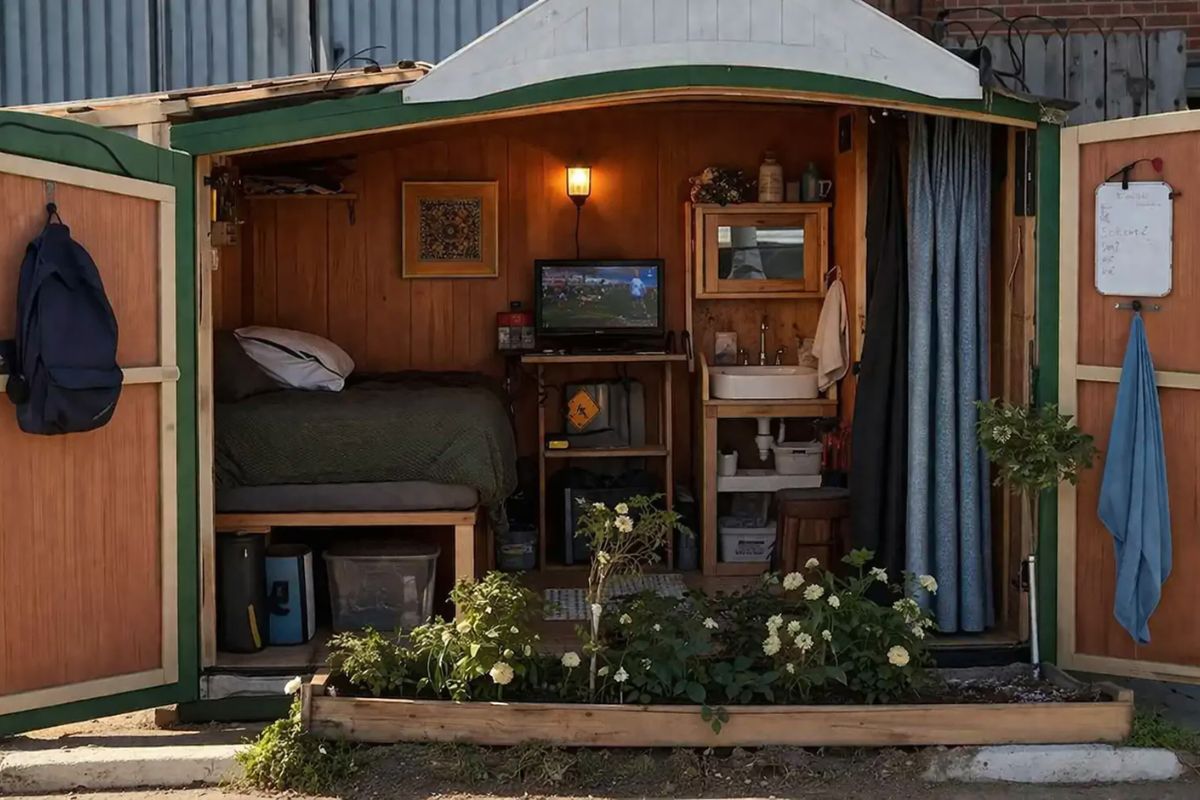


Osvaldo Medrano has already sold six units in the area, one of them with wheels, and does everything himself with scraps of wood and metal sheets while the city of Los Angeles spent $300 million on a housing program that returned 40% of the people to the streets.
The city of Los Angeles has already spent $300 million on the Inside Safe program to get homeless people off the sidewalks. Data from the city itself shows that about 40% of the people served ended up returning to the streets. Meanwhile, a man living on the street solved his problem with wood, metal sheets, and his own hands.
Osvaldo Medrano did not wait for any program. He built a mini house out of wood, planted a garden at the entrance, set up a room with a bed and television, and even created a separate space for bathing. And when other homeless people started stopping in front asking for one like it, he saw a business opportunity.
What is the house that Medrano built for himself like?

The structure is simple, made with pieces of wood and covered with metal sheets on the roof. But what stands out is the organization. Medrano keeps everything clean, tidy, and functional. He says he follows the same principles he had when living in an apartment: cleanliness, order, and no unnecessary clutter.
-
Giant Robots Build Entire Neighborhood of 100 3D-Printed Homes in the U.S., Showcasing Technology’s Impact on Construction Industry

-
Helsinki Residents Receive Water That Travels 120 Kilometers Through a Hidden Rock Tunnel from a Lake Before Treatment

-
Brazil’s Sertão Region Nears Completion of Latin America’s Longest Artificial River, Transforming Water Access in Drought-Prone Ceará
-
Pre-mixed stabilized mortar set to revolutionize construction in 2026: extends usability to 36 or 72 hours, boosts productivity, and minimizes waste in building projects.



The owners of a neighboring business authorized the use of electricity and water. To wash himself, he fetches water from a faucet a few blocks away and carries it back in a bucket. It’s not luxury. But it is dignity.
And that is more than many public shelters offer.
Why did he start selling houses to other homeless people?
Medrano works cleaning warehouses during the day. But when he built his own house, he realized that the demand was huge. People walked by, saw the structure, and asked for one like it.
“Once I was building one with wheels and a woman walked down the street, saw it, and said: I want that,” Medrano told NBC Los Angeles. “She left $100 as a deposit and I finished it for her.”
Each mini house costs $150. So far, he has made and sold six. Two of them are on Stanford Street, in downtown Los Angeles, occupied by people who previously slept in makeshift tents.
Why do many homeless people prefer these houses to shelters?
Medrano has a straightforward answer: “In shelters, they impose rules. On the street, people will live the same way, just in something different.” For him, the issue is not comfort, it’s autonomy. A wooden mini house gives the resident a roof, a personal space, and the freedom to maintain their routine.
“At least they won’t be living in garbage houses and tents made of plastic and rags anymore,” he said.
What does this say about the housing crisis in Los Angeles?
Los Angeles has one of the largest populations of homeless people in the United States. The Inside Safe program, which cost $300 million, managed to relocate thousands of people, but nearly half of them returned to the sidewalks. The problem is not just a lack of shelter. It’s a lack of solutions that people will accept.
While billions of dollars are debated in government plans, a man with scraps of wood, a bucket of water, and no public funding is solving, house by house, the problem of those living next to him.
Osvaldo Medrano has no office, no business registration, and no subsidy. He has a hammer, wood, and the clarity that sometimes the simplest solution is the one that really works.
With information from NBC Los Angeles and Telemundo 52.