






 Portuguese
  Spanish
  5 min of reading
  0 comments


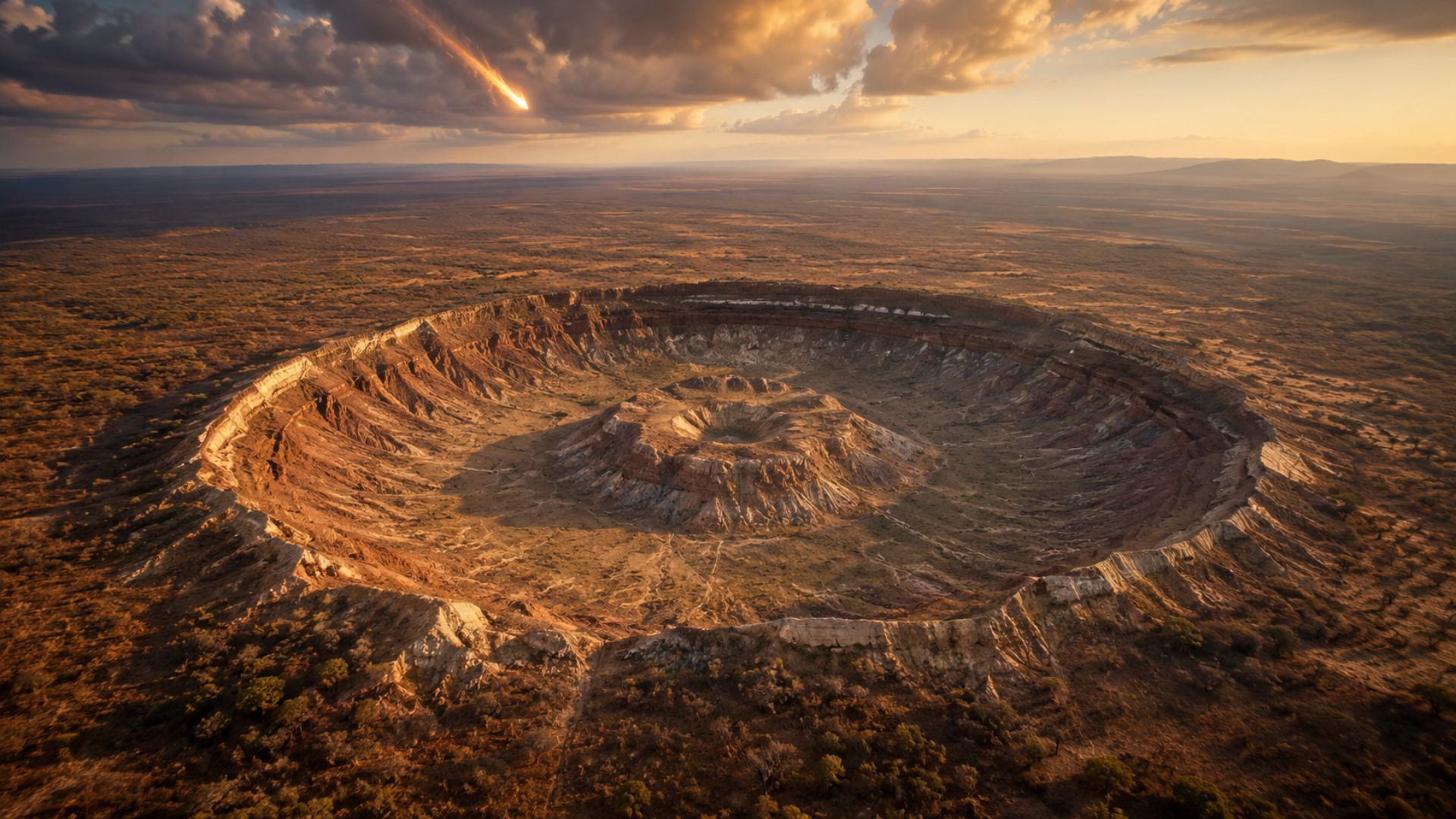
The definitive proof was in two sandstone samples collected near the center of the structure, in the heart of the Caatinga backlands. In them, quartz grains bear scars that only form under pressures of about 200 thousand atmospheres. The decisive expedition, in 2017, only overcame the impenetrable terrain with the help of a local resident and a Petrobras team.
A meteorite more than 2 kilometers in diameter, traveling at about 60 thousand kilometers per hour, created a 21-kilometer diameter crater in what is now northern Piauí, now officially confirmed as the second largest in South America. The discovery is the result of a Brazilian study that took nearly five decades and was published in the scientific journal Meteoritics & Planetary Science, of The Meteoritical Society, a world reference in meteorite research.
The structure is located in the municipality of São Miguel do Tapuio, about 215 kilometers from Teresina, and is now the ninth officially recognized impact crater in Brazil and the 37th largest in the world, among about 200 already identified on the planet. The confirmation was led by emeritus professor Álvaro Crósta, from the Institute of Geosciences at the State University of Campinas, Unicamp, who has been studying the formation for decades.
Almost 50 years to confirm the origin
The history of this crater is almost as impressive as the impact that formed it. The circular structure has been known since the 1970s and 1980s, when it appeared in radar images from the Radambrasil Project, but conclusive evidence of its extraterrestrial origin was lacking. Features such as concentric rings and a central elevated area suggested an impact, but could also be explained by Earth’s internal processes.
-
While scientists test giant balls on the seabed, a startup wants to sink concrete and steel tanks held by cages filled with stones up to 700 meters deep to transform compressed air into an invisible underwater battery.

-
Former NASA engineer transforms drones into “seed helicopters” capable of firing 300 balls per minute, targeting degraded areas with half-meter precision, and planting up to 40 million trees per year in a new race for aerial reforestation.

-
Brazil deploys drones to scatter seeds on nearly inaccessible slopes and attempts to transform degraded hills into forests with aerial planting up to 100 times faster, in a green offensive launched in Rio de Janeiro.
-
Second half of June brings more intense cold, polar air mass, and above-average rainfall in Brazil



Therefore, it was necessary to gather more robust evidence, and this is where the research encountered geography. The area is extremely isolated, with rugged terrain and the dense and thorny vegetation typical of the Caatinga, making it difficult to reach the center of the crater, precisely the point where the chances of finding evidence of the impact were greatest. Over nearly five decades, Professor Crósta conducted three expeditions to the site without being able to reach this central region in the first attempts.
The decisive expedition and the support of Petrobras
The turning point came during the 2017 expedition, when Crósta, accompanied by Professor Marcos Alberto Rodrigues Vasconcelos from the Federal University of Bahia, UFBA, finally managed to approach the core of the formation. To overcome the nearly impenetrable terrain, the team relied on the help of a local resident who knew the paths, and also on a group from Petrobras operating in the area, a detail that connects the scientific discovery to the universe of resource exploration in the country.
With this logistical support, the researchers reached about a kilometer from the center of the crater and collected sandstone samples that could hold the marks of the impact. It was meticulous work: of the 50 samples collected in a few days, only the last two, the closest to the center, contained the decisive evidence. The scientist himself described the task as detective work, comparable to looking for a needle in a haystack.
The scars that prove the impact
The definitive proof of the meteoritic origin was in microscopic deformations in the quartz grains of the rocks, known as shock deformation marks. These structures only form under extremely high pressures, on the order of 20 gigapascals, equivalent to about 200 thousand atmospheres, and are permanently recorded in the rock. According to the researchers, no other geological process is capable of generating such high pressures in the Earth’s crust’s most superficial portions.
The samples collected in Piauí were transformed into thin rock slices and analyzed under a microscope at the University of Vienna, Austria, where the confirmation came from. The study also involved researchers from federal universities in Ceará, Santa Catarina, São Carlos, and Brasília, in addition to USP, and also used radar satellite topographic data to analyze the shape and degree of erosion of the crater over time.
The size of the impact
The numbers of the event that created the crater help to gauge its violence. It is estimated that the meteorite was about 2.2 kilometers in diameter and hit the surface at approximately 60 thousand kilometers per hour. The energy released was so great that it pulverized much of the celestial body, with fragments sublimating and turning into gases, which explains why there are practically no pieces of the meteorite left at the site.
The exact age of the formation has not yet been determined, but analyses indicate that the impact occurred sometime between 159 and 267 million years ago. Erosion over all this time has erased much of the original relief, so that at the site, the crater is so large and so worn that it becomes difficult to perceive with the naked eye, appearing just like another set of common hills in the landscape.
Brazil on the crater map
With this confirmation, Piauí now hosts the second-largest impact crater in South America, second only to the Araguainha Dome, on the border between Mato Grosso and Goiás. That structure, about 40 kilometers in diameter, is believed to have been formed around 250 million years ago by the impact of a meteorite approximately 4 kilometers in size, and remains the largest on the continent.
All nine confirmed impact craters in Brazil to date have had the participation of Professor Crósta, who states that there are other structures under study, some flooded or submerged under layers of sediment. For scientists, researching these records helps to understand the evolution of the planet’s surface and even to predict the possibility of future catastrophic events, even though they are phenomena of very low frequency.
The confirmation of the São Miguel do Tapuio crater puts Piauí and Brazilian science on the international map of space impact research, showing how decades of persistence can transform an old suspicion into a consolidated discovery. More than a geological milestone, the story reveals the effort of Brazilian researchers to decipher an event that occurred hundreds of millions of years ago, hidden in the heart of the northeastern backlands. It is a reminder that Brazil still holds many secrets about the violent past of our planet.
And you, had you heard that there is a giant meteorite crater in the middle of the Caatinga of Piauí? Did you imagine that Brazil had so many marks of space impacts on its territory? Leave your comment, tell us what impressed you the most about this discovery, and share the article with those who love science, space, and the mysteries of Earth.







-

-

2 people reacted to this.