Portuguese
  Spanish


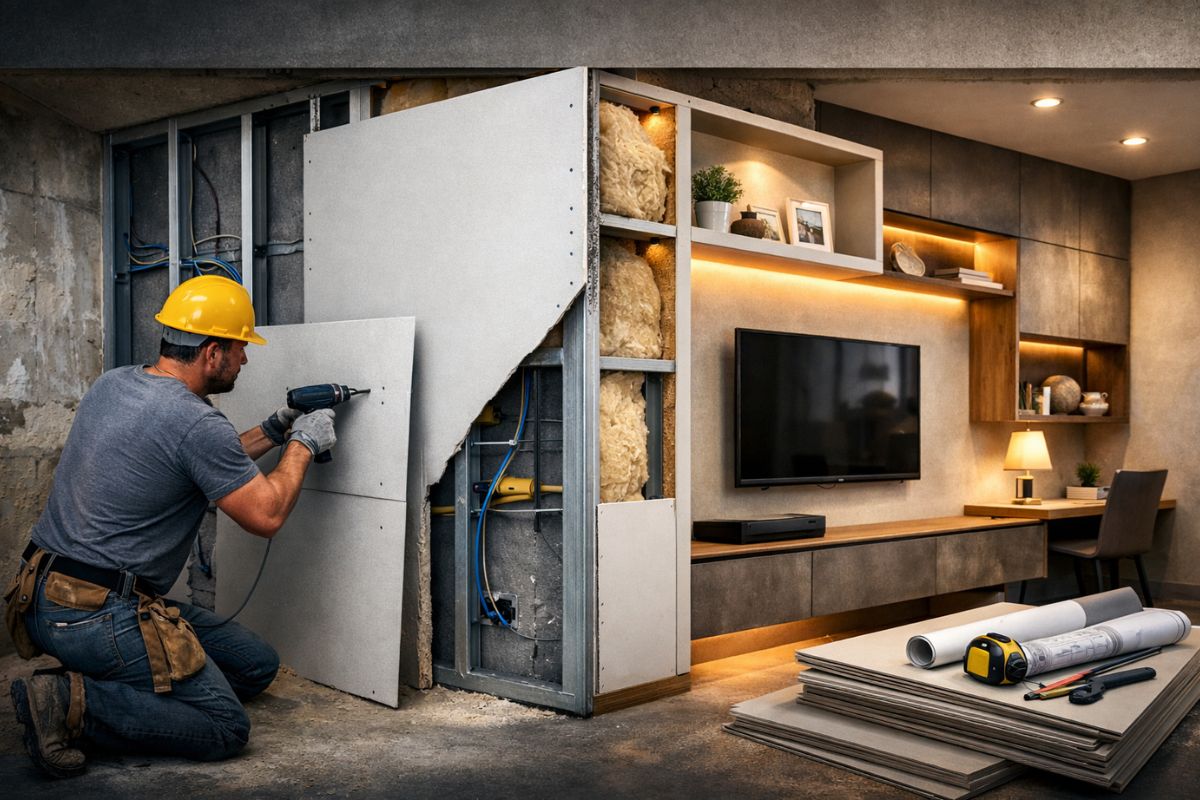


In 2026, Drywall Stopped Being a Quick Construction Trick and Became a Project Strategy: Thinner Partitions Increase Useful Area, Have Embedded Electrical and Lighting, Reduce Waste, and Prevent Weeks of Drying. The Comparison with Brick Exposes Where the Total Cost Falls and Where the Decision Requires Technical Knowledge.
Drywall entered renovations as a “system wall”: instead of bricks, plaster, and curing time, the internal division is born from plasterboard in a metal structure and provides quick organization, with less mess and less interruption to routine. The change is not just aesthetic; it’s about schedule, logistics, and maintenance.
Those who feel the difference most are typically those who need to reorganize their homes without “vanishing” from the property for weeks: families, residents of small apartments, those who want to create a closet, compact office, or an extra room. And the question that arises early on is simple, even if not always spoken aloud: why insist on masonry, if the division can be completed faster, smoother, and with a more controllable total cost?
Why Drywall Gained Space When Masonry Still Seems “Standard”

Drywall has consolidated itself by bringing together three advantages that, together, change the logic of construction: lightness, speed, and cleanliness. By dispensing with cement and bricks in the wall-raising stage, the process tends to generate less solid waste and reduces that domino effect of mess that invades the entire house. For renovations, this weighs as much as the final finish.
-
15-Year-Old Entrepreneur Malu Lira Publishes 20 Children’s Books on Financial Education, Earns $500,000, and Expands Her Project to the Amazon Rainforest

-
Entrepreneur Turns Rio Cemetery Canteen into a Successful Snack Chain Generating $4.9 Million Annually and Expanding to Metro Stations

-
Rare fox feared “extinct” found alive on Caribbean island after over two decades without official sightings

-
21-Year-Old Brazilian Student Turns Homemade Popsicle Hobby into $100,000-a-Month Business





There’s also the time factor, where the comparison with masonry usually becomes more uncomfortable: brick walls typically require lengthy steps and drying time, while drywall can be assembled in a few hours, depending on the project.
This doesn’t turn every renovation into “express work,” but shortens a critical part of the process and facilitates layout decisions without the trauma of breaking walls.
Where Drywall “Appears” Even When You Don’t Want to See Construction

Drywall is especially used in internal partitions, precisely where the objective is to divide environments, create new uses, and gain organization without overloading the structure.
It’s in this territory that it becomes a solution for closets, better-utilized corridors, compact offices, and additional rooms, because the thinner thickness helps “give back” valuable centimeters to the usable space. In small apartments, centimeters become circulation, furniture, and comfort.
In practice, this means that drywall usually comes into play when the question is “where can we fit another room without sacrificing the rest?”
Instead of thinking of the wall merely as a barrier, the project begins to treat the division as an element of interior design, allowing for panels, cutouts, and integrated niches that reduce dependence on heavy furniture.
Lower Total Cost: What Really Lowers Cost
When talking about drywall, the “how much does it cost” is rarely just the price per square meter. What drives down the total cost, in many cases, is the sum of items that masonry drags along: transportation of heavy materials, more extensive labor, longer execution time, and the impact of the work on daily life.
The savings are not just in the material; they’re in the entire intervention package.
Still, costs can vary significantly depending on the level of customization, the type of board used, and what will be embedded in the structure, such as lighting and electrical.
The technical point is that drywall tends to facilitate investment control because it accelerates stages and reduces waste, but requires planning: defining light points, passages, and supports in advance avoids rework and preserves the promised savings.
Drywall vs. Masonry: Technical Comparison That Changes the Decision

In a direct comparison, drywall usually wins in the areas that matter most during renovations: time, waste, and flexibility. It is light, which reduces structural load and can mean less demand for the foundation in certain project situations, in addition to offering high versatility for internal rearrangements. It’s a choice that aligns with tight schedules and cleaner renovations.
Masonry, on the other hand, maintains its strength through habit, perception of robustness, and being the historical reference for “real walls.”
However, when the focus is on dividing environments and quickly solving internal organization with a smooth finish, drywall tends to deliver a more favorable feasibility ratio, especially where the traditional process would be slow and costly.
Embedding Wiring and Lighting: The “Core” That Makes Drywall Yield More
One practical advantage of drywall is the internal cavity, which allows for embedding electrical wiring and accommodating lighting solutions more neatly.
Instead of tearing walls, running conduits, and then redoing plaster, the installation can be planned within the system itself, with designed access and a cleaner finish. The wall stops being an obstacle and becomes infrastructure.
This also benefits projects with more sophisticated lighting and strategically distributed points, provided they are defined in advance.
The gain here is not “magical”: it’s the result of a wall constructed as a system, where the routes of the cables and the positions of the points are solved during assembly, not improvisation.
Niches, Panels, and Minimalism: When the Wall Becomes Lightweight
Drywall supports the creation of niches directly within the structure, changing the aesthetic of the environment and reducing the need for bulky furniture.
In more minimalistic proposals, this feature appears as a solution to organize without visually cluttering, integrating lighting and cutouts with precise alignment. Well-thought-out niches resolve storage while also serving as a design language.
In addition to niches, panels and cladding with other finishes come as a natural finish of the system. This expands the repertoire: the same wall can receive wallpaper, wood, polished cement, and other decorative choices, with a smoother surface and easier-to-maintain right angles than in manual plaster.
Finishing and Aesthetics: Why the Result “Seems More Finished”
The finish is often the point where even those who are skeptical about drywall lower their guard. The precision of the boards favors smooth and aligned surfaces, with fewer typical undulations of plaster applied under variable conditions.
This speeds up the finishing stage and helps maintain the visual standard in integrated environments. When the finish is straight, the rest of the décor appears more expensive.
This “finished look” also facilitates changing styles over time: a well-executed wall accepts different finishes and allows for updates in language without each change becoming a complete renovation.
In terms of aesthetic lifespan, the advantage is the possibility of revamping with less heavy intervention.
Resistance in Daily Use: What It Can Handle and How to Avoid Frustrations
There’s a persistent myth about fragility, but drywall can support televisions, shelves, and floating cabinets when installed correctly and with specific anchors.
The point here is technical: hanging a load is not a “trick,” it’s a method, and the choice of fastener is part of the system, not an optional detail. Well-installed drywall is not fragile; it demands precise installation.
The resistance, therefore, depends less on bravado and more on compatibility between what you want to fix and how the structure was assembled. When treated seriously, everyday use tends to be smooth, even in environments that demand functionality and organization.
White, Green, and Pink Boards: Why There Are Different “Drywalls”
Not all drywall is the same, and the selection of the board changes performance according to the environment. For general use, the white board is suitable for living rooms, bedrooms, and dry corridors.
For humid areas, the green board is recommended, especially in kitchens and bathrooms. The pink board is used where fire resistance is a relevant need, such as in areas close to cooktops. The right board in the right place transforms practicality into durability.
This differentiation avoids generic decisions like “it works for everything.” Drywall is a system that adapts to the scenario, and selecting the type of board is part of the planning, along with defining where to run electrical systems, where to create niches, and where lighting points will exist.
Maintenance and Future Changes: The Bonus That Almost No One Calculates
A little-celebrated practical advantage is the ease of maintenance. Drywall allows access to piping or wiring with more precise cuts, which can be repaired and finished without leaving visible traces on the paint when executed well.
This changes the game for those who have suffered from wall breakage to solve a simple problem. Today’s renovation doesn’t have to become tomorrow’s headache.
There’s a second effect: the house becomes more “adaptable.” If the family changes, if remote work grows, if there’s a need to reorganize spaces, drywall promotes less traumatic interventions, with less waste and shorter construction time, keeping the property habitable during much of the process.
Drywall doesn’t eliminate masonry from the world, but it changes the logic of internal renovations by delivering elegant partitions, quick construction, smooth surfaces, the possibility of embedding wiring and lighting, and a real gain in usable area by being thinner than brick.
When the goal is to reorganize spaces with total cost control, it stops being an alternative and becomes a strategic decision.
Have you ever used drywall in your house or apartment and regretted something, or was it the best part of the renovation? In which environment would you have the most courage to replace masonry today: living room, bedroom, kitchen, bathroom, or that hallway that always seems cramped?