






 Portuguese
  Spanish


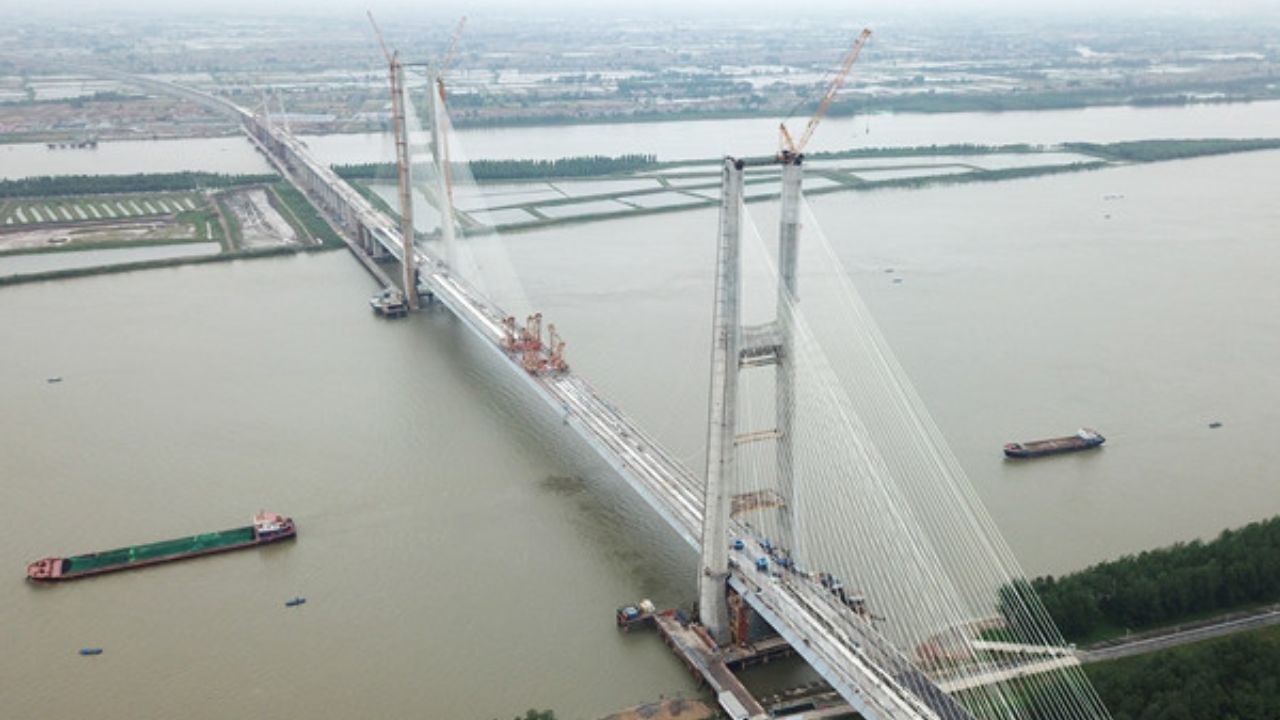

With 8,462 Meters in Length, a Main Span of 818 Meters, and Built over the Mighty Yangtze River, China’s Expressway Bridge Revolutionizes Transportation between the Provinces of Hubei and Jiangxi, Overcoming Intense Currents and Extreme Engineering Challenges.
The expressway bridge in China is one of the largest engineering works ever built. It crosses the Yangtze River, the third largest in the world, linking the provinces of Hubei and Jiangxi. This construction solved an old problem: crossing between the regions was slow, depending on ferries or long detours via secondary roads. With the bridge, the connection became faster and safer.
The project faced enormous challenges. The river has intense currents, varying depths, and an unstable bed. Engineers had to develop a resistant structure capable of withstanding these extreme conditions. The bridge towers were built with reinforced concrete and received high-strength steel cables to ensure stability.
The bridge does not only cross the river. The total length is 8,462 meters, including land accesses, a stretch over a lake, and the suspended part over the Yangtze River. The main span, the longest unsupported section, measures 818 meters. This is one of the largest in the world and required precise planning to withstand strong winds and vibrations.
-
U.S. City Builds Tiny Home Village on Water Company Land to House 136 Homeless People: Inside the Social Housing Units

-
Woman Turns Shipping Container into Home, Embraces Rural Life to Cut Monthly Expenses to Just Over $330
-
France Revamps 530 Social Housing Units with Large Balconies and Glass Facades Without Demolishing Existing Buildings

-
Facing high rent, couple transforms parents’ garage into a fully functional apartment, creating a complete home at a fraction of the market cost.




Construction began in 2009 to address the growing traffic in the region. Before the bridge, the main crossing was made by an old bridge that could no longer handle the vehicle demand. Travel time between the provinces was long, affecting goods transport and economic development. The new bridge brought more efficiency and safety for drivers and businesses.
In addition to the complex engineering, the construction required solutions to minimize environmental impacts. The height of the central span was designed to allow the passage of large vessels, ensuring that navigation on the river was not affected.
The expressway bridge in China can be compared to the Rio-Niterói Bridge in Brazil. Both are essential for regional mobility and faced unique challenges. The Chinese bridge has a larger span and more advanced technology, but the Brazilian structure is also impressive. Its 300-meter span is the largest in the world for a continuous straight beam, without pillars in the middle of Guanabara Bay.
The new bridge is not just a crossing. It represents innovation and economic development. The reduction in travel time has made transportation more efficient, boosting trade and facilitating the lives of those who need to cross the Yangtze River daily. This work is a symbol of China’s advancement in building large infrastructures.
The expressway bridge in China proves how engineering can transform realities. This structure connects cities, boosts the economy, and improves the mobility of thousands of people. A work that will mark the history of global infrastructure.








