Portuguese
  Spanish


In Vidal Ramos, in the interior of Santa Catarina, Paulo became famous for finding water veins with a peach fork. Residents mention wells he helped dig, but the practice, dowsing, has no scientific proof, and studies in Germany found no evidence that it works.
In Vidal Ramos, in the interior of Santa Catarina, according to a report from Vale Agrícola, a resident named Paulo became known for searching for underground water with a peach fork. The practice, known as dowsing, involves firmly holding a fork-shaped branch and walking until it points, according to those who believe in the technique, to the presence of a water vein. The scene has already become part of the city’s daily life.
Paulo claims to locate water veins and even says he can identify the depth and if the water is clean, and residents point to wells he would have helped find. Still, as the report itself acknowledges, there are no scientific studies confirming dowsing, and controlled laboratory research in Germany concluded there is insufficient evidence of the technique’s effectiveness. In other words, the practice remains without scientific validation.
The peach fork that searches for water in Vidal Ramos
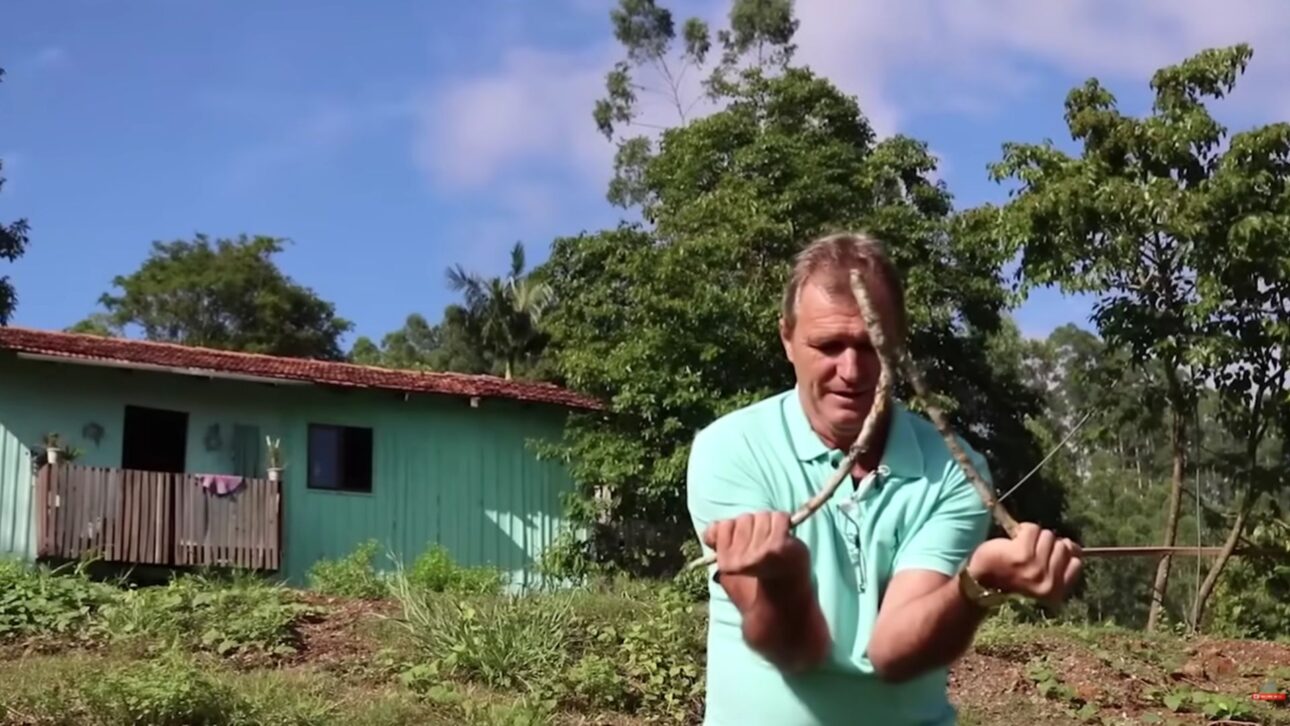
According to the report, he became known for the mission of finding underground water by firmly holding a peach fork, with his arms bent, until the branch points, in his assessment, to the presence of a water vein.
-
Self-Taught Brazilian Innovator Brings Solar Power to Shantytowns Using Scrap, Solar Panels, and Phone Batteries

-
Brazil Pioneers Innovative Project to Transform Used Baby Diapers into Sustainable Solutions for Schools and Cities
-
Cargo Ship Completes Historic Nighttime Voyage to Porto Alegre, Revolutionizing Large-Scale Navigation in Brazil After 42 Years
-
Say Goodbye to Round Drains: Linear Models Improve Water Drainage, Simplify Cleaning, and Offer Sleeker Finishes for Bathrooms and Balconies



The residents have already gotten used to the image.
Paulo says he discovered the ability by chance.
According to the account, he claims that not everyone can perform the technique and says that his own father would also have the knack, to the point of the fork spinning strongly in the hands of those who would have this sensitivity.
For those who do not have it, he assures, the branch simply does not move.
What is dowsing and where does it come from
The practice has a name, dowsing, and is not limited to seeking water.
According to the report, it is described as the study of sensitivity to certain energies supposedly emitted by living beings and elements of nature, usually with the help of rods, pendulums, and other instruments.
With them, practitioners claim to search for water, minerals, lost objects, and even buried bodies.
According to the video, the tradition is said to be very old.
The account states that the first records would date back to ancient Egypt, about two thousand years before Christ.
It is worth mentioning, however, that this origin and the idea of energies captured by the peach fork are part of the practice’s own narrative, and not a scientific consensus on how or if it would work.
The wells that Paulo claims to have found
In the municipality, there is no shortage of residents who point to wells linked to Paulo’s work.
According to the report, one of them is located at a station in the city center, where, after he indicated the spot, ten meters were dug, and the water is said to have withstood a severe drought.
In another case, in the countryside, a woman who had no water even to wash dishes was so happy with the discovery of a well that she could hardly believe it.
Paulo also attributes other capabilities to the peach fork.
According to the account, he claims to be able to estimate the depth of the water by the way the branch bends and even states he can tell if the water is clean or dirty, in addition to asserting that the technique would only work over the spring, and not over bridges, hoses, or rivers.
It is important to clarify that these are his claims, without independent verification.
What science says about the peach fork

No matter how popular these accounts are, they run into a lack of evidence.
According to the report itself, there are still no articles published in scientific journals that confirm the hypotheses of dowsing, and scientists in Germany have conducted controlled studies in laboratories and concluded that there is insufficient evidence of the technique’s effectiveness.
In other words, the practice has never been validated by science.
For science, the movement of the branch has another explanation.
In controlled tests, the performance of those using the peach fork is usually no better than chance, and the movement of the rod is attributed to small involuntary muscle movements of the person holding it, the so-called ideomotor effect.
This does not diminish the cultural importance of the practice nor the sincerity of those who believe in it, but it means that, from a scientific point of view, there is no way to affirm that it truly finds water.
The story of Paulo and his peach fork is, above all, a portrait of culture and tradition from the countryside.
For many people in Vidal Ramos, he is a source of pride, and Paulo himself sees what he does as a gift.
At the same time, science is clear in saying that dowsing has no proven efficacy, which keeps the practice in the realm of belief, not of tested and approved technique.
And you, do you know someone who looks for water with a fork or have you seen this up close? Do you believe there is something behind dowsing or do you think it’s just coincidence? Tell us in the comments, respecting different opinions and beliefs, and share this article with those who enjoy stories and curiosities from the countryside.