Portuguese
  Spanish


There is a private terminal in the north of Rio de Janeiro that alone handles more than 48% of all crude oil that Brazil exports from terminals. It is T-Oil, at the Port of Açu, and it has just signed its first long-term contract with Petrobras, ensuring the use of this infrastructure for years.
The number may seem exaggerated, but it’s in the Antaq data: almost half of the crude oil leaving Brazil through terminals passes through a single point on the coast of Rio de Janeiro. The T-Oil, at the Port of Açu, in São João da Barra, is the only private terminal in the country capable of receiving the gigantic VLCC class ships, and it has become the backbone of the Brazilian pre-salt oil flow to the world.
The contract that changes the game
On July 6, Vast Infraestrutura, which operates the terminal, and Petrobras signed the first take-or-pay contract of the partnership. The technical name hides something simple: Petrobras commits to using a minimum volume of the terminal and pays for the reserved capacity, even if it does not use it entirely. In return, it gains predictability and guaranteed space to flow its production.
The two companies have been working together on transshipment contracts since 2019, but always on an ad-hoc basis. This agreement, according to Vast, “marks a new phase of the partnership” and ensures more efficiency for export operations. The values were not disclosed. I confess that when I read the news, what caught my attention was not the contract itself, but the data it revealed in passing about the concentration of our oil exports.
-
At 2,700 meters below the sea, Equinor fits the piece that will pump 16 million m³ of gas per day in the Campos Basin.

-
A 33 km corridor in the Persian Gulf causes oil to jump 4% and threatens the diesel cut that Petrobras just implemented.
-
A 33 km corridor in the Persian Gulf causes oil to jump 4% and threatens the diesel cut that Petrobras just implemented.
-
Starnav orders 10 hybrid vessels with German MTU engines in Itajaí and prepares fleet to serve Petrobras in the pre-salt for 12 years.



How one terminal exports almost half of the crude
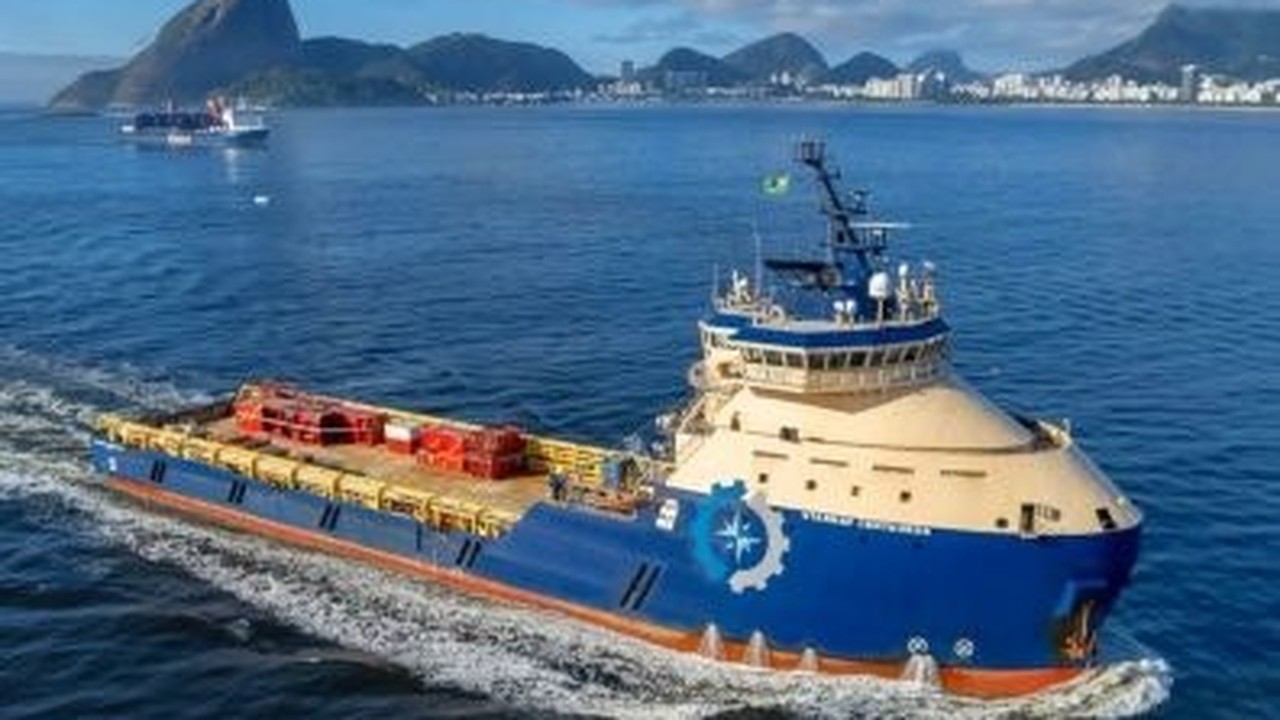
The explanation lies in a maneuver called transshipment, or ship-to-ship operation. Smaller tankers, called relief ships, collect the oil directly from pre-salt platforms and transfer it, at sea, to VLCC class ships, capable of carrying up to 2 million barrels. These colossi then head to major markets, especially Asia. Consolidating the cargo in a giant ship reduces the freight cost per barrel, and since very few terminals in Brazil receive VLCCs, everything is concentrated there.
In 2025, T-Oil carried out 229 transshipment operations, a 20% increase over the previous year, and exported 30.15 million tons of crude, a record since the start of operations. The terminal is licensed to handle up to 1.8 million barrels per day and, starting this year, even the South berth, previously restricted to smaller ships, will receive VLCCs, further increasing capacity.

Eleven oil giants at the same dock
The terminal’s client list is a snapshot of the global energy market. It includes eleven operators, among them Shell, ExxonMobil, Equinor, TotalEnergies, and PetroChina, in addition to Petrobras, Galp, Prio, CNOOC, Petronas, and BW Energy. The Port of Açu, controlled by Prumo Logística and the American group EIG, is the largest private port-industrial complex in operation in Brazil, housing about 30 companies and employing over 7,000 people, most of whom are local residents.
The terminal’s weight on the national map is enormous. In 2025, T-Oil was the second largest in the country in crude oil handling and ranked among the ten largest cargo terminals in Brazil, considering any type of merchandise. For Vast’s president, Victor Snabaitis Bomfim, the new contract “reflects the mutual trust” built with Petrobras over the years and reinforces the strategic role of the complex in pre-salt oil flow.

Where does so much oil come from
None of this would make sense without the pre-salt in full swing. National production hit a record in 2025, with 3.77 million barrels per day, and the pre-salt already accounts for almost 80% of everything the country extracts. The Búzios field, the largest in Brazil, surpassed the mark of 1.1 million barrels daily in June this year, producing from eight units and with a long-term goal of reaching 2 million barrels per day. It is this crude that fuels the carousel of ships at Açu.
There is also an environmental logic behind the concentration. Consolidating the cargo of several smaller tankers into a single giant ship reduces the number of long-haul trips and, consequently, the intensity of emissions per barrel transported. In an international market increasingly attentive to the carbon footprint of oil, this kind of efficiency has become a selling point, not just a freight economy. Few countries can offer such a structure, and this helps explain why so many foreign giants have chosen the same dock in northern Rio de Janeiro.
Last year, Brazil exported more than 700 million barrels of oil, the largest volume in history, and the product led the national export agenda for the second consecutive year, with $44.6 billion in sales. A large part of this share passed through the same funnel in northern Rio de Janeiro.
And the terminal is already preparing to grow further. The Açu Liquid Terminal is under construction, a new tank park for derivatives and biofuels, with long-term contracts already signed and operations expected by the end of 2026. I imagine the size this piece of Rio de Janeiro coastline will still reach, practically sustaining a large part of the country’s oil export account on its own.
Does it make sense for Brazil to concentrate almost half of its crude export in a single private terminal?