






 Portuguese
  Spanish


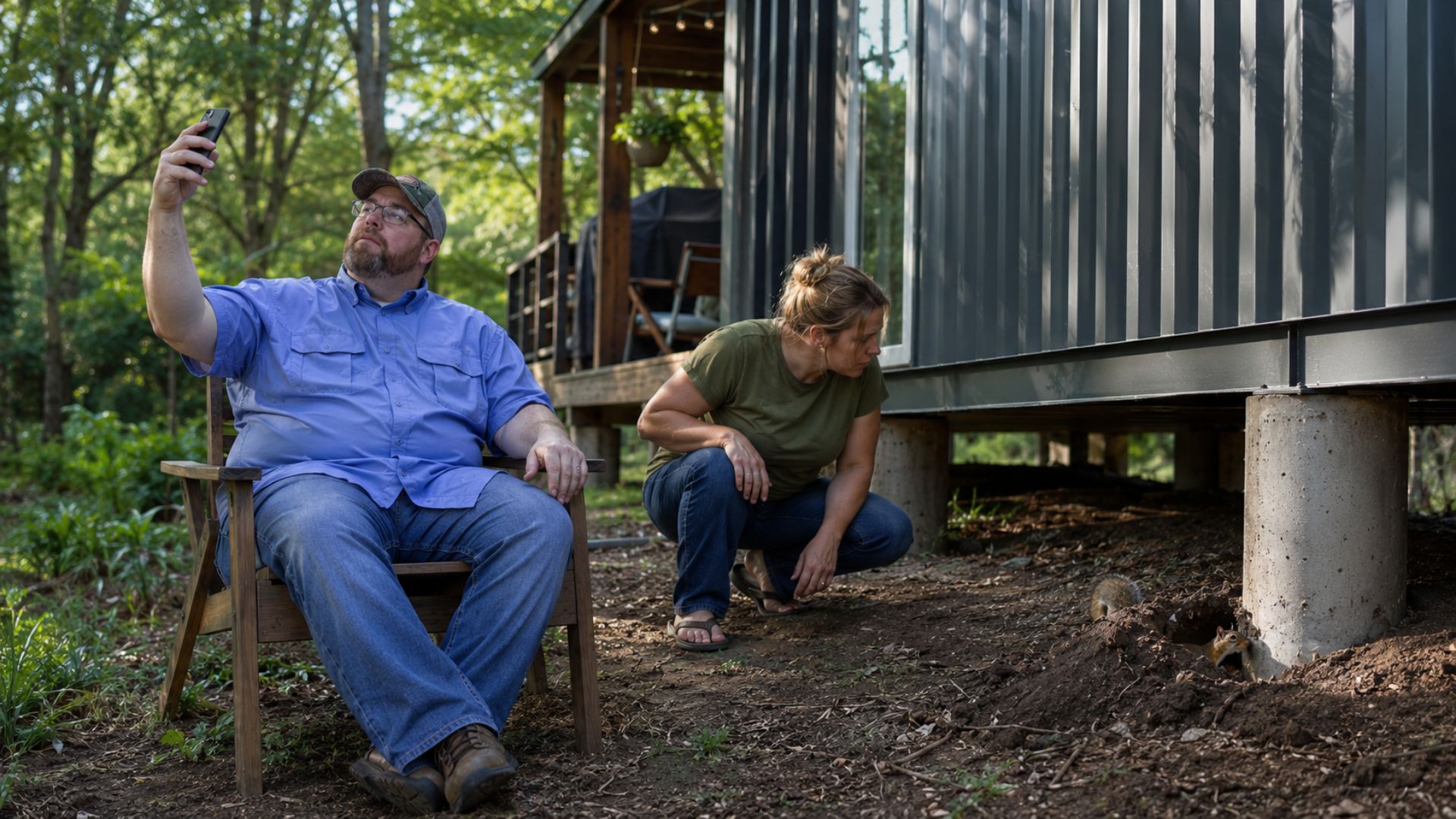

Residents face lack of space to host children and grandchildren, cracks in the floor and tiles, cell signal blocked by metal walls, difficulty adapting to the reduced size after coming from a much larger house, and even a ground squirrel digging tunnels under the structure’s foundation.
A couple who have been living for over a year in a shipping container home decided to publicly share in a video on their Lucky Star Acres channel the main frustrations of the experience. Their intention is to warn those considering adopting this housing model or any other type of micro-home, by showing practical situations that caught the couple by surprise despite all the research prior to purchasing the property. The chosen structure was a 40-foot High Cube container, a model slightly taller than traditional shipping containers, with a layout that includes a bedroom, bathroom, kitchen, and living room in less than 30 square meters of usable internal space.
The reason for disclosing their regrets is simple: to provide practical information for those still in the research phase before migrating to this type of housing. The two residents make it clear at the beginning of the video that they remain happy with the choice, but list five points they wish they had evaluated better before signing the contract. Among the most difficult issues are the lack of space to host visitors, structural problems that appeared after the move, difficulty adapting to the reduced size, cell signal blocked by metal walls, and the lack of personal space between the residents themselves in the day-to-day life of the container home.
First problem: there is nowhere to accommodate visitors and family

The first issue reported by the couple arises whenever children, grandchildren, or friends come to visit. The container home has all the essential spaces in a very reduced area, but there is no nook left to accommodate outsiders overnight. The resident’s wife loves when the grandchildren come to spend the night, but the couple admits that this routine has become a difficult puzzle to solve.
-
Former Atacadão Employee Turns Online Cake-Baking Lessons into a Confectionery Brand with Factory, Store, Delivery, and Nearly $400,000 in Revenue

-
Brazilian Startup Sells Nearly 9 Million Surprise Bags of Near-Expiry Food, Prevents Thousands of Tons of Waste, Aiming for $42 Million Revenue by 2026
-
How to Prevent Brown Recluse Spider Bites: Common Hiding Spots and Free Tips to Reduce Risks

-
Natto: The Unusual Japanese Superfood Gaining Popularity on Social Media and Driving Record Exports




The situation becomes especially complicated during holidays and weekends with more lively family gatherings. There is no extra room for guests, and when the weather doesn’t cooperate, it’s also not possible to use the outdoor area to accommodate visitors, creating a problem that the two residents admit they underestimated before moving to the micro-home.
When friends show up, improvisation works better with good weather, with everyone settling outside. But if the rain comes suddenly, there’s not enough space inside to host the whole group, and plans need to be adjusted on the spot. For those living in a container house and who like to entertain, this is a point that needs to be considered from the project stage, with solutions like a second attached container or a permanent covered outdoor area.
Second issue: cracks and structural adjustments after moving

The second regret involves the structural part of the house. The unit was prefabricated off-site and then transported to the final location, and the journey caused some damage that required immediate repairs after installation.
The main problems started to appear on the bathroom tiles, with cracks running long lines up the wall to the ceiling. The construction company returned to the site, removed all the tiles, and redid the work, but even after this repair, the house continued to settle, and new cracks appeared in other corners of the structure, showing that the settling process is more prolonged than it seemed.
The most concerning case is the bathroom floor, which is splitting in half even after the previous renovation. Another unexpected detail was the friction of one of the embedded sliding doors with the wooden frame: the settling of the container house slightly displaced the components, and now the door rubs against the wood when opening and closing. These small adjustments are frequent in the first year of use and require continuous maintenance.
Limitations for hanging pictures, shelves, and cabinets


Still on the structural side, there’s a curious limitation the couple didn’t anticipate: the difficulty of hanging things on the walls of the container house. Since the internal space is tight, the water pipes and electrical wiring run inside the walls at points that limit where it’s safe to drill holes.
The couple had to purchase a special stud finder to accurately locate the piping and wiring before any installation. Another complication is that some doors operate in a sliding embedded format in the wall, making it impossible to hang any items on the walls that house the door tracks, further restricting storage options within the microhouse.
The solution adopted for light frames was to use Command-type adhesive strips and tiny hooks that do not penetrate deeply into the drywall. For the TV, a firmer mount was necessary, fixed after precisely locating the pipes and wires with the beam detector. The TV mount still allows the screen to swivel in and out, enhancing the flexibility of the small space. Those planning to live in a container house should consider these limitations from the project stage, reserving free walls for storage.
Third problem: the shock of radical downsizing

The third regret is the most common among those who move to tiny houses: the difficulty of letting go of belongings accumulated over a lifetime. The couple came from a significantly larger house, and the shock with the new reduced space remains even after more than a year of adaptation.
The residents admit that the challenge is especially difficult for those coming from a large residence. Moving from a spacious house to a compact structure requires tough decisions about what to keep and what to discard, a process that can take years to complete even after the physical move is already done. For those moving out of a small apartment or their first home, the process is easier, but for the couple, the adjustment was much more difficult than they both imagined.
The experience also shows that some initial decisions needed to be revised. They gave up the microwave at the beginning of the move, thinking they wouldn’t use it frequently, but ended up realizing they missed it. The solution was to buy a device that combines a microwave and convection oven in one piece, solving two problems with a single appliance. This type of trial and error adaptation is part of life in any tiny house during the first few months.
Fourth problem: cell signal does not penetrate metal walls
The fourth regret is one of the most unexpected on the entire list. Inside, the maritime container house functions like a true Faraday cage: the metal walls almost completely block external cell and Wi-Fi signals.
The residents discovered this problem only after moving in. As soon as they enter the house and close the door, they lose all cell signal, with no internal coverage available, a situation that required a specific technical solution to make the house livable in their connected daily lives.
The solution was to install a Wi-Fi access point near the only window in the house, strategically positioned as the only location capable of capturing an external signal. Everything inside the residence is connected to this router, and the cell phones need to be configured in Wi-Fi calling mode to function without a direct mobile network. The only stable internet connection comes from the cell phone data plan routed through the access point. Anyone considering buying a container house needs to consider this point before closing the purchase, especially if the chosen land has limited carrier coverage.
The problem of uneven heating at both ends of the house
In addition to the five main regrets, the couple reported a problem associated with the linear shape of the container house. The original air conditioner was in the bedroom, at one end, and the airflow went straight through the central corridor to the living room at the other end.
This system worked reasonably well with all internal doors open. But when someone closed one of the embedded doors, either to take a shower or to sleep, the two ends of the house were at opposite temperatures. The solution was to install a second mini-split unit in the living room, which definitively solved the climate control problem but added extra cost that was not anticipated in the initial container house budget.
The case shows that the linear layout of container houses, as praised as it may be in projects, brings practical consequences for thermal comfort. Each additional meter of corridor between the air conditioner and the final environment requires extra planning to ensure that air circulates uniformly in all rooms of the residence.
The ground squirrel that threatens the support pillars
One of the couple’s most unexpected reports involves a ground squirrel that discovered the cool and shaded space under the container house and decided to make it its home. The animal began digging tunnels in the soil, forming small visible paths around the foundation of the structure.
The problem appeared after the resident moved a smoker to a different position on the land. It was exactly under this equipment that the squirrel opened an entry path, with the excavations passing right next to the foundation pillars of the house, generating real concern that the animal’s continuous work might compromise the stability of the structure over time.
The house is elevated from the ground precisely to avoid problems with crawling insects and moisture. But the gap between the structure and the ground ended up attracting other unwanted visitors, such as spiders that build webs on the container’s internal doors, and pine needles that accumulate due to the wind. In regions with a common presence of burrowing rodents, it is worth considering physical barriers under the house from the initial design, preventing the problem from growing over time.
Fifth problem: the lack of personal space between residents
The last regret on the list is perhaps the most delicate: the difficulty of having personal space among the residents themselves. The couple has been married for years, but living in a narrow corridor of a few square meters challenged their intimate routine in a way that was not anticipated before the move.
The linear format of the container house, with everything distributed in a straight plan, leaves very few options for the two to occupy separate spaces in moments of tension, fatigue, or simple desire to be alone. Even the simple routine of getting ready for work at the same time became a challenge, with the two needing to move side by side in a narrow space without getting in each other’s way, a situation that generates small inevitable frustrations in daily life.
The improvised solution was to use the two bedroom doors as a temporary privacy zone. When the husband gets irritated or needs a moment alone, he closes both doors and isolates himself in the bedroom, while the wife stays with the dog watching TV in the living room. But it’s a limited measure, and the couple acknowledges that this was one of the most difficult adjustments to life in the microhouse. Couples considering living in a container house should seriously consider this point before moving, especially if they come from larger homes where they had enough rooms for each to maintain their private area.
Despite the regrets, they continue in the container house
Even with the complete list of reported problems, the two residents make a point of making it clear that they remain happy with the choice. The positive aspects of life in a maritime container house, according to them, far outweigh the negatives, and none of the five regrets would have been enough to prevent the purchase if they had known in advance.
What the couple intends is simply to inform those on the same path. Simple adjustments in the initial design could have solved much of the reported problems, avoiding improvised solutions after the move and extra expenses with adaptations that were not in the original budget of the container house.
The two also consider the possibility of expanding the structure in the future, perhaps adding a second container to solve the space issues, or even migrating to another type of microhouse in a few years. For now, the container house remains a permanent home, with all its challenges and peculiarities, in a routine that mixes constant adjustments and personal satisfaction with the life choice made over a year ago.
This couple’s testimony shows that living in a container house goes far beyond the minimalist aesthetic and the sustainability appeal that modular housing usually sells. The practical experience brings challenges that only appear over time, from the cell signal blocked by the metal walls to the unexpected interaction with the local fauna digging under the structure’s foundation.
And you, what do you think about this model? Would you consider living in a shipping container house for more than a year with your partner? Have you considered points that this couple raised, such as the lack of personal space and the structural problems that arise after the move? Leave your comment, share your opinion, and tag someone who is thinking about building a tiny house.








