Portuguese
  Spanish


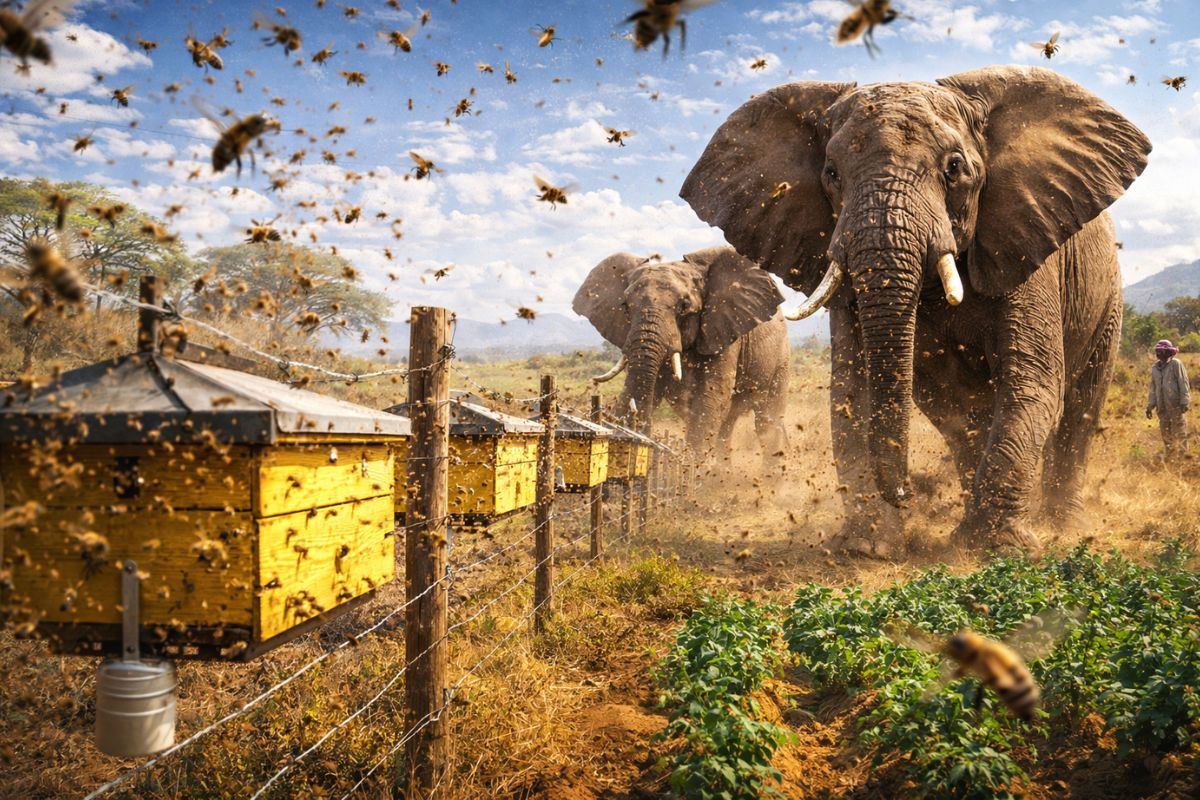


In Kenya, Beehive Fences Use Bees to Repel Elephants, Reduce Human-Elephant Conflict, Protect Crops, and Generate Honey.
The bees have become an unlikely ally on the frontline of one of Africa’s most delicate conflicts: the struggle between elephants and farmers for space, food, and safety. As cities expand and rural areas grow, entire plantations can be destroyed in a single night by hungry elephant groups, leaving farmers without income and communities at risk. On the other side, these gentle giants end up injured or killed in control actions, creating a loss spiral for both sides.
A nine-year study led by the organization Save the Elephants and partners revealed that fences built with live beehives can repel elephants in 86% of approaches during peak harvest times. The same solution that protects crops and people still produces honey and strengthens bee populations, especially at a time when these insects face growing threats worldwide.
The Conflict Between People and Elephants Is Growing

In countries like Kenya, the advancement of cities, roads, and farmland reduces the available habitat for elephants and increasingly brings wild animals closer to agricultural areas. As the human population grows, dangerous encounters become more frequent.
-
How Much Does Starlink Satellite Internet Cost for Cars, Trucks, and RVs? Prices for Antenna, Accessories, and Plans

-
Scientists Convert Food Waste into Aviation Fuel, Successfully Test 50% Blend with Conventional Kerosene to Cut Emissions and Promote Sustainable Flights
-
OnePlus N6 Smartphone to Launch in India with 8,000mAh Battery and 45W SuperVOOC Charging, Lasting Up to Three Days
-
Scientists Plan to Release Air Bubbles Underwater to Protect Antarctica’s “Doomsday Glacier” from Melting





Between 2010 and 2017, about 200 people died in conflicts between humans and elephants, according to the International Fund for Animal Welfare.
To try to control these episodes, Kenya’s wildlife authorities end up culling between 50 and 120 elephants per year after attacks on humans.
This scenario creates a difficult impasse. Farmers fear losing crops and their own lives. Conservation teams are forced to make extreme decisions to avoid new tragedies. And elephants, already pressured by habitat loss, pay a high price in every confrontation.
It is in this tense context that bees emerge as a surprising alternative to reduce conflict without relying solely on lethal actions.
Why Do Bees Scare Giant Elephants
The key to this method lies in a fear that elephants have carried for millennia. In 2002, researchers from Save the Elephants published a study showing that elephants flee when they hear the sound of agitated bees.
They do not just have a reaction of retreat. Many shake their heads, kick up dust, and make alarm vocalizations to warn other elephants of danger.
According to Lucy King, leader of the Elephants and Bees project, this happens because, despite their thick skin, elephants have very exposed weak points.
Bees can attack the eyes, mouth, and trunk, sensitive areas that cause intense pain if stung.
Over generations, these painful encounters have built an innate fear. Even without seeing the bees, the sound of buzzing is enough to trigger a flee response.
From this finding, Save the Elephants began testing how bees could be used strategically to drive elephants away from plantations, turning an evolutionary fear into a conservation tool.
How Beehive Fences Filled with Bees Work


The solution is simple and ingenious. Instead of conventional fences, farmers install beehive fences, structures where live beehives are hung between posts, forming a continuous line around the plantation.
When an elephant tries to cross the fence, it ends up touching the beehives. The movement shakes the boxes, irritates the bees, and increases the buzzing. The sound and risk of stings cause the animal to retreat before crossing the boundary.
In the recent study, researchers monitored 26 properties in two villages near Tsavo East National Park, Kenya.
They analyzed nearly 4,000 elephant approaches between 2014 and 2020, including six peak cultivation seasons.
The results were clear. In 86% of approaches during the harvest period, the constant noise from the beehives drove the elephants away before they reached the plantations, concretely reducing nighttime invasions that caught entire communities off guard.
Today, the program already maintains about 14,000 beehives in 97 locations in Africa and Asia, and beehive fences are being tested in at least 23 countries within the elephant range, at over 100 different points. This shows the initiative’s potential for scale.
Extra Benefits: Honey, Income, and Pollination

Beehive fences not only protect crops and human lives. They also generate economic and environmental advantages.
By working with African wild bees, projects create pollination services that go far beyond elephant control.
The presence of bees contributes to the health of agricultural crops and native vegetation, enhancing local productivity and biodiversity.
Furthermore, the beehives produce honey. In the study, the beehives used generated about one ton of honey, sold for approximately 2,250 dollars.
This extra income can be crucial for small farmers, who begin to see conservation as a real source of income and not just an obligation.
At a time when bees face threats like pesticides, pollution, habitat destruction, and changing climate patterns, initiatives like this serve as a double investment: they protect communities and strengthen a species essential for global food security.
When the Climate Changes, the Beehive Fence Weakens
Despite the success, this nature-based solution is not immune to the changes of the planet. In 2017, a severe drought hit the studied region and reduced beehive populations by 75%.
With fewer active bees, the buzzing decreased, and elephants became more confident in approaching the fields.
This episode raises an important alert. More frequent droughts and extreme climate changes can weaken the performance of beehive fences, precisely in a scenario where the conflict between humans and wildlife tends to increase with population growth and pressure on habitats.
The researchers themselves emphasize that, while beehive fences are very effective in reducing attacks when crops are more attractive, increased habitat fragmentation and recurring droughts may limit this effectiveness in the future.
Therefore, adapting and reinforcing beehive fence projects in rapidly changing climate environments will be a central challenge to maintaining this bee-mediated peace.
A New Way to Share Responsibility with Nature
One of the strengths of beehive fences is that it is a low-cost and easy-to-maintain solution, which can be directly managed by farmers without relying on constant intervention from authorities or external organizations.
To encourage adoption, Save the Elephants has made construction manuals and explanatory videos available for free in open code.
In practice, this means that communities from different regions can adapt the idea to their reality, share learnings, and expand impact without barriers to access to information.
As Lucy King highlights, the more farmers have tools they can handle themselves, the more the responsibility of caring for wildlife becomes shared among all, and not just a duty of official institutions.
In this model, bees cease to be just honey-producing insects and become mediators of a more balanced coexistence between people and elephants, showing that nature itself can offer sophisticated solutions to complex problems, as long as it is heard and respected.
In their place, barbed wire and weapons would give way to a strategy that protects crops, generates income, strengthens ecosystems, and reduces deaths of animals and humans. It is a vision of the future where conservation and production go hand in hand.
Do you believe that bee-based solutions, like beehive fences, could be adopted in other parts of the world to balance coexistence between rural communities and large wild animals?