Portuguese
  Spanish


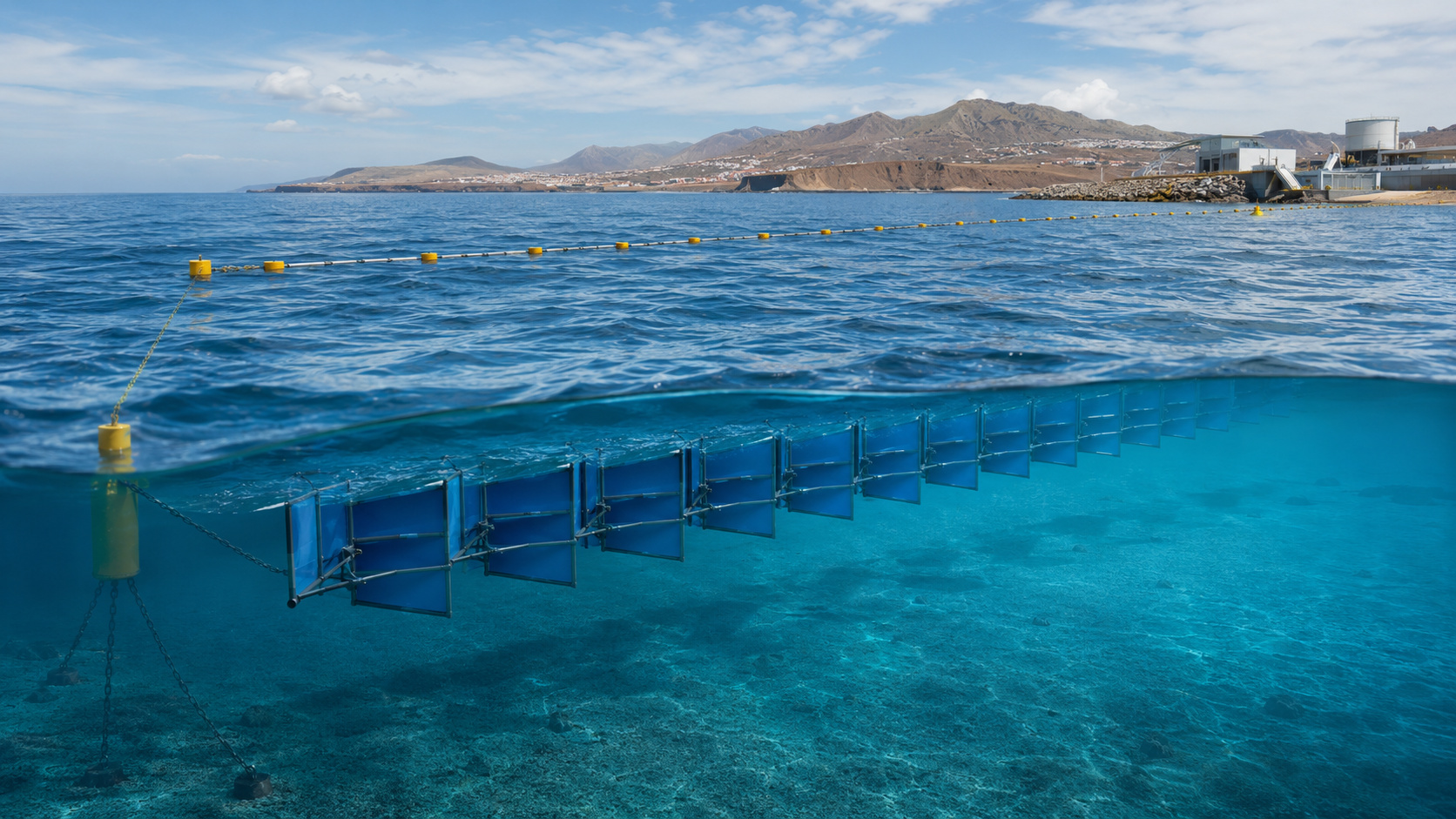


Wavepiston installs real wave energy system in Gran Canaria with 24 collectors, 200 meters long and production of electricity and desalinated water.
According to PLOCAN, the Danish company Wavepiston completed in June 2024 the installation of its full-scale wave energy conversion system at the Oceanic Platform of the Canary Islands, off the coast of Gran Canaria. The deployment began in February 2024 with the first collector and progressed over four months until the complete system became operational.
The device is 200 meters long and consists of 24 energy collectors each 8 meters wide, stretched between two buoys anchored to the seabed. As waves pass, the system transforms this movement into hydraulic pressure, which can be used to generate electricity or produce desalinated water through reverse osmosis.
Wave energy is still rare because the ocean destroys almost everything installed
Wave energy is one of the most attractive renewable sources on the planet because it is abundant, seasonally predictable, and continuously available. The problem is that the ocean imposes corrosion, mechanical fatigue, and extreme loads that make many projects unfeasible when they leave the laboratory and enter the open sea.
-
OnePlus N6 Smartphone to Launch in India with 8,000mAh Battery and 45W SuperVOOC Charging, Lasting Up to Three Days

-
Scientists Plan to Release Air Bubbles Underwater to Protect Antarctica’s “Doomsday Glacier” from Melting

-
Chinese R6000 Drone Combines Airplane and Helicopter Features, Carries Up to 12 People for Multiple Missions
-
In the World’s Most Densely Populated Desert, Families Dig Funnel-Shaped Underground Cisterns to Capture Rare Rainfall and Store Drinking Water for Up to Eight Months



Over the past decades, dozens of companies have tested similar technologies, but many have failed when they needed to operate at full scale. The most well-known case was the British Pelamis Wave Power, which installed units in Portugal in 2008 and ended up going bankrupt in 2014 after repeated structural and operational failures.


Wavepiston underwent 14 years of development from the initial concept tested in 2010, scaled-down models, intermediate tests in the North Sea, to the full-scale installation in 2024.
During this period, it faced a collision with a fishing vessel, cable breakage due to fatigue, and successive redesigns, until reaching the current version installed in Gran Canaria.
How the Wavepiston system transforms waves into electricity and desalinated water
The principle of Wavepiston is simpler than that of many competitors. The main structure functions like a long floating line of 200 meters, with 24 collector plates attached perpendicularly. As the waves pass, each plate rises and falls in sequence, activating internal pistons that compress seawater inside a central pressure tube.
The pressurized water travels through this system to a seabed duct, which carries the pressure to PLOCAN on land. There, two containers perform the conversion.
One uses the pressure to drive a conventional turbine and generate electric power. The other sends this same pressure directly to a reverse osmosis system, producing desalinated drinking water.

The technical advantage is significant. In conventional desalination systems, electricity is first generated and then reconverted into pressure.
In the Wavepiston solution, the pressure created by the waves is already used directly, reducing conversion losses and enhancing the technology’s appeal for locations with scarce water and expensive energy.
Gran Canaria became the ideal laboratory for wave energy and desalination
The choice of Gran Canaria was not by chance. The archipelago combines a consistent wave regime, strong dependence on desalination, and high electricity costs. This combination makes the Canaries a natural market for technologies that deliver both energy and water.
The island relies on reverse osmosis for more than 60% of its drinking water supply, because precipitation is limited and surface aquifers are insufficient to meet the needs of the population and tourism.
The problem is that desalination consumes a lot of electricity, and on the islands, this cost is higher because much of the generation depends on imported fuel.

The sea off the coast of Gran Canaria also helps. The waves usually vary between 1 and 3 meters during much of the year, with a moderate and consistent regime.
This reduces the risk of immediate equipment destruction, but still offers enough energy to demonstrate the system’s viability in continuous operation.
Wavepiston’s business model targets islands, coastal communities, and diesel-dependent locations
Most wave energy technologies have tried to compete directly with offshore wind and solar in large-scale electricity markets. Wavepiston adopted a different logic. Instead of selling only electricity, the company positions its solution as an integrated energy plus water platform, aimed at remote coastal communities, islands, and offshore structures.
This shift changes the economic equation. In places like Gran Canaria, the real cost is not only generating 1 kWh but also desalinating 1 cubic meter of water. When both services are combined and compared to diesel use, the financial proposition of the technology becomes more competitive.
CEO Michael Henriksen summarized this strategy by targeting populations living on Atlantic and Pacific islands dependent on diesel for energy and expensive desalination for water.
The system’s modularity also matters. Each additional collector increases electrical capacity and water production, allowing the installation to scale without redesigning the entire technology.
What the tests in Gran Canaria need to prove for wave energy to become a business
The system installed in 2024 in Gran Canaria is still a full-scale demonstrator, not a consolidated commercial product.
Wavepiston needs to prove three points that have brought down many previous projects: survival in storms, operational availability over long periods, and competitive cost per kWh and per cubic meter of desalinated water.

This means demonstrating that the collectors, pistons, seals, pipelines, and subsea connections can operate for months without serious failures. It also means showing that the system not only works but works with numbers that make economic sense without relying forever on public subsidies.
If the tests deliver robust data on survival, availability, and cost, the next step will be the first commercial installation, probably on an Atlantic island with high diesel expenses and strong dependence on desalination.
In other words, Gran Canaria could become the test that decides if wave energy finally moves from the experimental stage to the real market.