Portuguese
  Spanish




In the United States, Canvas robots use UR10e, AI, and sensors to apply and sand compound on drywall, reducing deadlines by up to 60% and labor by about 40%. The solution works in dynamic sites, reaches over 15 feet, and seeks to improve worker safety and ergonomics.
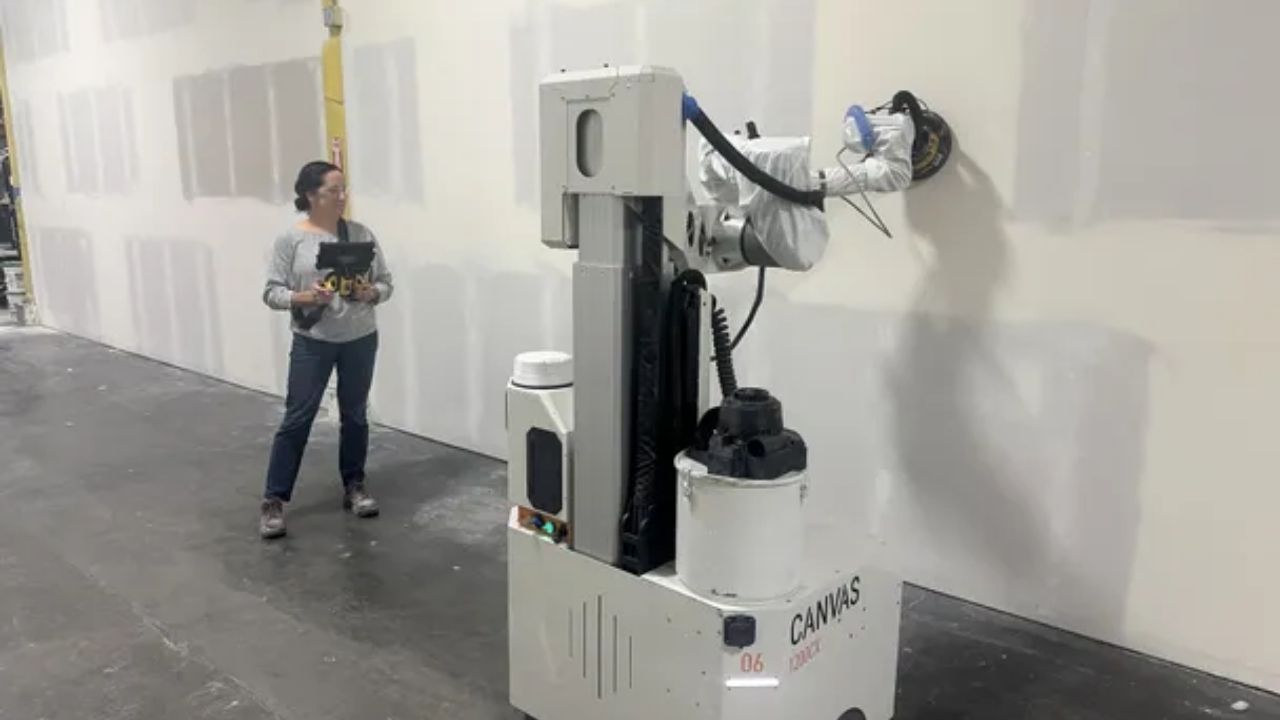
The robots are entering one of the most exhausting stages of construction: drywall finishing. The San Francisco-based startup Canvas has developed a mobile platform with sensors, artificial intelligence, and UR10e cobots to apply and sand compound on interior walls.
The proposal targets a traditionally manual, repetitive, and physically demanding job. According to the company, the technology can reduce finishing deadlines by up to 60% and cut labor needs by about 40%, without eliminating human presence from the site.
Robots take over application and sanding on drywall
The Canvas system was created to perform two central tasks in drywall finishing: spraying the compound on joints and surfaces and then sanding. These stages usually require repeated returns to the same wall, constant physical effort, and high repetition.
-
Antarctic Sea Creature Yields Promising Compound Against Melanoma, Captivating U.S. Researchers

-
Underwater Guardian: The Autonomous Robot Monitoring Submarine Cables, Self-Returning, Wirelessly Charging, and Transmitting Data Without Onboard Crew

-
Robots Clean Solar Panels in Desert Power Plants Without Water, Preventing Energy Losses
-
AI Radar Built with Old Camera and $20 Gains Attention After Alleged $317,000 Sale to Chinese Government, But Lack of Documentation and Official Confirmation Raises Questions




With the use of robots, the company claims that tasks that previously took five to seven days can be completed in about two days, both in Level 4 finishing, focused on drywall joints, and Level 5, applied to the entire wall.
The difference lies in the organized repetition of the machine. According to Kevin Albert, co-founder and CEO of Canvas, in a manual approach, 20,000 square feet of wall can represent about 100,000 square feet of work, because the worker needs to return several times to the same location.
With the robotic platform, this return is reduced. The machine needs to return to the same wall only a few times, which shortens the schedule and makes the stage more predictable within the project.
AI and sensors help machine understand the site

One of the biggest challenges in bringing robots to construction is that each site changes all the time. Unlike factories and logistics centers, where the environment is more standardized, construction sites have different walls, obstacles, accesses, and surfaces for each project.
Canvas claims to have solved part of this problem with a platform equipped with advanced sensors and AI. The system automatically detects the location and starts working without requiring detailed prior mapping.
This is important because it reduces the adoption barrier. If each construction site required lengthy preparation before the machine’s entry, the productivity gain could disappear.
The idea is to bring the robot inside the building, position it, and start finishing with less dependence on prior plans. For a dynamic site, this adaptation is a central part of the technology.
UR10e Cobots provide strength and control to the system
At the core of the solution is the UR10e cobot from Universal Robots. Canvas chose this robotic arm for combining strength, lightness, and sufficient control to operate on a mobile platform.
According to Kevin Albert, the UR10e is one of the lightest robots for the strength it delivers. This characteristic was important because the machine needed to reach heights over 15 feet without compromising stability.
Force control is also crucial in drywall. The compound applied to the walls is a delicate material that can be scratched even with a fingernail, according to the company’s description.
Maria Telleria, co-founder and CTO of Canvas, highlights that the force control integrated into the robotic arm allows for precise and smooth application. The company states that it did not need to use external force control because the feature is already part of the robot.
Safety and ergonomics become part of the gain

Speed is not the only argument of automation. Canvas also highlights gains in safety and ergonomics, especially because finishing and sanding drywall are repetitive and physically demanding activities.
Kevin Albert states that one in four construction workers ends their career with a musculoskeletal problem related to repetitive and heavy tasks. The company’s proposal is to take the hardest part of this process away from the workers.
In this model, robots take on the main effort, while professionals start to coordinate the operation, monitor execution, and handle more complex or detailed areas.
This point was important for acceptance by unions, according to Canvas. The company presented the technology as a tool for productivity, well-being, and professional mobility, not just as a direct replacement for workers.
Reduction of labor does not mean a site without people
The company talks about a reduction of approximately 40% of the labor needed for drywall finishing, but this does not mean a construction site without workers. The model depends on operators, planning, platform movement, and execution monitoring.
Automation changes the type of work required. Instead of maintaining large teams for repetitive tasks of application and sanding, part of the function shifts to coordination, control, and finishing in specific areas.
This detail is important to avoid a simplistic reading. The technology does not remove all the complexity from the site but reorganizes the finishing stage.
For construction companies, the interest lies in the combination of shorter deadlines, less physical effort, and more predictability. For workers, the central issue is how this transition will be made and what functions will be created or valued.
Mobile platform was designed for real construction


Canvas needed to develop a light, strong, and mobile solution to operate inside buildings under construction. The machine needs to circulate, reach high walls, and deal with space variations.
In addition to the application and sanding, the system needs to handle the drywall compound with precision. The challenge is to balance strength, delicacy, and mobility in a step that previously relied almost entirely on manual skill.
Another highlighted factor was the maturity of the Universal Robots platform. According to Canvas, just two months after receiving the first UR cobot, the company was already performing its first job.
The openness of the software also aided in development. The team could access sensor data and customize controls at lower levels, adapting the robot to the demands of the drywall application.
Construction faces labor shortage
Automation appears at a time of pressure on construction. Kevin Albert states that much more will need to be built in the coming decades, while the sector faces retirements and difficulty attracting new professionals.
In this scenario, collaborative machines can help alleviate stages with greater physical strain. The stated goal is not only to speed up construction but to make certain functions less harmful to the body.
The shortage of workers makes drywall finishing a natural target for automation. It is a repetitive stage, requiring strength, technique, and constant return to the same surfaces.
If the technology works on a large scale, it can free up teams for activities requiring greater coordination and reduce delays in tight schedules, especially in interior works.
Canvas already targets taller robots and painting
Canvas sees the current system as a first step. The company intends to develop taller robots, capable of reaching above 20 feet, further reducing fall risks and improving safety in elevated areas.
Another natural path is painting. Since the platform already works with material spraying, the company sees this application as a possible extension of the technology.
This shows that drywall may be just the beginning. Interior finishing, historically done with manual tools, is beginning to receive heavy machinery adapted to the construction environment.
If automation advances to other stages, construction sites may undergo a change similar to what has already occurred in factories: less direct repetitive effort and more technical coordination of systems.
Robots can change the internal finishing of constructions
The Canvas robots show how the construction industry is beginning to automate stages that seemed resistant to technology. The drywall finishing, once dominated by manual application, heavy sanding, and constant return to the same wall, now relies on AI, sensors, and cobots.
With a reduction in deadlines by up to 60%, an approximate cut of 40% in labor, and a focus on ergonomics, the solution promises to change the logic of internal finishing. The big question now is how this technology will be incorporated without leaving workers behind.
For construction companies, the gain is in speed, precision, and predictability. For professionals, the challenge is to adapt to a site where heavy physical effort begins to share space with collaborative machines.
And you, do you think robots in drywall finishing are a necessary advancement for faster and safer construction, or could this automation put too much pressure on construction workers? Share your opinion.